

Running News Daily
Running News Daily is edited by Bob Anderson and team. Send your news items to bob@mybestruns.com Advertising opportunities available.
Index to Daily Posts · Sign Up For Updates · Run The World Feed
Articles tagged #000m
Today's Running News
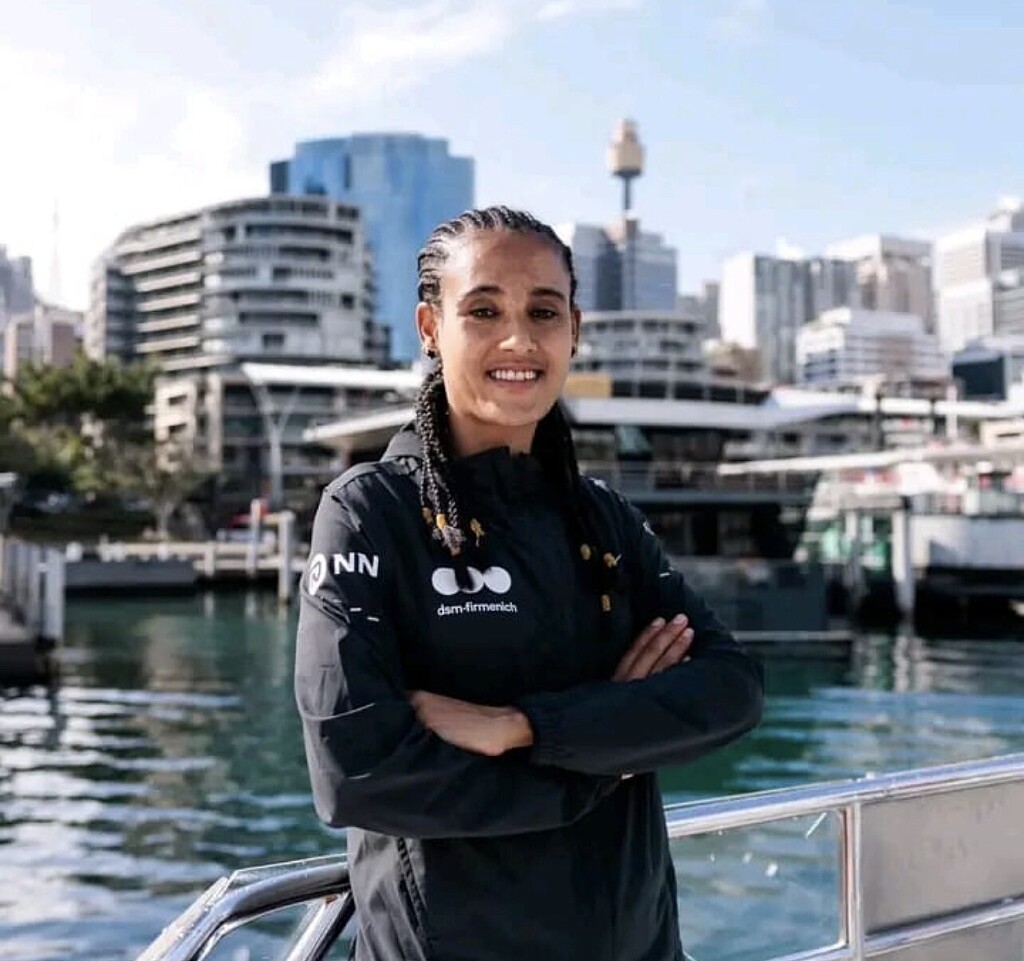


Sydney Marathon 2026: World Champions, Record Hunters And A Star-Studded Showdown
SYDNEY, AUSTRALIA — August 30, 2026
Sydney is preparing for a spectacular morning of marathon racing as reigning world champions Peres Jepchirchir of Kenya and Alphonce Simbu of Tanzania headline a world-class elite field at the TCS Sydney Marathon on Sunday, August 30.
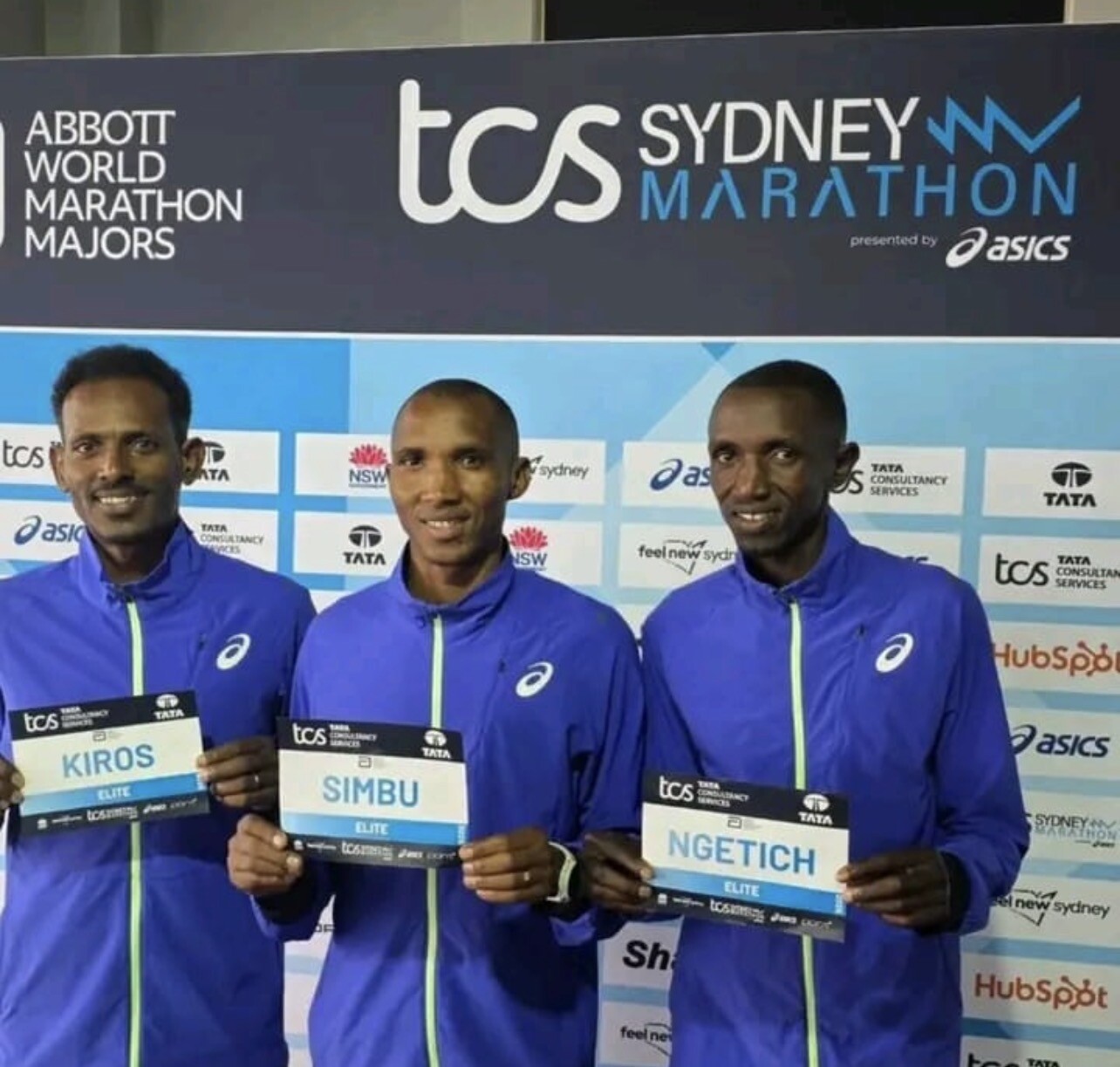
The race is set to provide another defining moment for Australian distance running, with more than 40,000 participants expected to take on the streets of Sydney and a remarkable collection of elite athletes competing for victory on one of the world's newest Abbott World Marathon Majors.
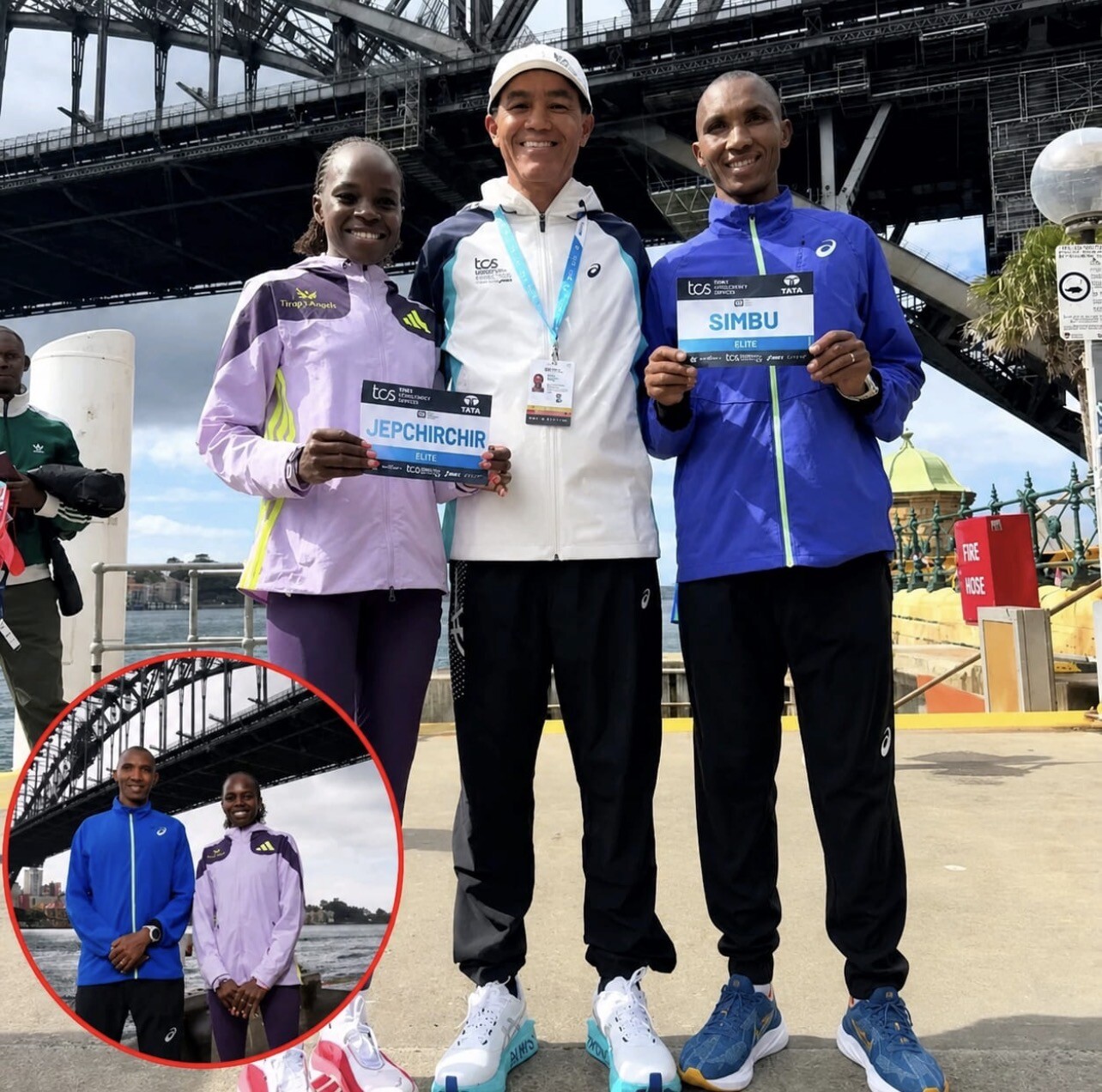
Jepchirchir and Simbu will bring an added layer of prestige to the occasion as the reigning women's and men's world marathon champions. Their presence ensures that the spotlight will be firmly fixed on Sydney as some of the world's finest distance runners battle for one of the most coveted titles on the international marathon calendar.

There will also be records in the crosshairs. The men's course record stands at 2:06:06, while the women's benchmark is 2:18:22, meaning the quality of the field has created genuine anticipation that both marks could come under threat.
In the men's race, Simbu arrives with considerable confidence and an ambitious target. The Tanzanian produced one of the most dramatic finishes of the 2025 World Athletics Championships in Tokyo, holding off Germany's Amanal Petros to claim the world title. With a personal best of 2:02:47, Simbu has the speed, championship experience and belief to challenge the very best, and he has made no secret of his desire to attack Sydney's course record.
However, standing in his way is an elite group led by Ethiopia's Sisay Lemma, whose outstanding 2:01:48 personal best makes him the fastest entrant in the field. A former London and Boston Marathon champion, Lemma brings a wealth of experience at the highest level and will be one of the principal threats to Simbu's ambitions.
Kenya will also have a strong presence, with Timothy Kiplagat and Vincent Ngetich adding further firepower to an already formidable men's lineup.
Perhaps the most intriguing storyline, however, belongs to Ethiopian track star Hagos Gebrhiwet, who is set to make his highly anticipated marathon debut. A former Olympic 5,000m medallist and one of the world's fastest track distance runners, Gebrhiwet has already shown extraordinary endurance over shorter distances, including a 57:41 half-marathon personal best. His transition to the marathon will be closely watched, with fans eager to discover whether his world-class track speed can be converted into success over 42.195 kilometres.
The depth of the men's field is remarkable. No fewer than 25 athletes have broken 2:10, while 19 have already recorded times faster than Sydney's existing course record, setting the stage for a race that could develop into a battle of extraordinary pace and tactics.
The women's contest promises just as much drama, with Jepchirchir leading the way. The Kenyan superstar arrives in Sydney as the reigning world champion and Olympic champion, carrying a 2:14:43 personal best, the fastest among the women entered.
Yet victory will not come easily. Jepchirchir faces a powerful Kenyan challenge from Irine Cheptai, who owns a 2:17:51 personal best and has already established herself as a major force on the international marathon circuit.
Tanzania's Magdalena Shauri, the country's national record holder with a personal best of 2:18:03, will provide another serious threat, while the experienced Vivian Cheruiyot of Kenya adds further championship pedigree to an already impressive women's field.
Ethiopian stars Shure Demise and Haven Hailu, alongside Uganda's Stella Chesang, will also be looking to make their mark as the race unfolds through Sydney's iconic streets.
The setting could hardly be more spectacular. Starting in North Sydney, the marathon takes runners across the famous Sydney Harbour Bridge before heading towards the unforgettable finish at the Sydney Opera House. With the city providing a breathtaking backdrop, the race has all the ingredients for another historic chapter in its rapid rise on the global marathon scene.
For the elite athletes, however, the beauty of Sydney will quickly become secondary once the gun goes off.
The champions will be chasing victory. The record hunters will be chasing history. And for Gebrhiwet, an entirely new chapter of his career will begin.
Two reigning world champions. Multiple sub-2:05 contenders. A world-class women's field. A highly anticipated marathon debut. And course records that could be under serious threat.
Everything is in place for an unforgettable Sunday in Sydney.
Will Alphonce Simbu turn his ambition into a new course record?
Can Sisay Lemma's 2:01:48 experience carry him to victory?
Will Hagos Gebrhiwet announce himself as a future marathon superstar?
And can Peres Jepchirchir add the Sydney Marathon crown to her already extraordinary list of achievements?
Sydney is ready.
The champions have arrived. The records are waiting. The stage is set for a spectacular showdown.
by Erick Cheruiyot for My Best Runs
Login to leave a comment
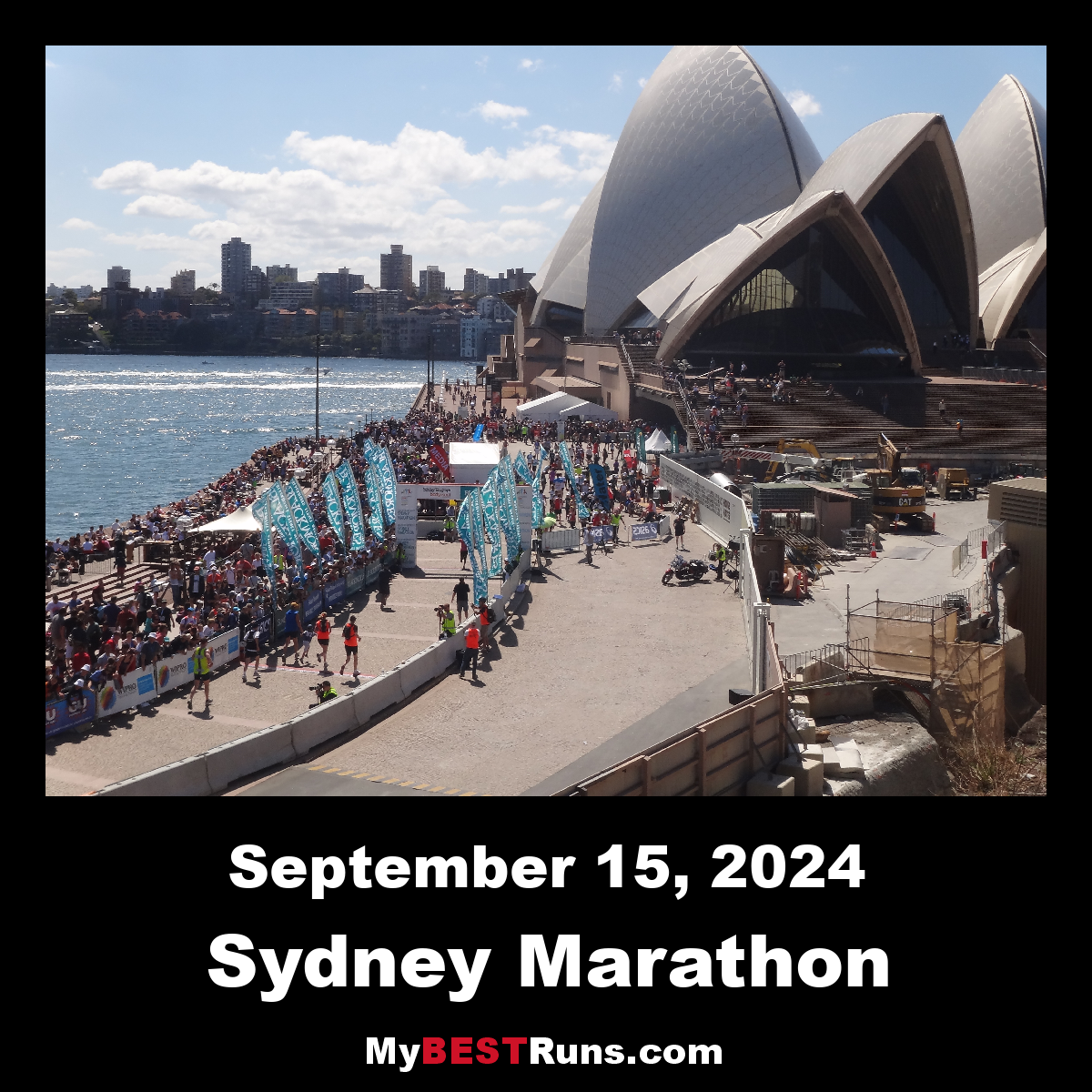
Sydney Marathon
The Sydney Marathon is a marathon held annually in Sydney, Australia. The event was first held in 2001 as a legacy of the 2000 Summer Olympics, which were held in Sydney. In addition to the marathon, a half marathon, 9 kilometres (5.6 mi) "Bridge Run", and a 3.5 kilometres (2.2 mi) "Family Fun Run" are also held under the banner...
more...
Two London-Area Standouts Set for Marathon Debuts at Toronto Waterfront
Two Canadian distance running stalwarts will make their marathon debuts at the 2026 TCS Toronto Waterfront Marathon October 18. Both make their homes in the London area of southwestern Ontario.
The event is a World Athletics Elite Label race and also serves as the official Athletics Canada Canadian Marathon Championships.
Connor Black and Jeremy Coughler are former training partners and Canadian championship medalists over 10,000m and cross country. They have followed different paths since the retirement of their coach, Dave Mills, although they occasionally meet for long runs while preparing for Toronto.
Coughler still follows a program designed by Mills—a special exception made by his former coach—while Black has worked with two-time Canadian Olympic marathoner Reid Coolsaet for the past two years. Their approaches to the Toronto race could hardly be more different.
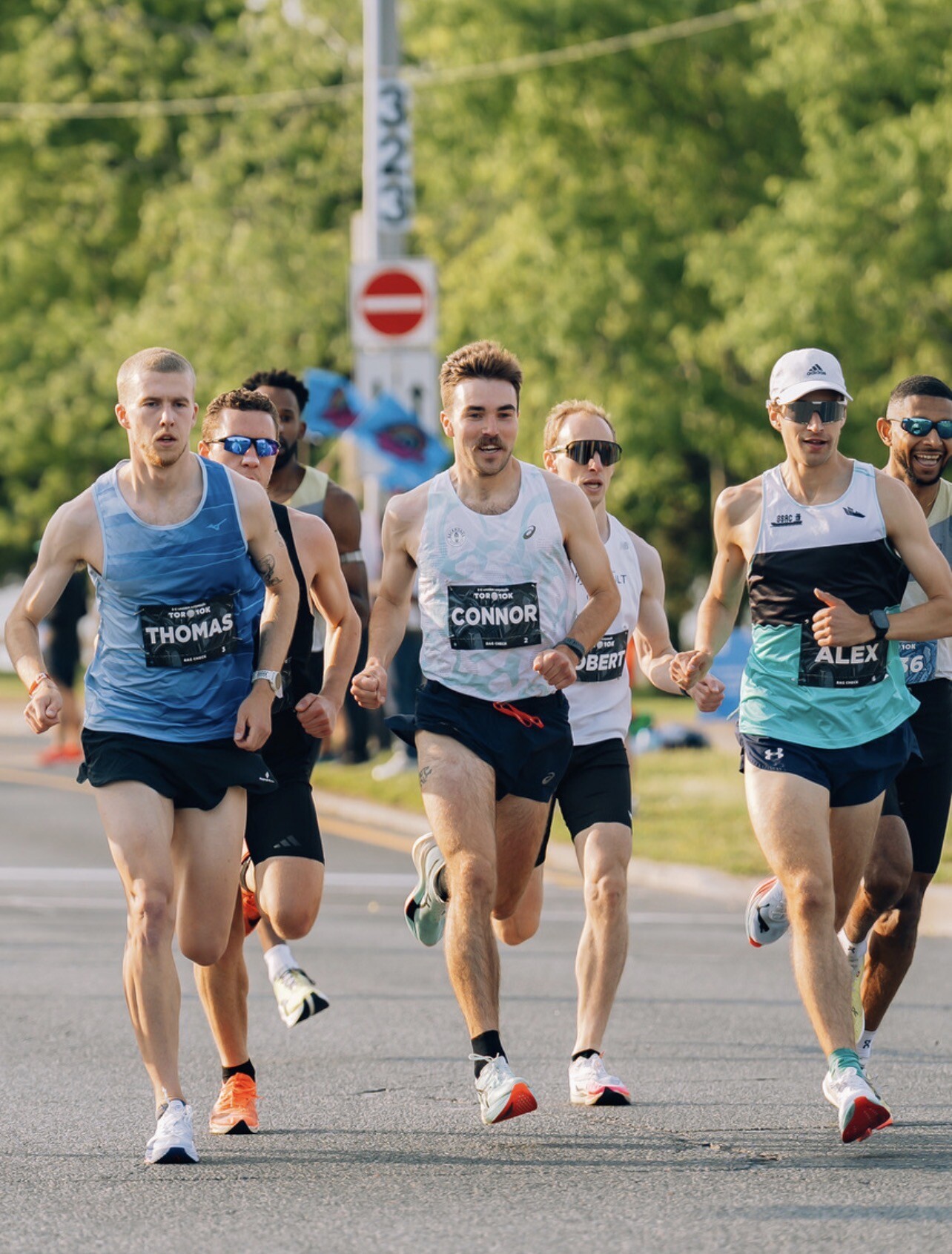
Black, who lives in London—known as “The Forest City”—sees his marathon debut as an important step toward a possible challenge for Canada’s 2028 Olympic team.
“I am 30 years old and I am not making money in the sport, but I still have goals,” Black declares. “My final goal would be to try and make an Olympic team, and I don’t think it’s feasible as an unsponsored track runner targeting the 5K or 10K.
“The marathon is a more even playing field. I can get into any marathon I want, within reason. There are 80 spots in the Olympics. So, if I am going to give it one last shot, it has to be in the marathon.”
At the 2025 Project 13.1 Half Marathon in Congers, New York, Black ran a personal best of 1:03:34 in his first race at the distance. Until then, he had competed primarily over 5,000m and 10,000m. In 2022, he won the Canadian Cross Country Championships.
Black is a secondary school teacher but remains classified as “Long Term Occasional,” meaning he moves from school to school wherever there is an opening.
“Last year I was at Strathroy District Collegiate Institute, which, funnily enough, was where Dave taught for 10 or 15 years,” Black says. “I taught phys ed and math. I can also teach English as a Second Language and biology. I am kind of a Swiss Army knife.”
As he increases his training load for Toronto, completing most of the work by himself, he admits he has reservations about returning to work.
“I am quite nervous to resume teaching,” he reveals. “Recently, my mileage has gone up. When you are starting your build, you are tired. It has been nice having the summer off and being able to focus on training.
“I used to believe you could train like a professional and have a full-time job. I think it’s possible, but if you want to run 200 kilometres a week for the marathon, it is definitely easier and probably better for your performance if you don’t have to work full time.”
Meanwhile, Coughler and his wife, Emma, are chiropractors and partners in Re-Charge Health and Wellness in London’s east end. They are also the parents of a young son, Otto, which means managing their time carefully.
“My wife and I split the work schedule,” Coughler, 30, explains during a day off. “I work Tuesday, Thursday, Friday and Saturday, so I try to do workouts on my days at home—Mondays and Wednesdays.
“If I have something first thing at 7 or 8 a.m., I do a run and then a shakeout between patients or after work. It’s not too bad.”
Running remains important to Coughler, but it is now one of several priorities. He estimates he is running up to 110 kilometres a week, similar to the volume he maintained when finishing third at both the 2023 and 2024 Canadian 10K Championships in Ottawa. He also won the Canada Running Series’ Beneva Spring Run-Off 8K four consecutive years between 2022 and 2025.
Although that mileage is well below what many elite marathoners run, Coughler set a half-marathon personal best of 1:04:33 earlier this year at the Project 13.1 Half Marathon in New York State. The performance earned him eighth place in a strong field. He admits his attitude toward running has changed.
“It’s a shift mentally because I have so much other stuff going on,” he explains. “I am trying to view running as something I do because I love it rather than because it’s my whole life.
“When I was at Indiana University, running was everything. When you run well, it’s great, but when you are not running well, it starts eating you alive.”
With the support and encouragement of Mills, they have mapped out a plan they hope will see Coughler finish his debut in the 2:14 to 2:16 range. He also intends to run more marathons in the future.
“It’s nice knowing there will be a bunch of other Canadian guys who can run around the same time, and that will make it deeper,” he says. “At the front, there are always good Kenyans and Ethiopians running fast. Even if there are a bunch of guys running between 2:12 and 2:20, it would be great.”
The race’s proximity to his home in Thamesford—15 minutes from his practice and about a two-hour drive from Toronto—means Emma, Otto and his parents can accompany him on race weekend. It is one reason he chose the TCS Toronto Waterfront Marathon for his debut.
Coughler is also familiar with the first half of the course, having finished third in the Toronto Waterfront Half Marathon a year ago. Runners in both events follow the same route until the 20-kilometre mark.
Between now and race day, there are many kilometres to be covered. Subject to their schedules and traffic conditions, the two London-area runners will reunite for some workouts.
If all goes well, they will arrive at the starting line ready to join the long list of Canadians who have successfully made the move to the classic marathon distance.
by Paul Gains
Login to leave a comment
TCS Toronto Waterfront Marathon
The Scotiabank Toronto Waterfront Marathon, Half-Marathon & 5k Run / Walk is organized by Canada Running Series Inc., organizers of the Canada Running Series, "A selection of Canada's best runs!" Canada Running Series annually organizes eight events in Montreal, Toronto and Vancouver that vary in distance from the 5k to the marathon. The Scotiabank Toronto Waterfront Marathon and Half-Marathon are...
more...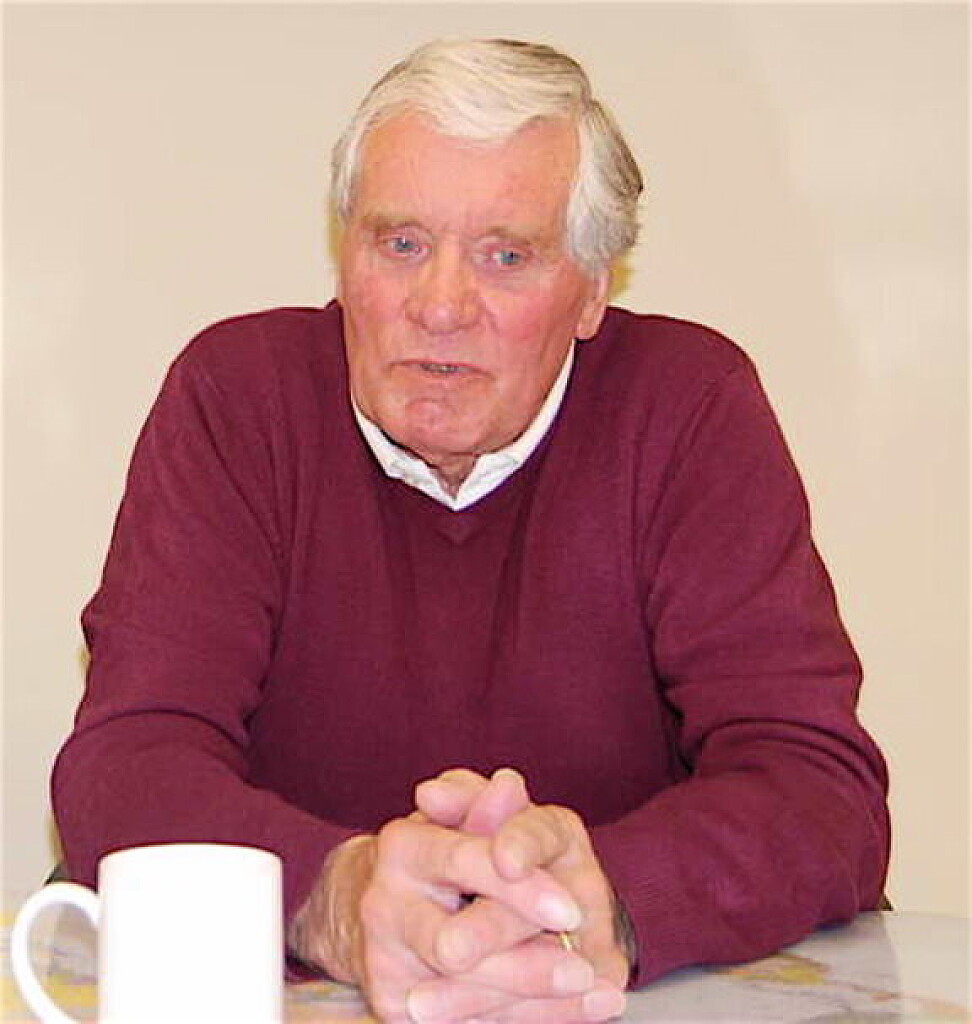
Maurice Herriott: Olympic Silver Medallist and Steeplechase Great Dies Aged 86
British athletics is mourning the loss of one of its most accomplished steeplechasers, Maurice Herriott, who has died aged 86 following a short illness.
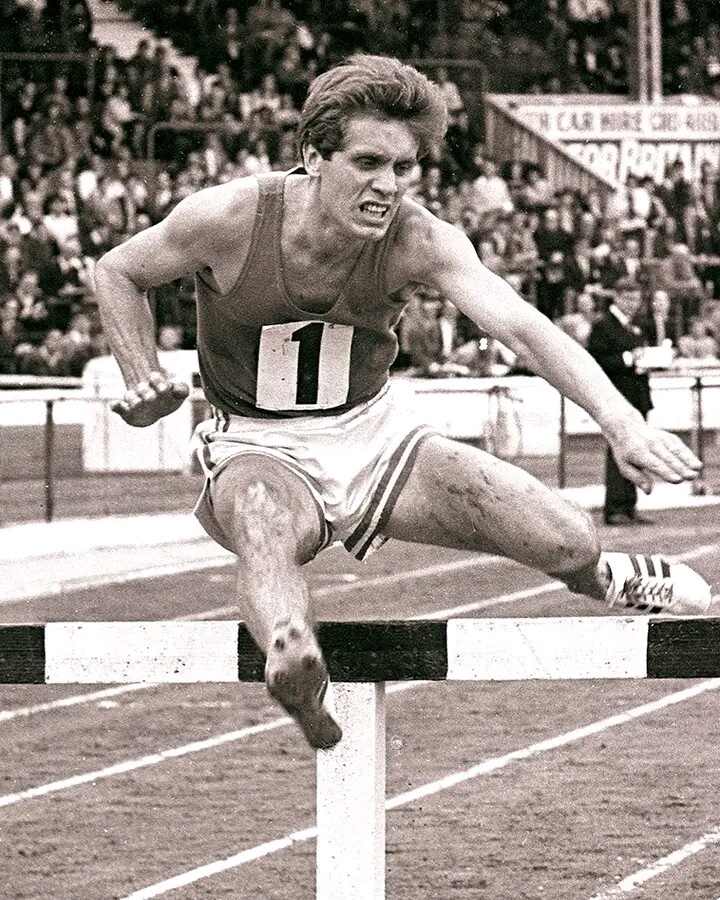
Herriott leaves behind a remarkable legacy, highlighted by his unforgettable silver-medal performance in the men’s 3000m steeplechase at the 1964 Tokyo Olympic Games. Competing for Great Britain, he clocked 8:32.4 to finish second behind legendary Belgian runner Gaston Roelants, who won in an Olympic record of 8:30.8.
It was a performance that underlined Herriott’s extraordinary determination. He was not a full-time professional athlete. Away from the track, he worked at the Birmingham Small Arms (BSA) motorcycle factory, combining demanding full-time employment with the training required to compete at the highest level of international athletics. Team GB notes that he held down a full-time job on the BSA motorcycle production line while competing at the Olympics.
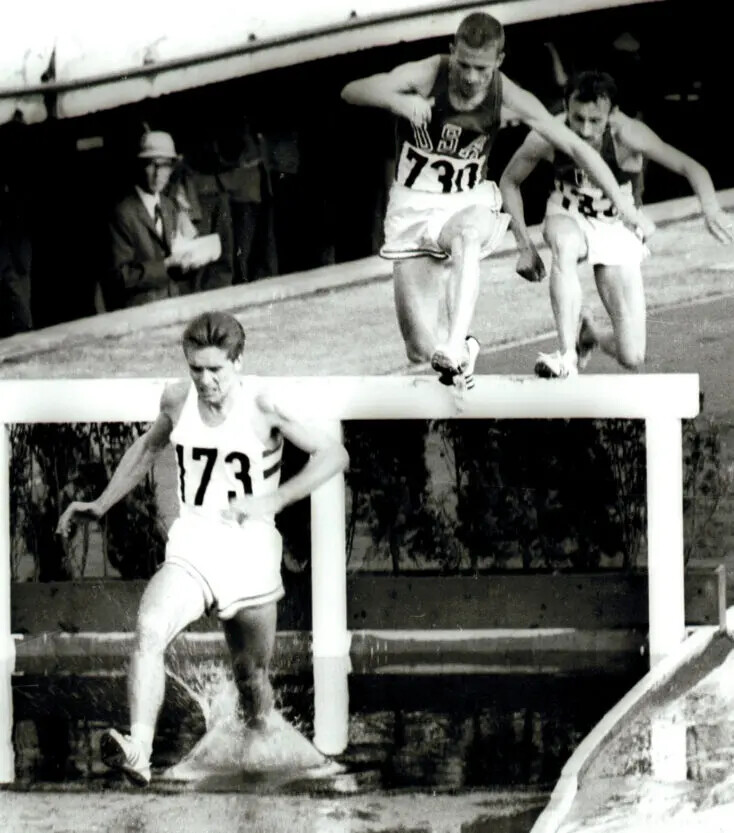
His Tokyo silver was the defining moment of a career built on consistency and resilience. In the Olympic final, Roelants established a commanding lead, but Herriott produced a powerful finish to move into second and close the gap considerably. He finished only 1.6 seconds behind the Belgian, with Soviet runner Ivan Belyayev taking bronze in 8:33.8.
Herriott had already established himself as a dominant force on the British scene. He won an astonishing eight AAA 3000m steeplechase titles, beginning with his first championship in 1959 and then claiming seven consecutive titles from 1961 through 1967.
His achievements also earned recognition beyond the medal table. In 1963, Herriott became the first British Athletics Writers' Association Male Athlete of the Year, an honour that reflected the esteem in which he was held during the peak of his career. He was also voted the award again in 1965.
His international career extended beyond Tokyo. Herriott had won Commonwealth Games silver in the steeplechase at Perth in 1962 and later represented Great Britain again at the 1968 Mexico City Olympics, where he reached the heats.
Born on 8 October 1939 in Great Wyrley, South Staffordshire, Herriott represented Birmingham-based Sparkhill Harriers and remained closely associated with the club, eventually becoming an honorary lifelong member.
His career is a reminder of an era when elite athletes could combine extraordinary sporting ambition with demanding working lives. Herriott did not simply win medals; he built a legacy through years of discipline, consistency and determination.
The British athletics community now says goodbye to a man who stood among the country's finest steeplechasers and whose silver medal in Tokyo remains one of the memorable achievements of British distance running.
Maurice Herriott — Olympic medallist, eight-time AAA champion and pioneer of British steeplechasing — will be remembered with great respect.
Herriott leaves behind an enduring legacy in British athletics, remembered not only for his Olympic silver medal but also for his remarkable consistency, determination and contribution to steeplechasing. He was 86.
by Erick Cheruiyot for My Best Runs.
Login to leave a comment
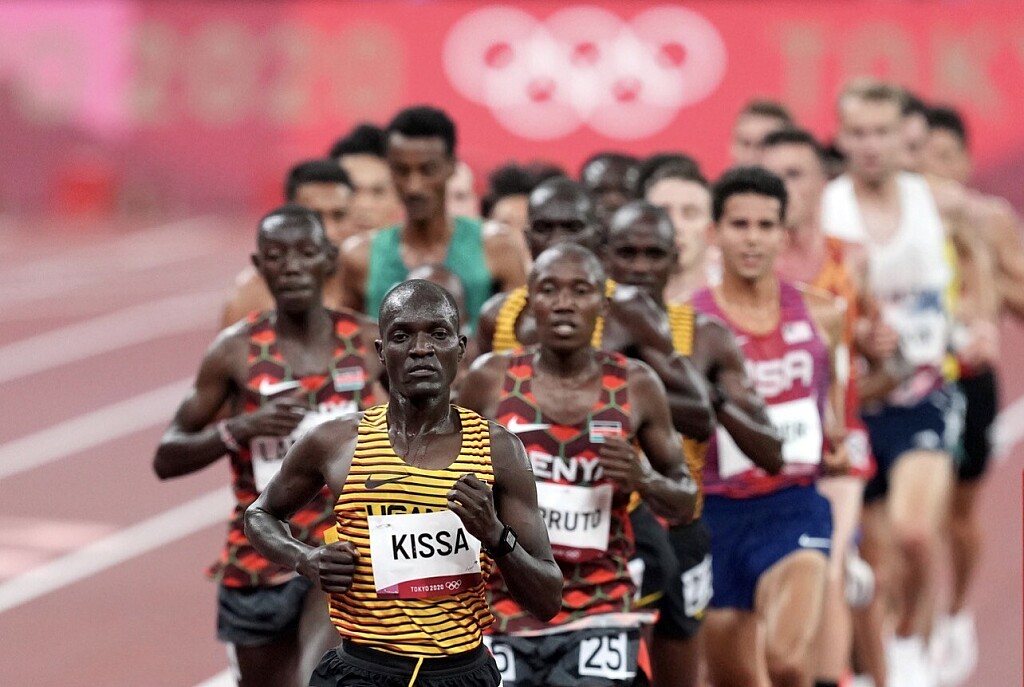
Stephen Kissa Carrying Ugandan Hopes at TCS Toronto Waterfront Marathon
Ugandan long-distance runners have emerged from the shadows of their legendary East African neighbours to earn distinction at the highest level.
Now Stephen Kissa will represent his nation at the 2026 TCS Toronto Waterfront Marathon on October 18 against a strong contingent of Kenyan and Ethiopian athletes. The event is once again a World Athletics Elite Label race.
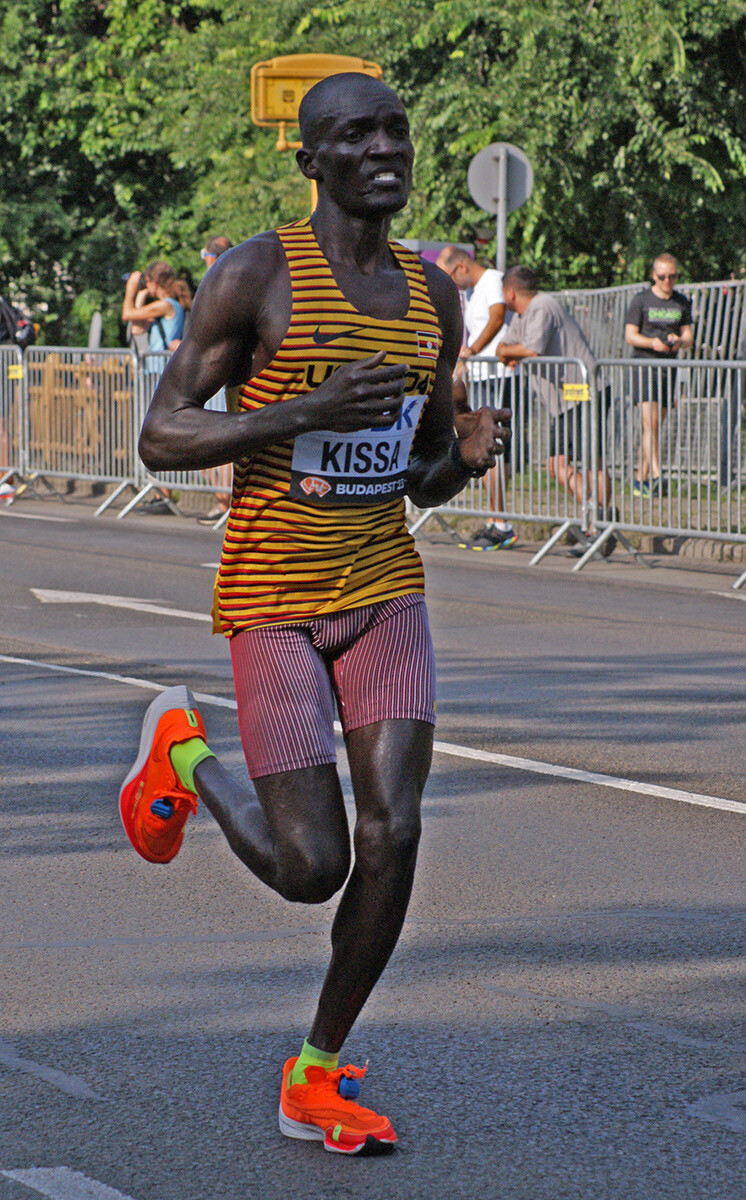
Kissa set a Ugandan national record of 2:04:48 when he finished second in his 2022 marathon debut in Hamburg. That record was only broken this year. He was subsequently selected for Uganda’s 2023 World Championships marathon team, finishing fifth on the streets of Budapest.
He has also represented his country twice at the Olympics and competed at the World Cross Country Championships. With such experience, the 37-year-old is intent on challenging for Toronto’s $25,000 Canadian first-place prize.
“When I come to Toronto, I will do my best,” he declares with a broad smile. “I will be really happy if I can run 2:03 or 2:04.
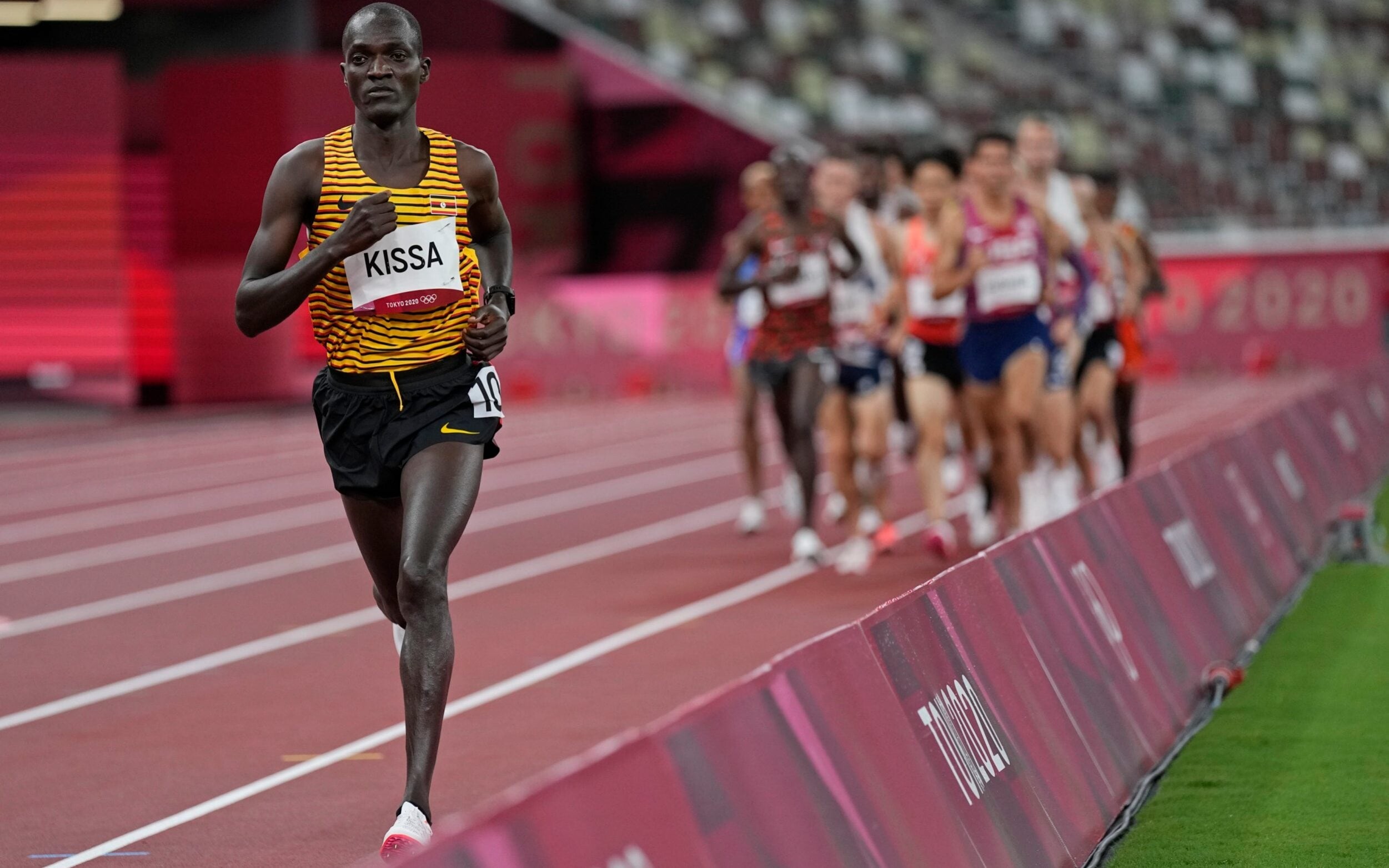
“With training, we have been comparing the past to now, and we have come up with a solution. We do long runs and tempo runs ranging from 25km and 28km to 30km and up to 40km. I am running around 120km a week but will go up closer to 200km.”
Kissa is not the first of his compatriots to compete in the Toronto Waterfront Marathon. Stephen Kiprotich, the 2012 Olympic champion, finished seventh in the 2018 race. Kiprotich remains a national hero in Uganda, and his success has contributed significantly to the nation’s emergence as a distance-running power.
“I was really inspired a long time ago by Stephen Kiprotich,” Kissa admits. “He did some tremendous work, and I can say he is our mentor. We really respect him.
“He has given me advice. He told me, ‘Our sport is not a one-day journey. It is a long journey that takes a lot of patience and commitment. If you have commitment, patience and work hard, you will go far.’”
Kiprotich has been an occasional and welcome visitor to the training camp in Kapchorwa that Kissa calls home for most of the year. It sits at an altitude of 2,500 metres, or 8,200 feet.
From Monday through Saturday, Kissa trains there with a group that includes two-time Olympic champion Joshua Cheptegei, 2023 world marathon champion Victor Kiplangat and 2022 Olympic 3,000m steeplechase champion Peruth Chemutai.
The centre was built by their management company, Global Sports Communications, with a contribution from Cheptegei. The athletes return home to their families on Saturday evenings.
Kissa lives in Kapchorwa’s town centre, about 14 kilometres away, in an area dominated by Mount Elgon, an extinct volcano estimated to be 24 million years old. He lives there with his wife and two young children.
“Right now they are at school,” he says of his children. “They are about to come home for a holiday. That’s when I will meet them. At school, they concentrate on their studies unless there is a problem. Then they will call me.”
The training camp includes a dormitory, dining room, kitchen and recreation room where the group gathers to watch sports. The recent FIFA World Cup generated great interest, and Kissa admits enjoying the play of Spanish winger Lamine Yamal. When asked what he does to relax, he smiles.
“I can play pool. I like that,” he says, adding with a laugh, “Not for money. We also play cards.
“Sometimes, when I have time, I cook chapati. It is made from wheat flour. We also have potatoes and ugali, which is made from corn.”
The group holds a prayer before each workout. Victor Kiplangat is an assistant pastor at a nearby church called Temple of the Most High God, but the others, including Kissa, also take turns leading prayers.
For more than a decade, the group was coached by Addy Ruiter. After the 2024 Paris Olympics, the Dutchman returned home. He continues coaching the athletes remotely through WhatsApp, with an on-site team led by fellow Dutchman Roy Hoornweg.
“Kapchorwa is a hilly, mountainous area,” Kissa explains. “The tempo runs are done on a plateau where it is flat. Our training differs depending on the location. You can’t do long runs in the hilly area, so we go to the plateau. We also have flatlands where we can do long runs and tempo runs.”
Kissa understands that he is approaching the later stages of his running career and must look toward life beyond competition. Still, he laughs when asked how many more years he can compete.
“Maybe 10 years! I will be happy if I can run 2:03 or 2:04,” he says.
“If Toronto goes really well, I will look to invest in assets in town, build apartments and start a business. I can really say thank you for inviting me to Toronto. If it goes well, I will be very proud.”
Kissa won’t be the only Ugandan presence at the TCS Toronto Waterfront Marathon. At the Runner’s Expo on October 16 and 17 at the Better Living Centre, a Uganda Tourism booth will offer information about the Mount Rwenzori Marathon and Great Lakes Safaris.
On the starting line, Kissa can be confident that he has the international experience and talent to compete with anyone. As for his ultimate goals, he is succinct.
“I pray that in the years to come I will stand on the podium at the Olympics or World Championships,” he says. “That is what I am really looking forward to.”
A victory in Toronto would bolster that ambition.
by Paul Gains
Login to leave a comment
TCS Toronto Waterfront Marathon
The Scotiabank Toronto Waterfront Marathon, Half-Marathon & 5k Run / Walk is organized by Canada Running Series Inc., organizers of the Canada Running Series, "A selection of Canada's best runs!" Canada Running Series annually organizes eight events in Montreal, Toronto and Vancouver that vary in distance from the 5k to the marathon. The Scotiabank Toronto Waterfront Marathon and Half-Marathon are...
more...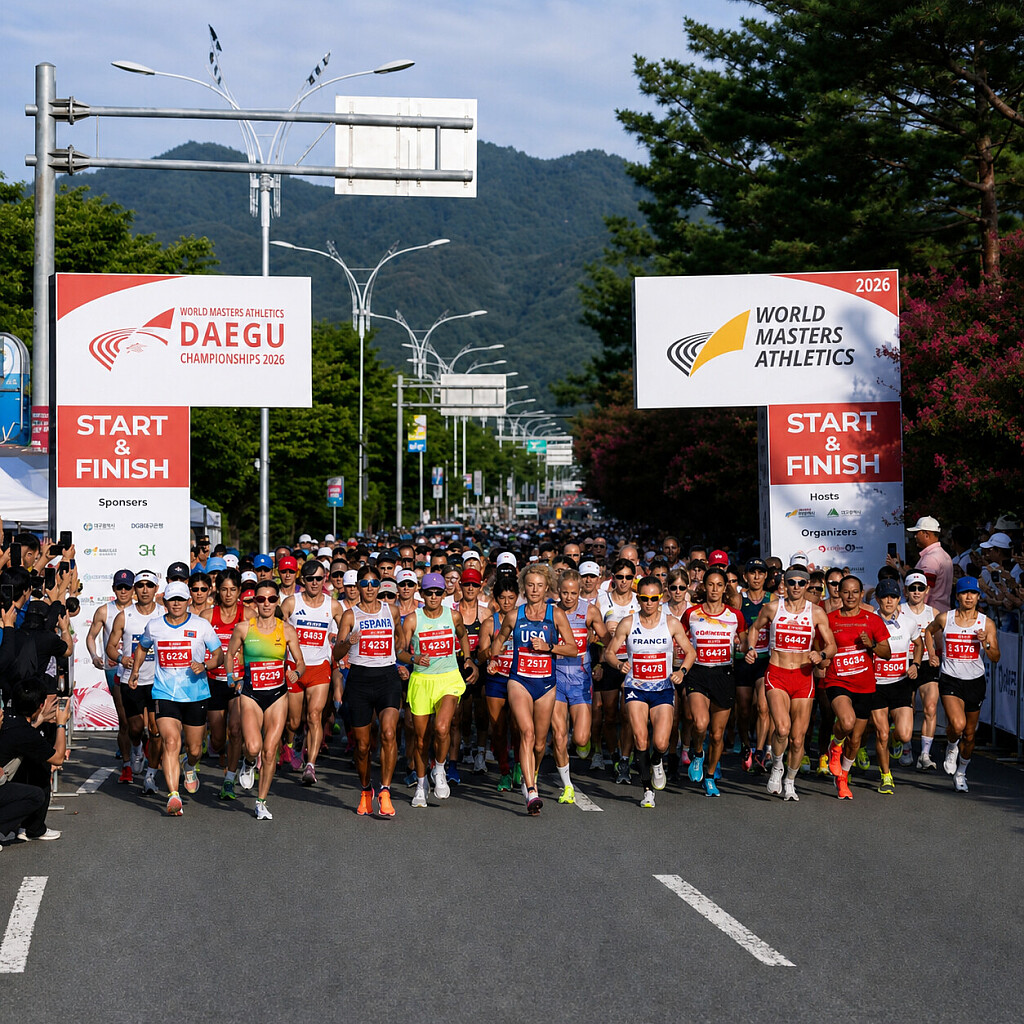
Four World Records Fall as Daegu Masters Championships Explode Into Life
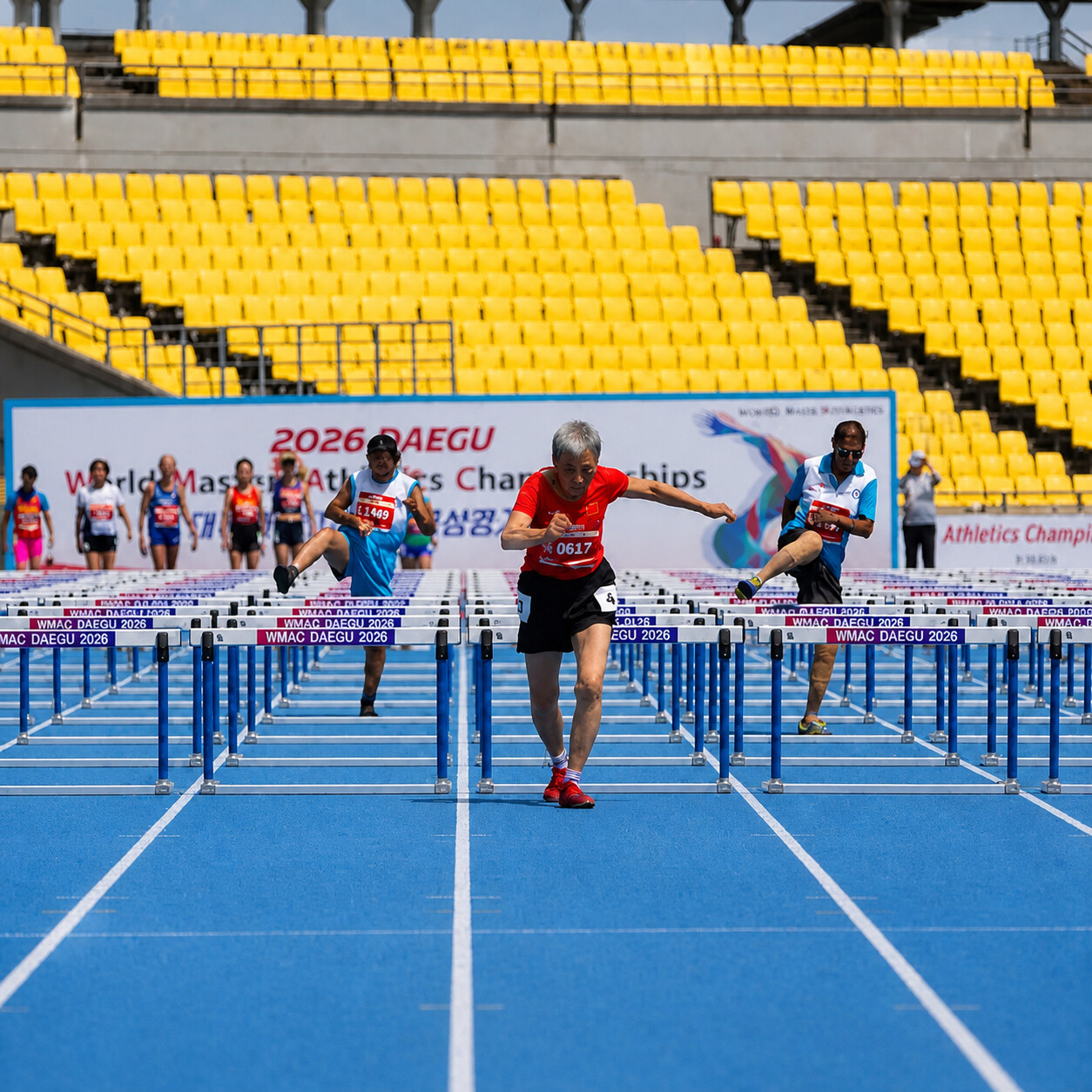
The World Masters Athletics Championships in Daegu, South Korea, are only three days old, but the competition has already produced a remarkable display of speed, endurance and longevity, with four world records shattered and another 10 championship records rewritten.
The record-breaking action began on the opening day when the United States’ Richard Lee produced a stunning performance in the M65 2,000m steeplechase. Lee stopped the clock at 7:09.29, winning gold while lowering the existing world record in the age group.
Day two proved even more dramatic, delivering three world records in quick succession.
Great Britain’s John Wright was first to strike, clocking 12.03 seconds to win the M65 100m. In doing so, the veteran sprinter improved his own world record of 12.15, set in 2024, underlining his remarkable consistency at the highest level of masters competition.
Only minutes later, the United States’ Kenton Brown produced another record-breaking run in the M80 100m. Brown crossed the line in 14.16, taking 0.05 seconds off his own previous world record of 14.21, which he established last year.
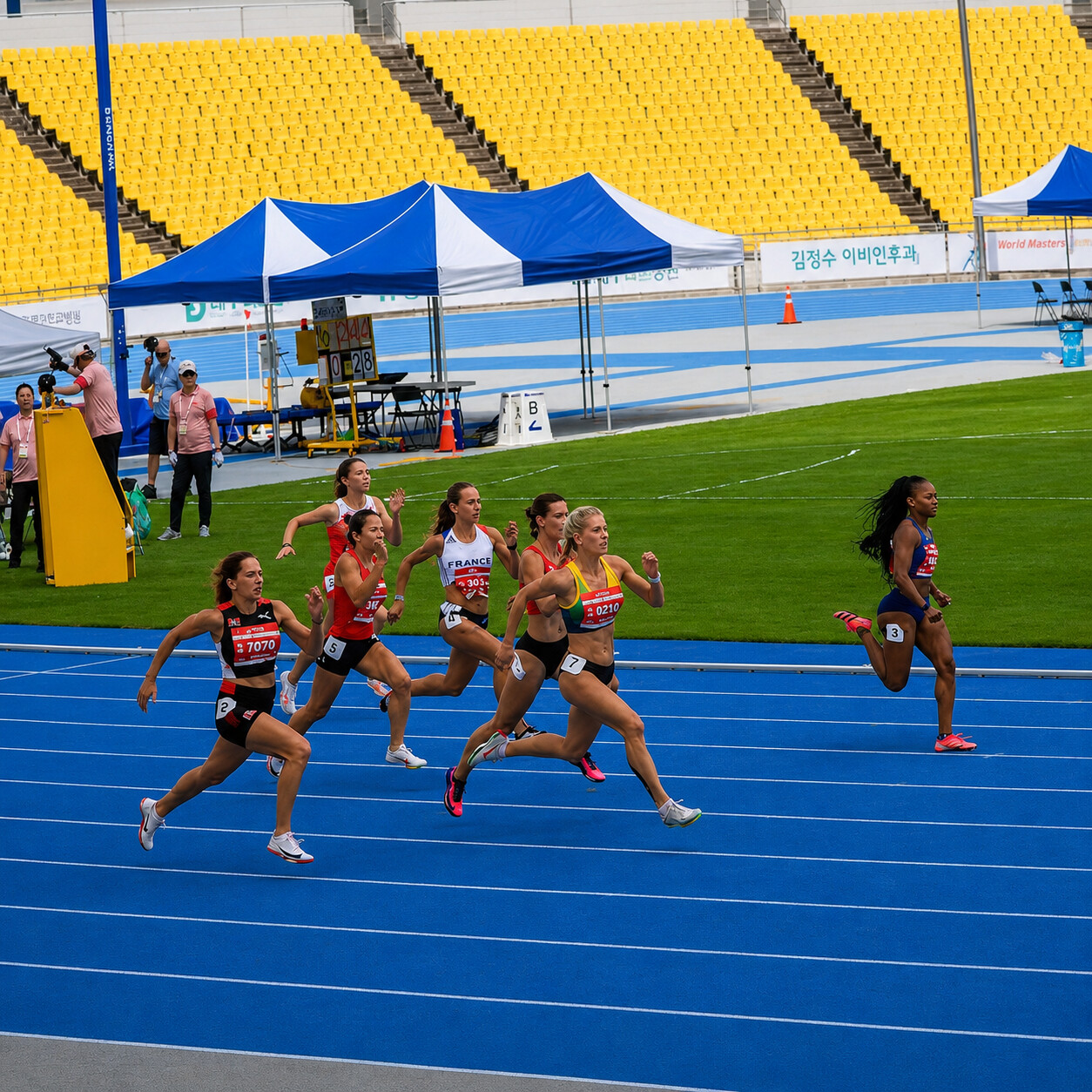
Thailand then added another name to the growing list of Daegu record-breakers. Somsanga Boonnok won the W70 80m hurdles in 15.61, breaking a world record that had belonged to Austria’s Marianne Maier since 2016.
Four world records in just three days tell only part of the story. Across the championships, 10 championship records have already fallen, highlighting the extraordinary standard being produced by athletes competing across the masters age groups.
Canada has also made its presence felt on the medal podium. Johana Flipsen captured W70 10K race walk gold in 1:04:18, while Vern Christensen won the M85 2,000m steeplechase in 14:48.25.
Canadian athletes have continued to add to the medal tally, with Lynne Wawryk Epp taking bronze in the W70 800m in 3:21.04, while Vanessa Johnson secured silver in the W40 race walk after finishing in 1:05:52.
But one of the most intriguing storylines to watch as the championships continue belongs to Canada’s Wendy Alexis.
At 71 years old, Alexis has arrived in Daegu with a world record firmly within reach. She is just 0.04 seconds away from the W70 100m world record of 14.37 seconds, and after targeting the championship throughout the season, she now has the opportunity to turn that ambition into history.
Alexis will contest her semifinal on Tuesday morning, with the final scheduled for later that evening.
With four world records already gone, 10 championship records broken and some of the world’s finest masters athletes still waiting to take to the track, Daegu is proving that age is no barrier to extraordinary performance.
And if the opening three days are anything to go by, the record books may have plenty more rewriting to come.
by Erick Cheruiyot for My Best Runs.
Login to leave a comment
Amanda Marie Grefstad Ends 45-Year Wait With Stunning Norwegian 1000m Record
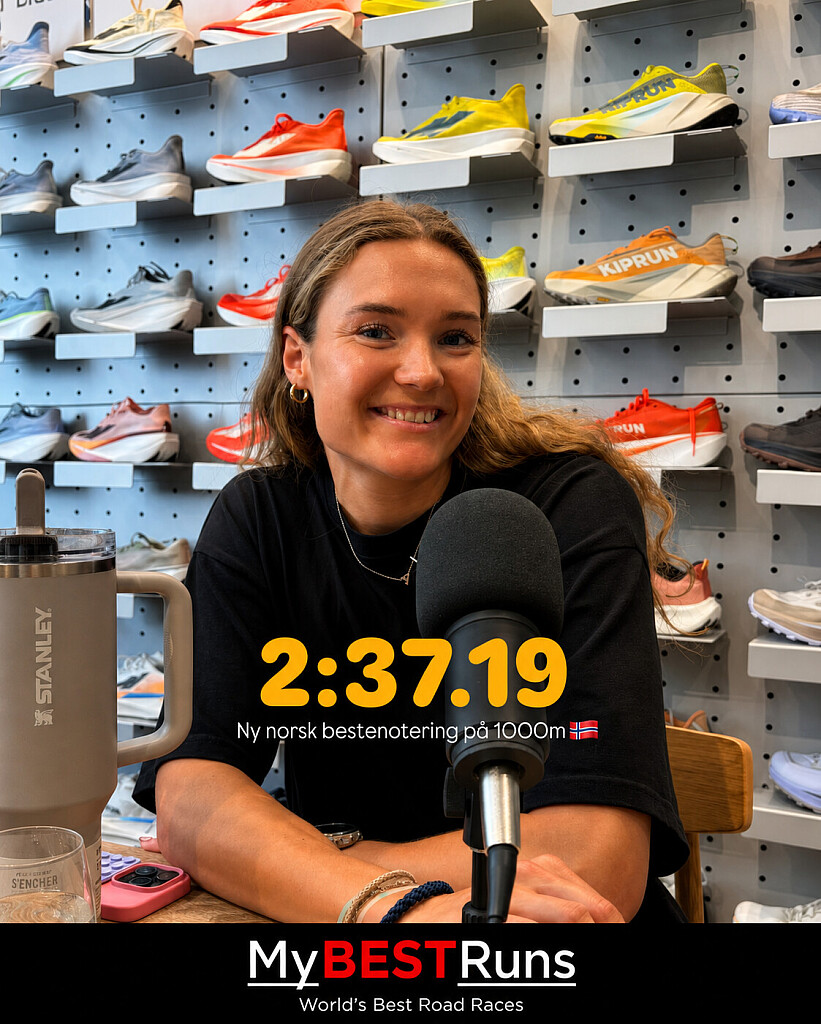
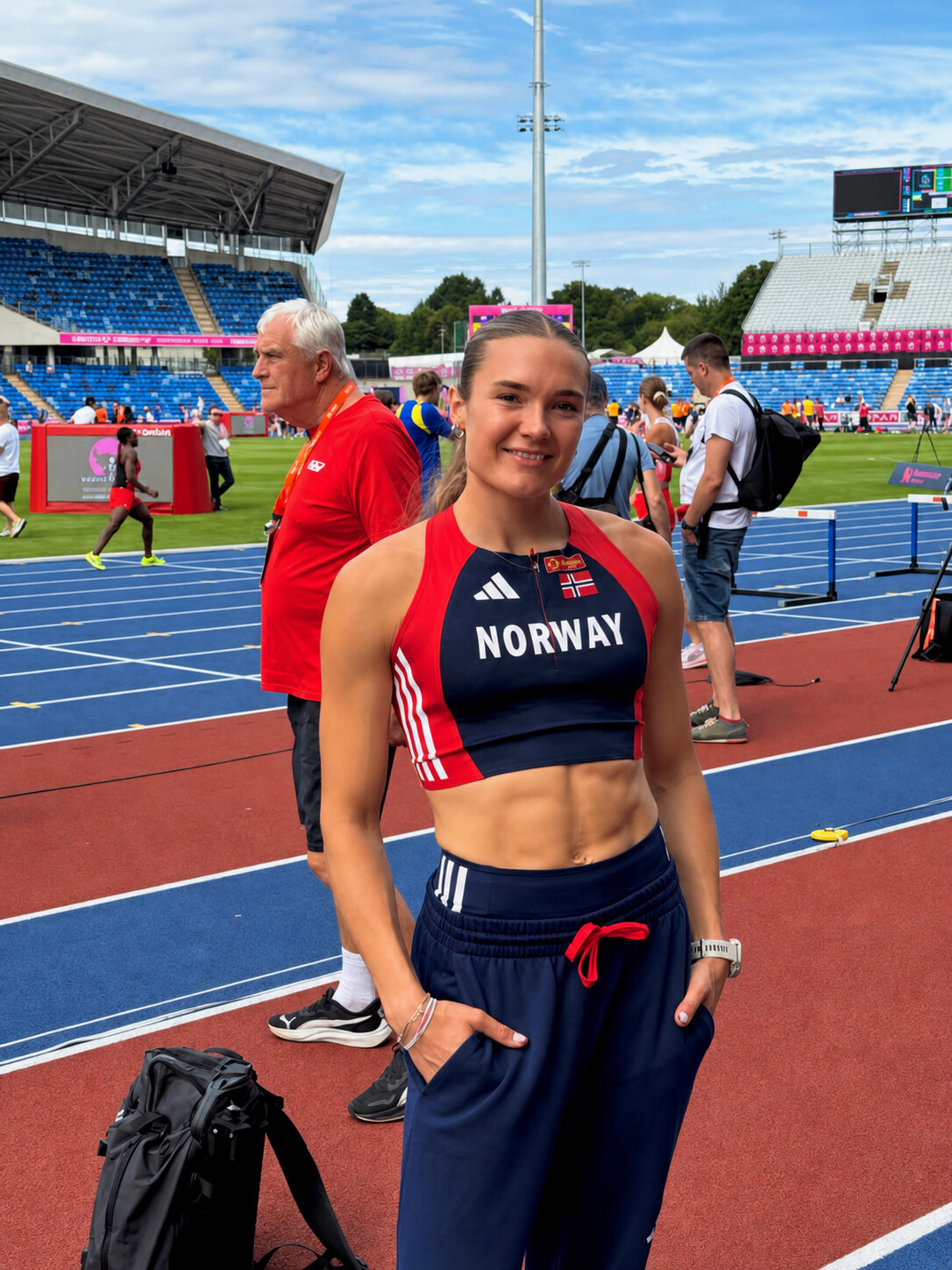
Amanda Marie Grefstad has written her name into Norwegian athletics history with a remarkable performance at the Folksam Grand Prix in Gothenburg, where she shattered the national women’s 1000m record in spectacular fashion.
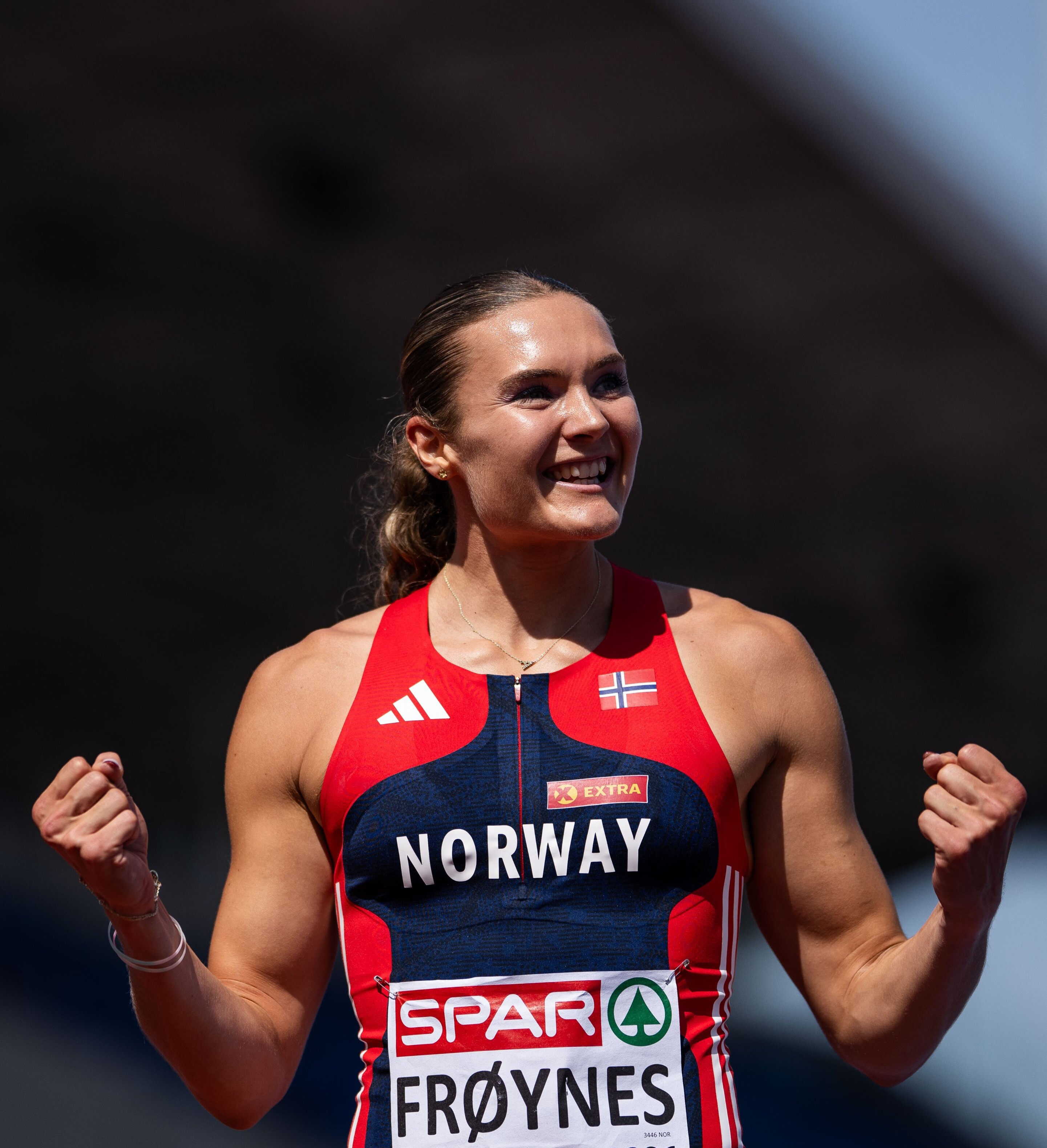
Grefstad stopped the clock at 2:37.19, producing a sensational run that not only delivered a Norwegian record but also brought down a mark that had stood untouched for an astonishing 45 years.
The significance of the performance goes far beyond the numbers. For nearly half a century, the old national record had remained one of the most enduring benchmarks in Norwegian middle-distance running. Now, Grefstad has finally rewritten the record books, replacing a piece of athletics history with her own name.
Her 2:37.19 performance was a powerful demonstration of speed, strength and determination, highlighting the progress she has made and the growing level of Norwegian middle-distance running.
Breaking a record that has survived for 45 years requires something special, and Grefstad delivered exactly that when it mattered most. Her run in Gothenburg marks a defining moment in her career and gives Norwegian athletics another exciting name to watch.
With the record now hers, Grefstad has opened a new chapter in the event’s history. The old mark may have lasted for four and a half decades, but the future now belongs to a new generation.
2:37.19. A new Norwegian record. A historic breakthrough. And a performance that will not be forgotten anytime soon.
Amanda Marie Grefstad has arrived in the record books — and Norwegian athletics has a new 1000m record holder to remember.
by Erick Cheruiyot for My Best Runs.
Login to leave a comment
Kenenisa Bekele’s Paris Coronation: The Night Ethiopia’s Distance Running Dynasty Changed Forever
Paris, France — August 24, 2003.
The Stade de France witnessed far more than a World Championship 10,000m final that night. It witnessed the beginning of a new era.
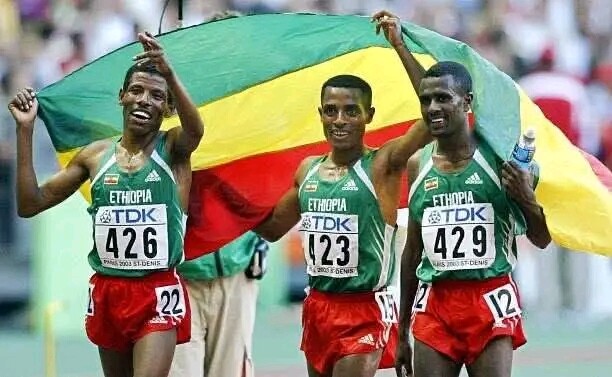
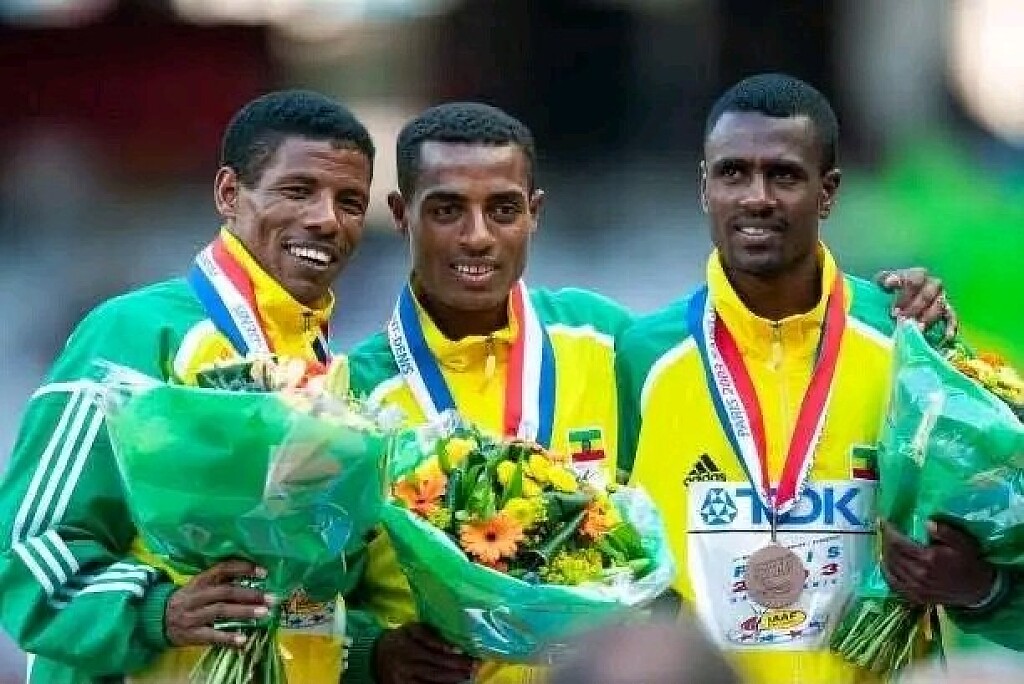
For years, Haile Gebrselassie of Ethiopia had stood virtually untouchable at the summit of world distance running. He arrived in Paris as a two-time Olympic champion and four-time World Champion over 10,000m, carrying the reputation of a man who had dominated the track for much of the previous decade.
But waiting in the same race was a 21-year-old Ethiopian whose running style looked remarkably familiar.
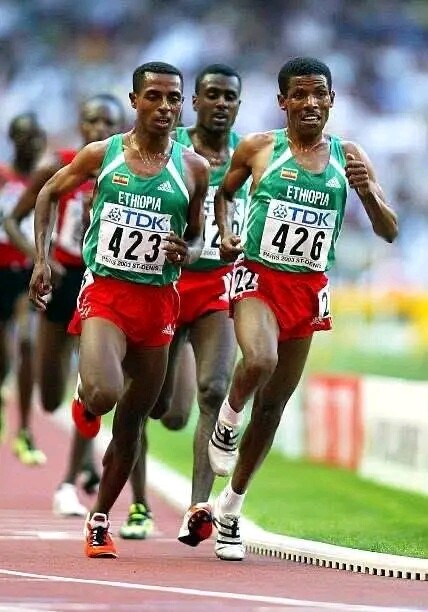
His name was Kenenisa Bekele.
The younger Ethiopian had already shown flashes of extraordinary potential, but Paris was where potential became reality.
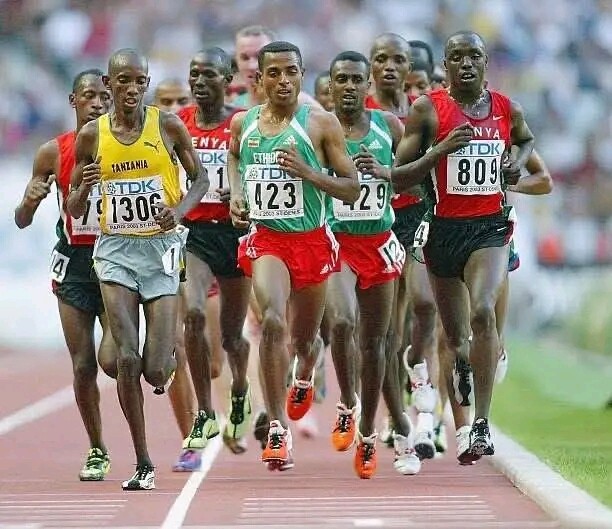
As the race unfolded, Gebrselassie ran aggressively, repeatedly applying pressure in an attempt to break the field and shake off his young compatriot. One by one, the world's best distance runners were dropped, including a strong Kenyan contingent.
Yet Bekele refused to disappear.
He stayed glued to Gebrselassie's shoulder, matching every surge and every change of pace. Behind them, Sileshi Sihine of Ethiopia remained in contention, setting the stage for what would ultimately become a historic Ethiopian sweep.
Then came the decisive moment.
With only 200 metres remaining, Bekele made his move.
Gebrselassie, famous for his devastating finishing speed, tried to respond. But this time, there was no answer. Bekele powered away down the final straight, creating daylight between himself and his legendary compatriot.
The changing of the guard had arrived.
Bekele crossed the finish line in 26:49.57, becoming the first athlete to break 27 minutes at these World Championships and setting a championship record.
Behind him, Gebrselassie finished second in 26:50.77, while Sihine completed an extraordinary Ethiopian clean sweep with 27:01.44.
It was not simply a victory for Bekele.
It was the moment the young star announced that he was ready to inherit the throne.
Paris 2003 — Men's 10,000m Final
1. Kenenisa Bekele — Ethiopia — 26:49.57 CR
2. Haile Gebrselassie — Ethiopia — 26:50.77
3. Sileshi Sihine — Ethiopia — 27:01.44
4. Ahmad Hassan Abdullah — Qatar — 27:18.28
5. John Cheruiyot Korir — Kenya — 27:19.94
6. Wilberforce Talel — Kenya — 27:33.60
7. Charles Kamathi — Kenya — 27:45.05
8. Kamiel Maase — Netherlands — 27:45.46
9. Karl Keska — Great Britain — 27:47.89
10. Ismail Sghyr — France — 27:54.87
11. David Galván — Mexico — 27:55.31
12. John Yuda Msuri — Tanzania — 27:56.21
13. Fabiano Joseph Naasi — Tanzania — 28:06.36
14. Alan Culpepper — United States — 28:14.92
15. Teodoro Vega — Mexico — 28:31.71
16. Mebrahtom Keflezighi — United States — 28:35.08
17. Cathal Lombard — Ireland — 28:36.43
18. Tomoo Tsubota — Japan — 28:37.10
19. Dan Browne — United States — 29:01.60
Bekele's Paris triumph proved to be the beginning of something much bigger. He went on to win Olympic 10,000m gold in Athens the following year and established himself as the dominant track distance runner of his generation.
At the 2008 Beijing Olympics, he completed the extraordinary 5,000m and 10,000m double, cementing his place among the greatest distance runners in history.
Gebrselassie, meanwhile, successfully reinvented himself beyond the track. He turned increasingly toward the 10km, half marathon and marathon, where he continued rewriting the record books and building another extraordinary chapter of his career.
But Paris remains special.
On August 24, 2003, one Ethiopian legend was still fighting to protect his kingdom while another was stepping forward to claim it.
Kenenisa Bekele didn't simply win a World Championship gold medal that night. He announced the arrival of a new era in distance running.
by Erick Cheruiyot for My Best Runs.
Login to leave a comment
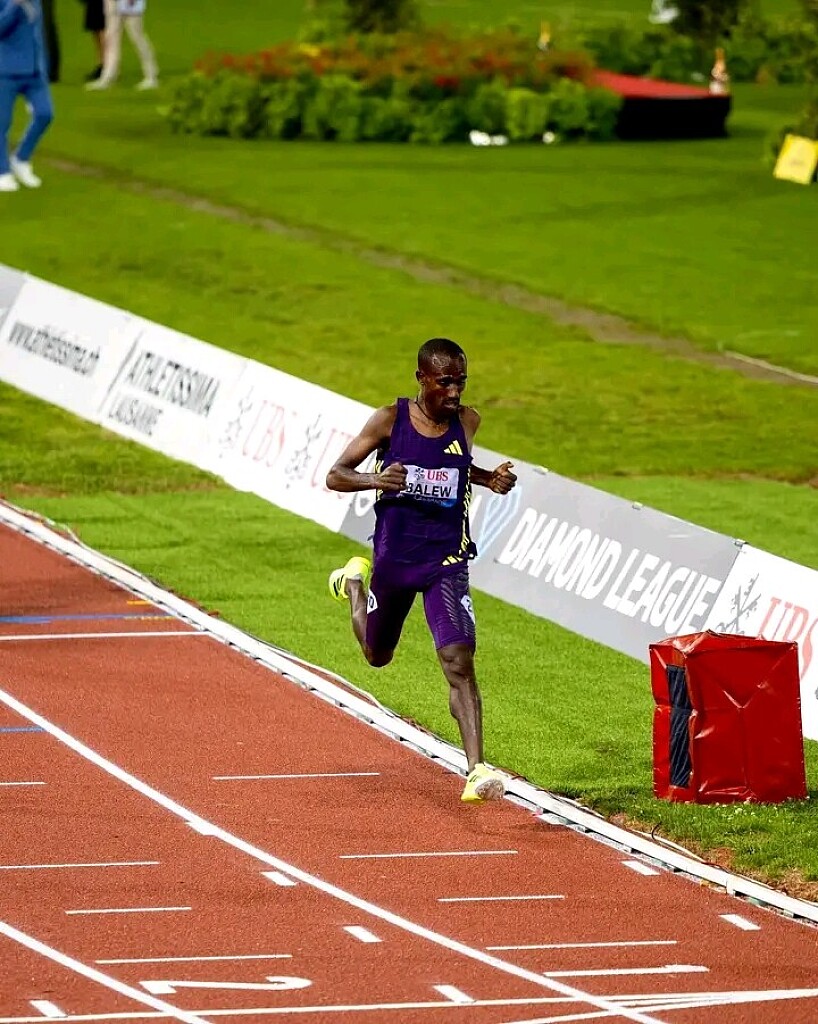
Six Men Smash the 13-Minute Barrier in a Stunning Lausanne 5000m Showdown
The men’s 5000m at the Lausanne Diamond League produced one of the most electrifying distance races of the season, as six athletes broke the coveted 13-minute barrier in a breathtaking display of speed and depth.
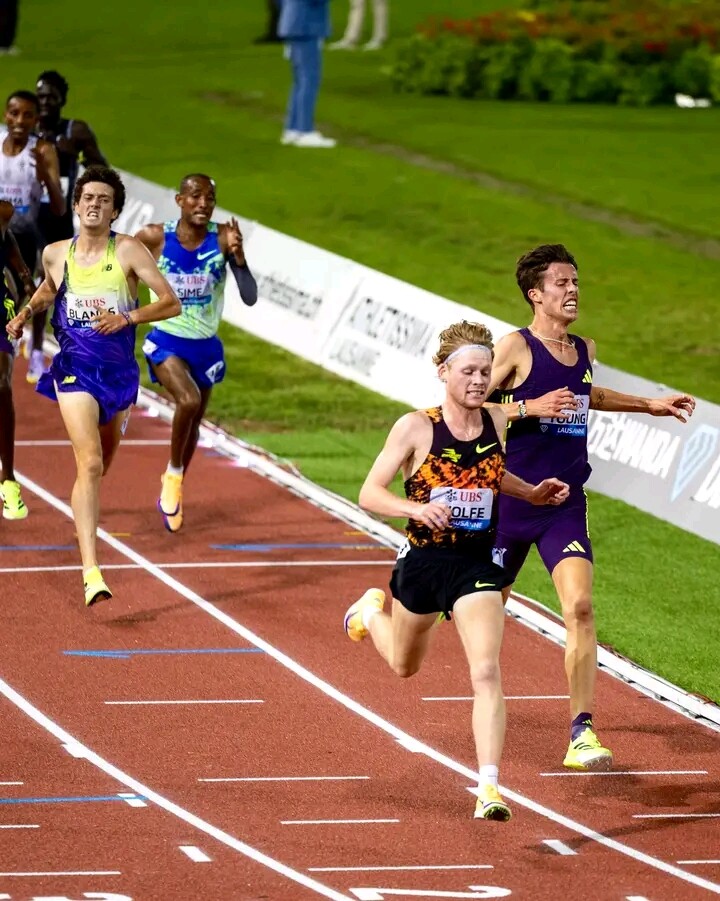
Bahrain’s Birhanu Balew emerged victorious in a fiercely contested race, clocking 12:57.55 to secure a brilliant win against a world-class field. Balew held off relentless pressure behind him to claim the victory as the race exploded into a spectacular battle over the closing stages.
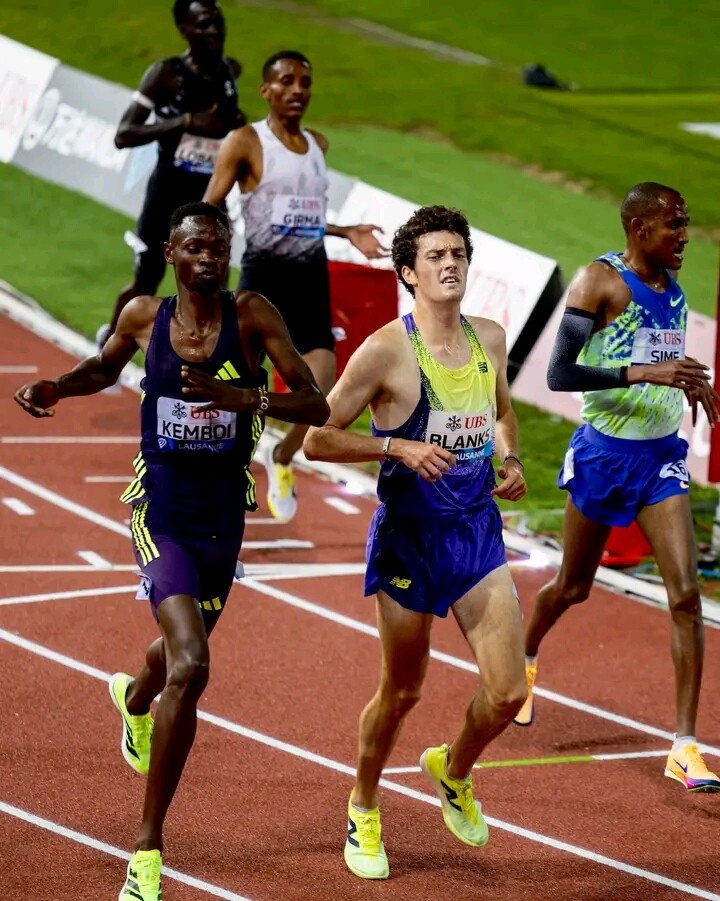
The United States produced an especially impressive performance, with Parker Wolfe leading a powerful American charge in second place. Wolfe crossed the line in a personal best of 12:58.20, while Nico Young followed closely in third with a season's best of 12:58.33. Graham Blanks made it three Americans in the top four, dipping under 13 minutes with 12:59.16.
Kenya’s Cornelius Kemboi added another sub-13-minute performance in fifth, clocking 12:59.33, while Ethiopia’s Mezgébu Sime completed the extraordinary group of six athletes under the historic barrier with 12:59.48 in sixth place.
The quality of the race was underlined by the fact that Ethiopia’s Kuma Girma, despite recording a season's best of 13:00.22, could finish only seventh. Switzerland’s Dominic Lobalu took eighth in 13:00.73, followed by Ethiopia’s Kahiri Bejiga, who ran a personal best of 13:03.27.
Grant Fisher, one of the biggest names in the field, finished 11th in 13:07.74 on a night when the remarkable depth and pace of the competition left no room for error.
Lausanne has once again delivered a memorable night of distance running, with the men’s 5000m becoming a showcase of the extraordinary standard currently being produced on the track. Six men under 13 minutes in a single race was a powerful statement, while Balew's victory and the exceptional performances from the American trio ensured this was one of the standout races of the 2026 Diamond League season.
Top 10 finishers:
1. Birhanu Balew (Bahrain) — 12:57.55
2. Parker Wolfe (United States) — 12:58.20 PB
3. Nico Young (United States) — 12:58.33 SB
4. Graham Blanks (United States) — 12:59.16
5. Cornelius Kemboi (Kenya) — 12:59.33
6. Mezgébu Sime (Ethiopia) — 12:59.48
7. Kuma Girma (Ethiopia) — 13:00.22 SB
8. Dominic Lobalu (Switzerland) — 13:00.73
9. Kahiri Bejiga (Ethiopia) — 13:03.27 PB
10. Egide Ntakarutimana (Burundi) — 13:07.21
In a race packed with exceptional talent, Balew ultimately had the decisive finishing strength—but Lausanne's biggest story was the sheer depth of the performance, with six men racing beneath 13 minutes and turning the 5000m into an unforgettable Diamond League showdown.
by Erick Cheruiyot for My Best Runs.
Login to leave a comment
Olympic Champion Winfred Yavi Beats World Champion Faith Cherotich in Lausanne Steeplechase Thriller
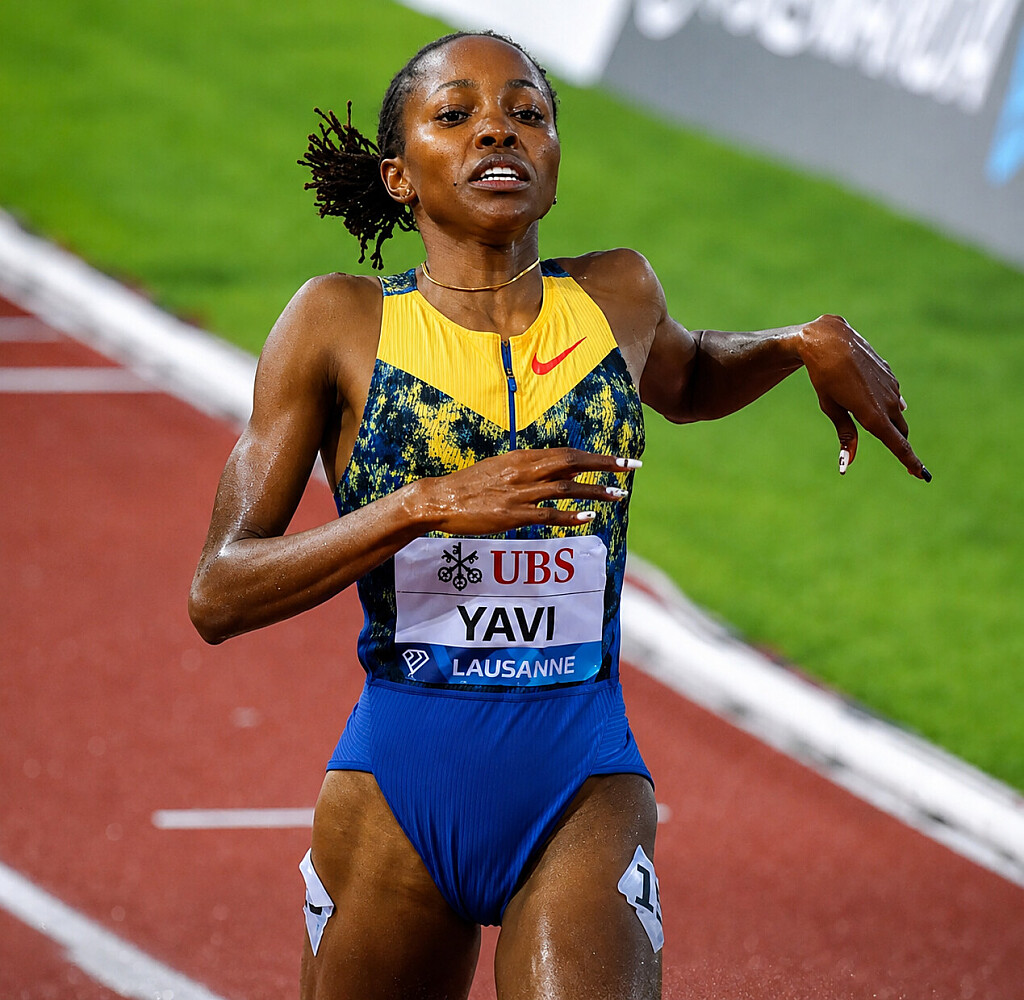
Winfred Yavi delivered a statement performance at the Lausanne Diamond League, defeating reigning world champion Faith Cherotich in a thrilling women's 3000m steeplechase showdown and taking the lead in their increasingly compelling 2026 rivalry.
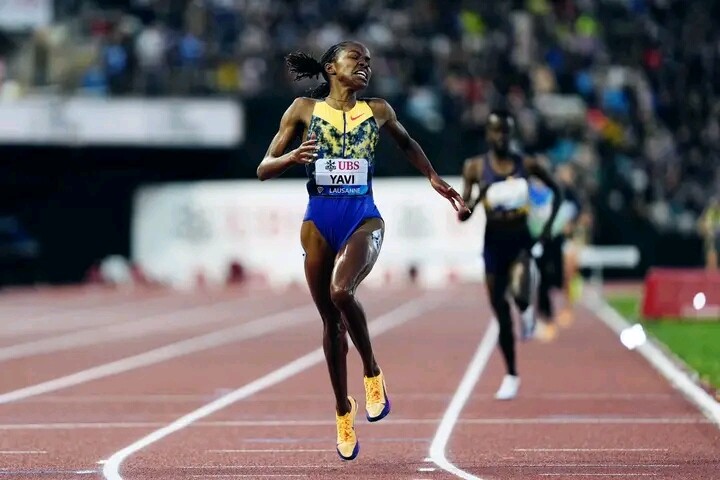
The Bahraini star, the 2024 Olympic steeplechase champion, led from the opening stages and never surrendered control, crossing the line in a meet record of 9:00.04. Cherotich, the reigning world champion, fought hard throughout but had to settle for second in 9:01.90.
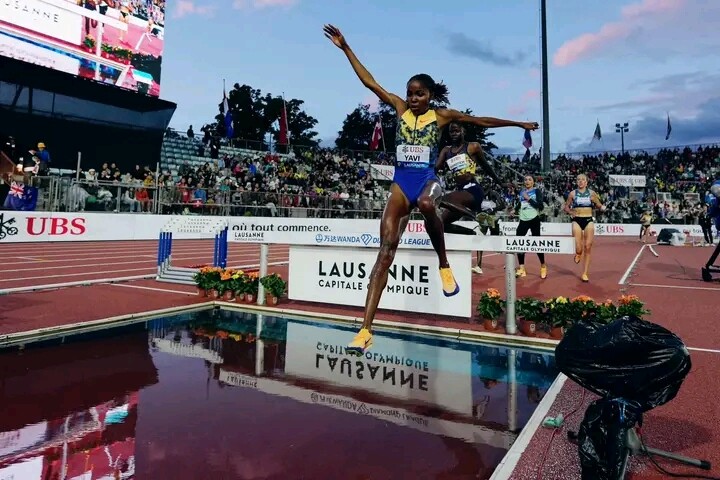
The victory gave Yavi the upper hand in their head-to-head battles this season, with the Olympic champion now holding a 2-1 advantage over Cherotich in their three meetings in 2026.
For much of the race, Cherotich remained within striking distance of Yavi, staying close as the two stars negotiated the barriers at a relentless pace. However, Yavi refused to give her Kenyan rival an opportunity to take control, maintaining the lead and producing another powerful display when the pressure intensified in the closing stages.
It was a fascinating battle between two of the dominant figures in women's steeplechasing. The reigning Olympic champion against the reigning world champion lived up to expectations, and on this occasion, Yavi had the answers.
Tunisia's Marwa Bouzayani completed the podium in 9:05.55, while Kenya's Doris Lemngole finished fourth in 9:07.09. American Lexy Halladay rounded out the top five with a personal best of 9:08.35.
Yavi's winning time was not only enough to secure another important victory over her biggest rival but also established a new Lausanne meet record, underlining the exceptional standard of the race.
With Yavi now leading their season series 2-1, the rivalry between the Olympic champion and the world champion is becoming one of the most exciting battles in women's distance running. Lausanne belonged to Yavi, but Cherotich remains close enough to ensure that their next meeting could produce another spectacular contest.
by Erick Cheruiyot for My Best Runs.
Login to leave a comment
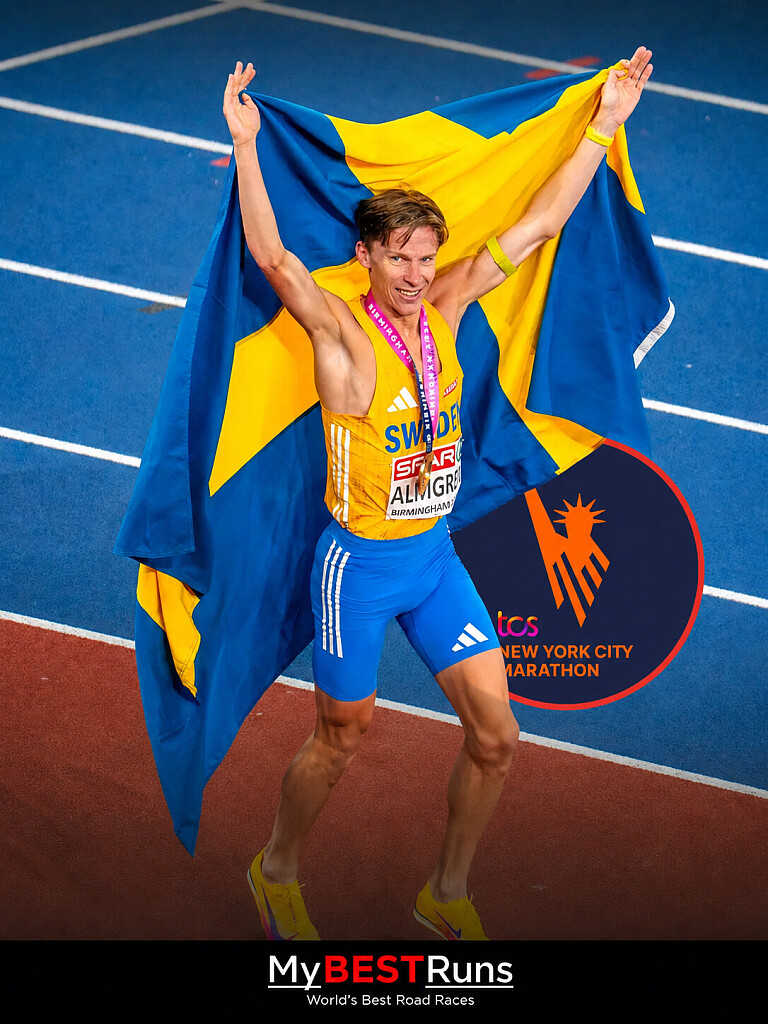
From European Records to 42.195km: Andreas Almgren Takes on New York
Andreas Almgren has spent the past two seasons transforming himself into one of Europe’s most formidable distance runners. Now, the Swedish star is ready to take on an entirely new challenge — the marathon.
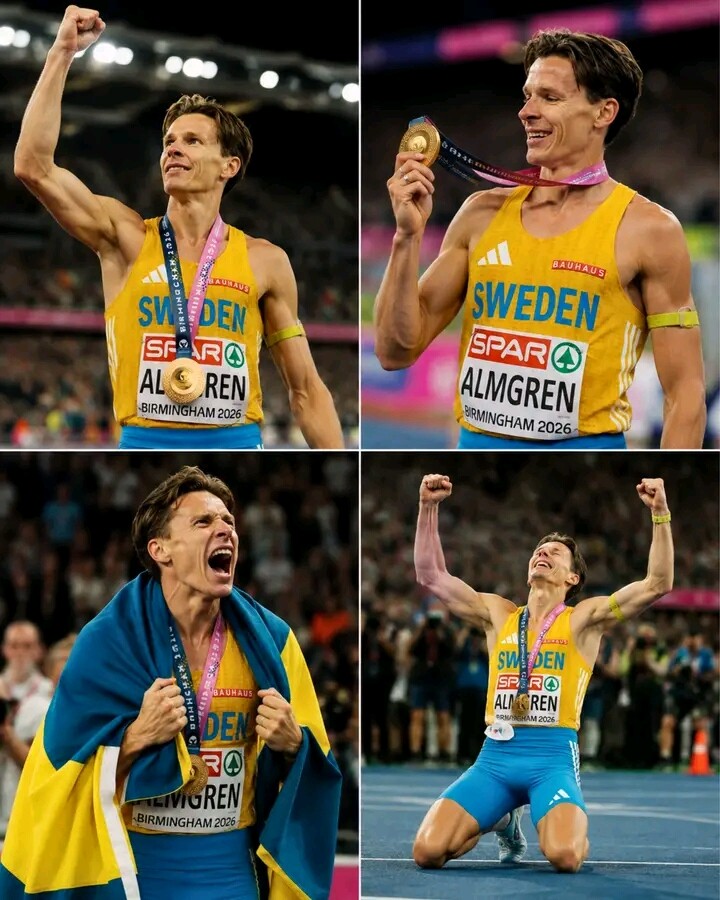
Fresh from a commanding European 10,000m triumph in Birmingham, Almgren has confirmed that he will make his marathon debut at the TCS New York City Marathon on November 1. The decision adds another intriguing chapter to a remarkable rise that has seen him repeatedly rewrite the European record books.
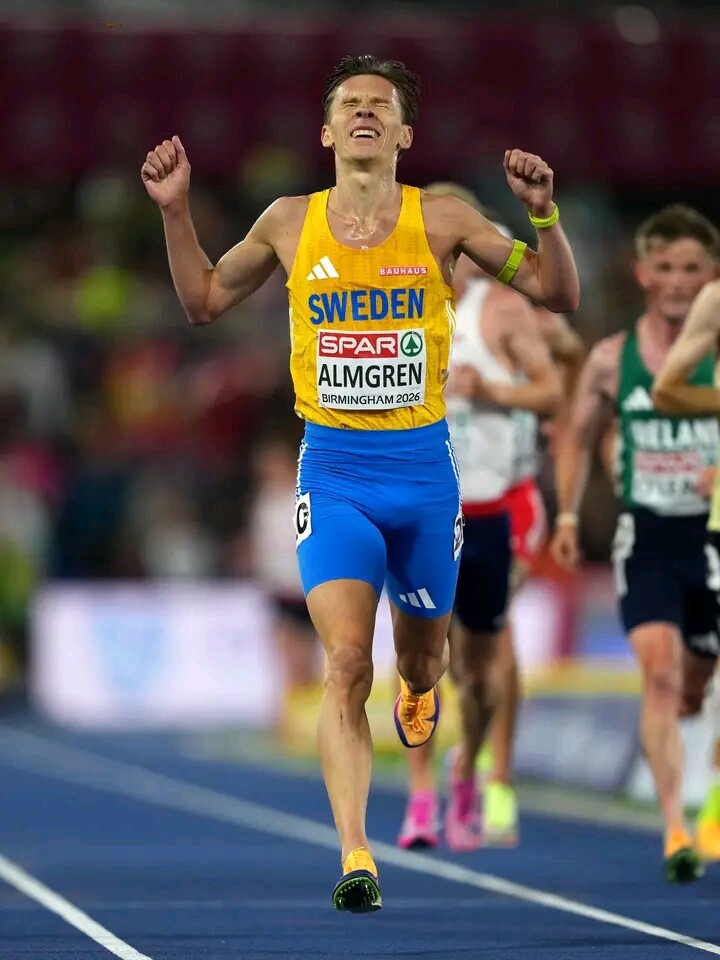
The 31-year-old owns European records of 12:44.27 for 5,000m, 26:45 for 10km on the road and 58:41 for the half marathon — extraordinary marks that underline both his speed and his growing endurance. His 26:45 in Valencia in January 2026 lowered his own European 10km record, while his 58:41 in Valencia last October made him the first European athlete to break the 59-minute barrier for the half marathon.
His latest achievement came in Birmingham, where Almgren produced one of the most dominant performances of the European Championships. He stormed to the 10,000m title in 27:23.44, setting a championship record and adding a major senior title to the World Championships bronze medal he won over the same distance in Tokyo last year.
Yet his choice of New York for his first marathon is what makes the announcement particularly fascinating.
Rather than selecting a traditionally fast, flat course where a debutant can concentrate almost exclusively on the clock, Almgren has chosen one of the most demanding and tactically complex marathons on the calendar. The New York course takes runners through all five boroughs and across five bridges before the finish in Central Park, combining repeated climbs, descents, turns and constantly changing race dynamics.
It is a course that rewards patience, strength and tactical intelligence as much as raw speed. For Almgren, whose career has been built around racing at the highest level rather than simply accumulating fast times, the setting could provide a fascinating test of how his exceptional track and road credentials translate to 42.195 kilometres.
And he will not be entering a quiet debut race. The 2026 field features defending men's champion Benson Kipruto, former champion Geoffrey Kamworor, Dutch star Abdi Nageeye, American contenders Conner Mantz and Zouhair Talbi, as well as several other elite marathoners. Almgren is one of a small group of high-profile athletes making their marathon debuts in New York.
The race will also mark the 50th anniversary of the modern five-borough New York City Marathon course, adding even greater significance to an already prestigious occasion. With Almgren bringing European-record credentials, a fresh continental title and the confidence of a breakthrough period behind him, his first encounter with the marathon promises to be one of the most closely watched stories of the autumn road-racing season.
For a runner who has already conquered the track and rewritten the European road-running record books, New York represents the beginning of another journey.
On November 1, the question will no longer be how fast Andreas Almgren can run 5,000m, 10km or a half marathon.
It will be how far that extraordinary speed and endurance can carry him over 42.195 kilometres through the streets of New York.
by Erick Cheruiyot for My Best Runs.
Login to leave a comment

TCS New York City Marathon
The first New York City Marathon, organized in 1970 by Fred Lebow and Vince Chiappetta, was held entirely in Central Park. Of 127 entrants, only 55 men finished; the sole female entrant dropped out due to illness. Winners were given inexpensive wristwatches and recycled baseball and bowling trophies. The entry fee was $1 and the total event budget...
more...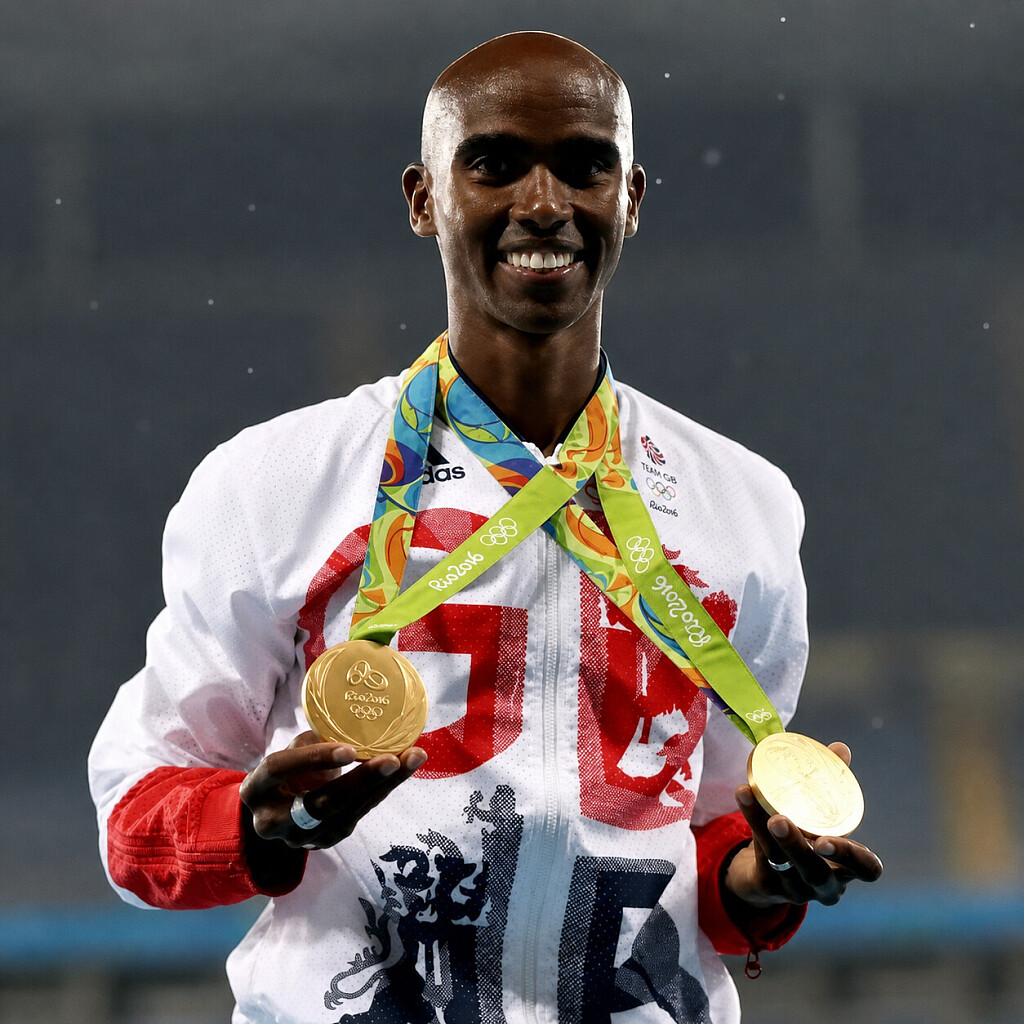
Mo Farah’s Golden Olympic Legacy: The Night a Legend Completed His Double-Double
Ten years ago, on August 20, 2016, Sir Mo Farah cemented his place among the greatest distance runners in Olympic history with another extraordinary triumph in the 5,000 metres at the Rio Olympic Games.
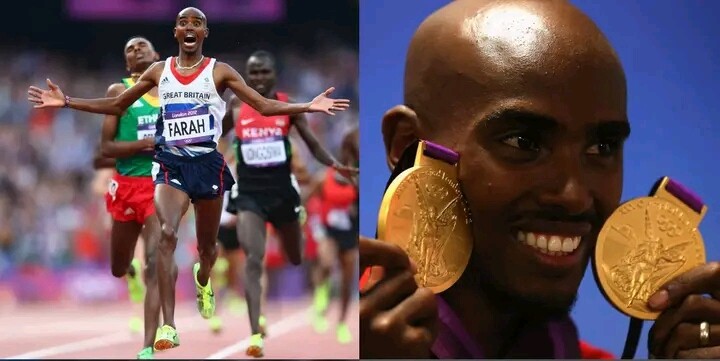
Farah had already secured the 10,000m title in Rio, but victory in the 5,000m delivered something even more significant. By successfully defending both Olympic distance titles he had won four years earlier in London, the British superstar became only the second man in history, after Finland’s Lasse Virén, to complete the remarkable Olympic “double-double” — winning the 5,000m and 10,000m at two successive Games.
His Olympic record was extraordinary.
At London 2012, Farah claimed gold in both the 10,000m and 5,000m, announcing himself as the dominant force in global distance running. Four years later in Rio, he repeated the feat, bringing his Olympic gold medal tally to four.
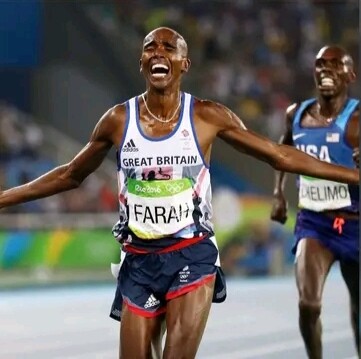
But Farah’s achievement extended far beyond the Olympic stage.
Between 2011 and 2015, he won six World Championship gold medals across the 5,000m and 10,000m, completing an unprecedented run of dominance. With his Olympic victories in London and Rio added to his World Championship success, Farah became the first man to successfully defend both distance titles at successive Olympic Games and World Championships — a remarkable achievement widely associated with the term “quadruple-double.”
His Rio campaign also produced one of the most memorable images of his career. After falling during the 10,000m final, Farah recovered, charged back into contention and ultimately retained his title, raising his arms in celebration before performing his trademark “Mobot.”
That moment captured the essence of Farah’s career: resilience, confidence, extraordinary endurance and an almost relentless ability to deliver when the stakes were highest.
For more than a decade, Mo Farah was synonymous with British distance running. He transformed major championships into his personal stage, accumulated titles across the biggest competitions in the sport and inspired millions with his distinctive celebrations and unmistakable competitive spirit.
Ten years after that historic night in Rio, the question is no longer whether Farah belongs among the greats. His record has already answered that.
The real debate is where he stands on the all-time list.
Four Olympic gold medals. Six World Championship gold medals. Two Olympic double-doubles. A career defined by championship dominance.
Mo Farah did not simply win races.
He created an era.
by Erick Cheruiyot for My Best Runs.
Login to leave a comment
From Track Rivals to Marathon Queens: Sifan Hassan and Hellen Obiri Renew Their New York Rivalry
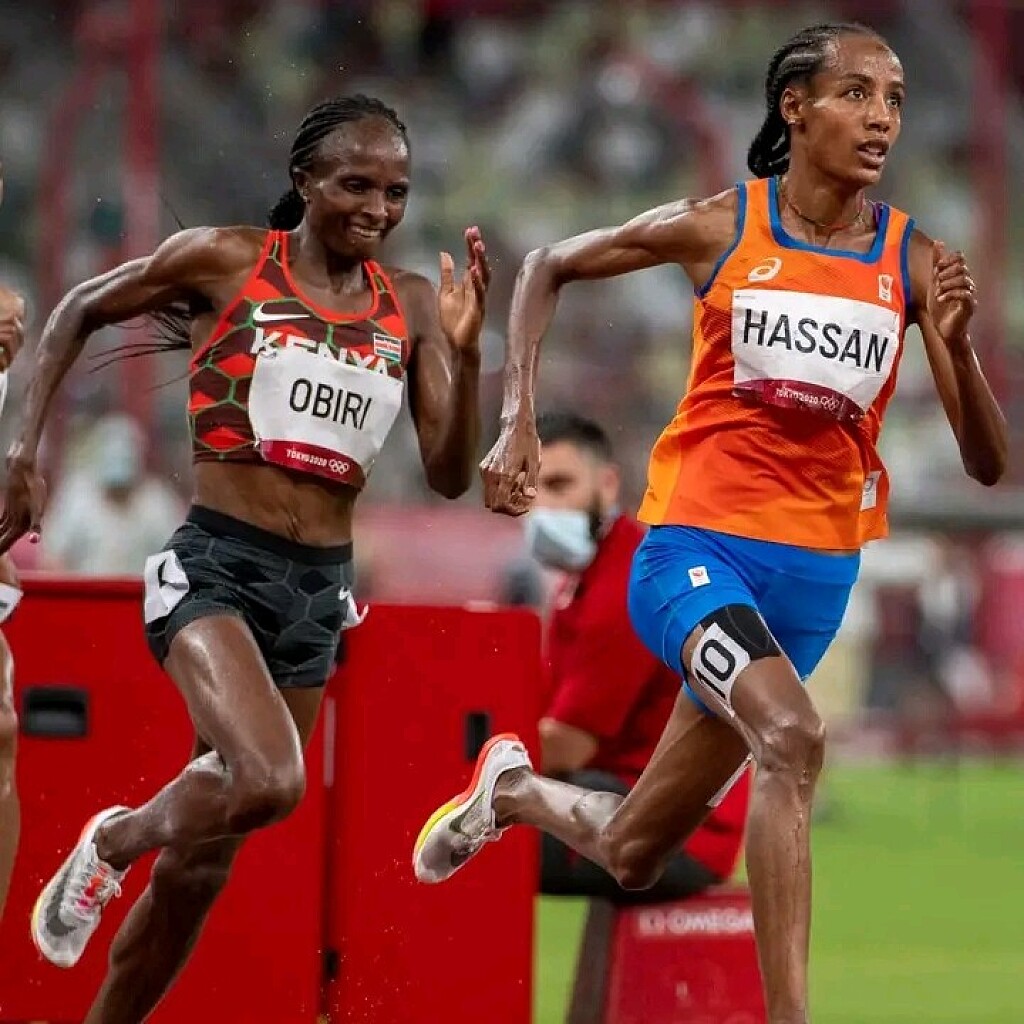
For more than a decade, Sifan Hassan of the Netherlands and Hellen Obiri of Kenya have been familiar opponents on the biggest stages of distance running. Their rivalry was forged on the track, where Hassan’s extraordinary versatility and finishing speed repeatedly collided with Obiri’s strength, tactical intelligence and championship pedigree.
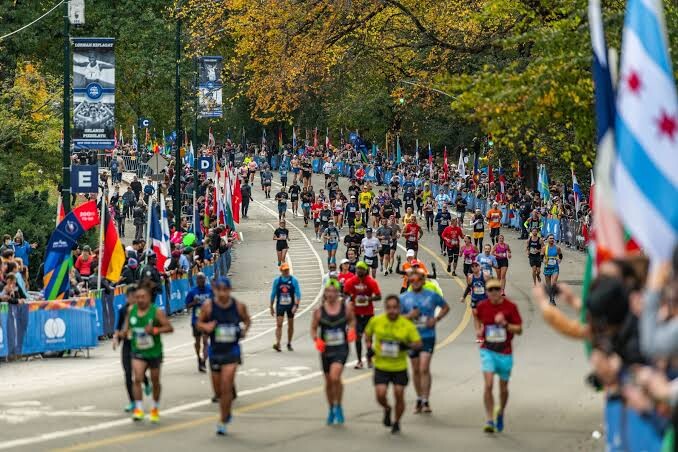
Now, after conquering different chapters of the sport, the two global stars are set to meet again on the streets of New York on November 1, 2026 — with another marathon crown at stake.
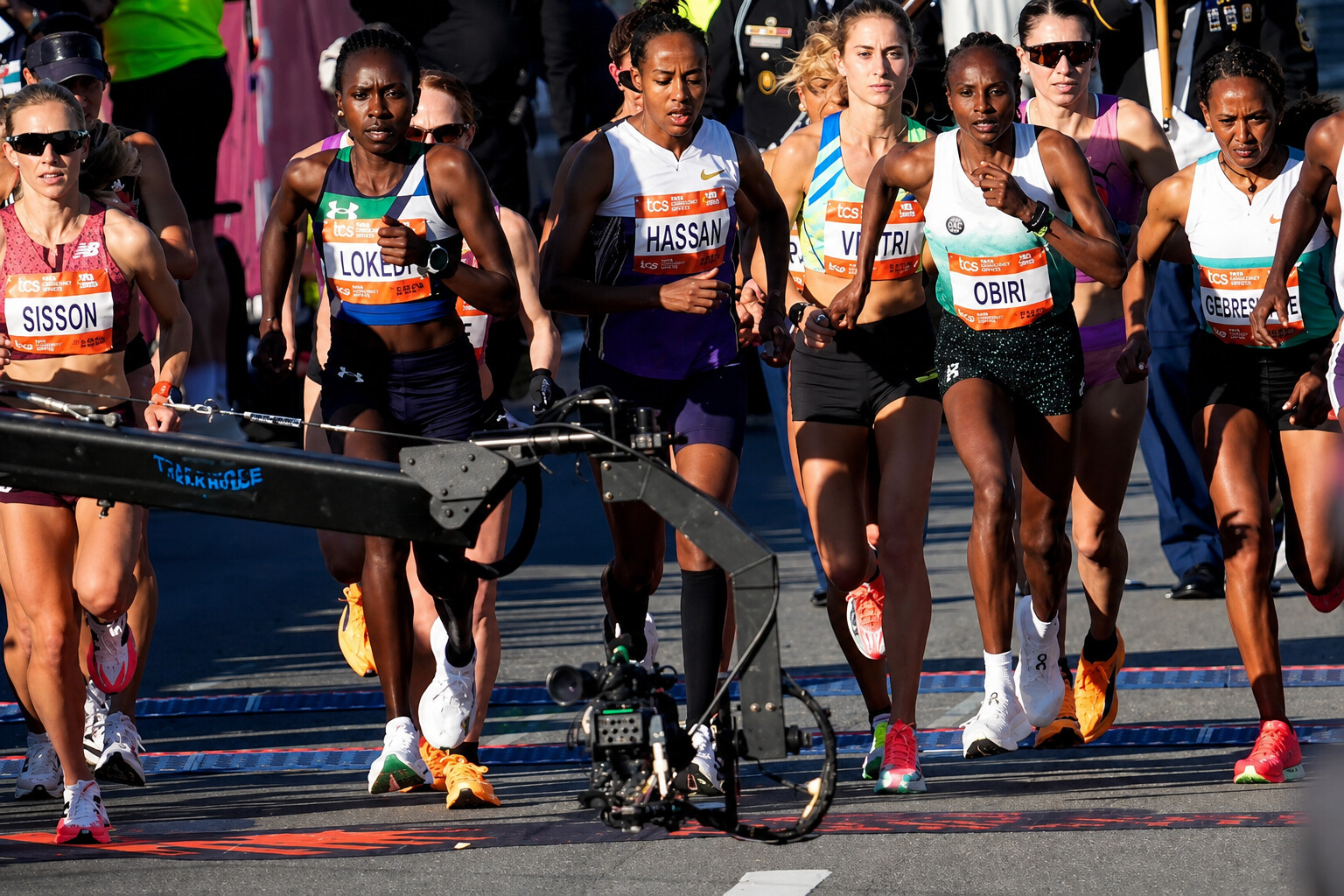
Their most memorable encounters came during the golden years of their track careers. At the Tokyo 2020 Olympics, Hassan defeated Obiri in a thrilling 5000m final, winning gold in 14:36.79 while Obiri took silver in 14:38.36. A year later, the two were again among the leading figures in the 10,000m at the 2022 World Championships in Oregon, where Obiri claimed silver and Hassan finished fourth.
But both athletes eventually turned their attention to the marathon, transforming a track rivalry into a new battle over 42.195 kilometres.
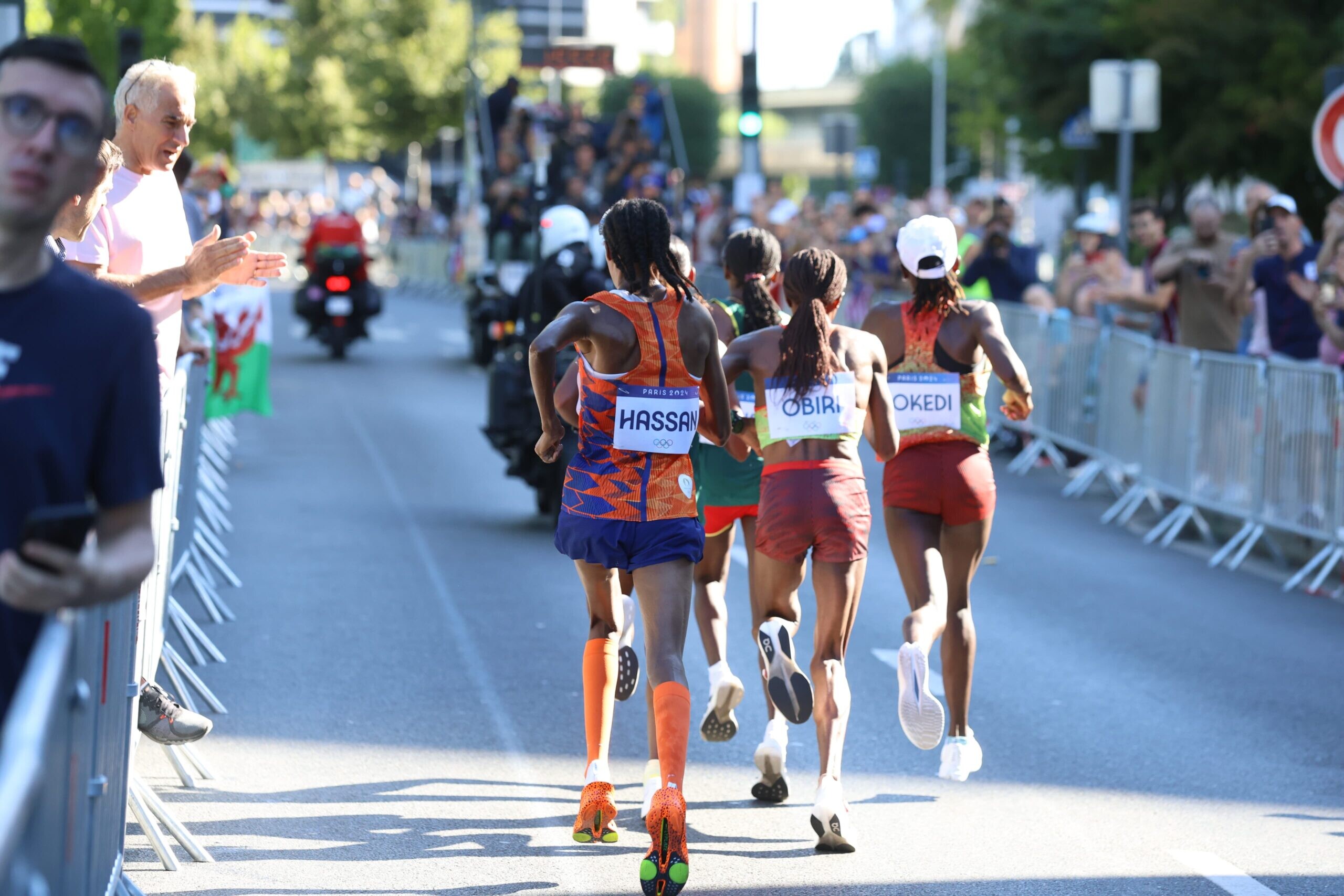
Hassan’s transition was extraordinary. After already establishing herself as one of the most versatile distance runners in history, she conquered the marathon at the Paris 2024 Olympics, winning gold and setting a personal best of 2:13:44 — a mark that remains significantly faster than Obiri’s current personal best.
Obiri, meanwhile, built her own formidable reputation on the roads. The Kenyan became a major force in the World Marathon Majors, winning the New York City Marathon in 2023 before returning to the top of the podium in 2025.
That 2025 New York race added another compelling chapter to the Hassan-Obiri rivalry.
Hassan made her New York debut but finished sixth in 2:24:43, while Obiri produced a commanding performance to win in 2:19:51. Her victory not only secured her second New York title but also shattered Margaret Okayo’s long-standing course record of 2:22:31.
The contrast could hardly be more intriguing heading into 2026.
Hassan owns the faster marathon personal best and the ultimate Olympic marathon prize. Obiri owns two New York titles and knows exactly how to master the famously demanding five-borough course. And the Kenyan has continued to strengthen her marathon credentials, running a personal-best 2:15:53 in London in 2026.
Hassan, meanwhile, returns to New York with unfinished business. After describing her 2025 debut as a physically punishing experience, she is preparing to tackle the course again, bringing the lessons of her first attempt and her vast championship experience with her.
This time, the stakes feel different.
There is history between them. There is unfinished business. And there is the intriguing question of whether Hassan’s superior lifetime speed over the marathon distance can finally translate into victory on the streets where Obiri has already established herself as a two-time queen.
One athlete has Olympic marathon gold and a 2:13:44 personal best.
The other has two New York crowns and a course record that announced her arrival among the marathon elite in emphatic fashion.
When Hassan and Obiri line up together again in New York, it will be more than another World Marathon Major showdown. It will be the latest chapter in a rivalry that began with championship battles on the track and has now evolved into one of the most compelling confrontations in women’s marathon running.
Track rivals. Olympic champions. Marathon queens.
On November 1, New York gets the next chapter.
by Erick Cheruiyot for My Best Runs.
Login to leave a comment
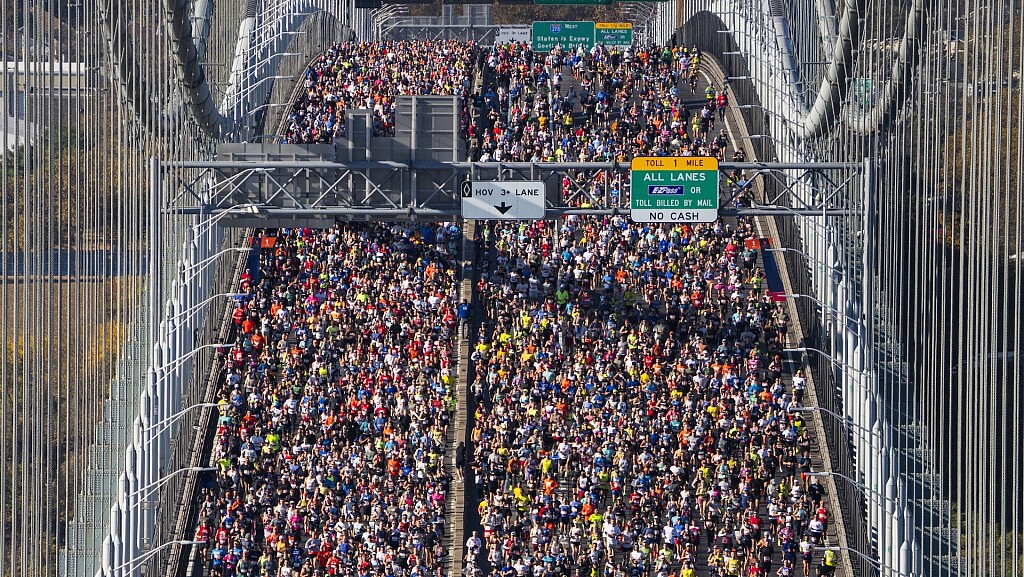
Three Rising Distance Stars Ready to Make Their Marathon Debuts at the 2026 New York City Marathon
The next generation of marathon talent will take centre stage on the streets of New York this November, with Weini Kelati of the United States, Andreas Almgren of Sweden and Kenya’s Patrick Kiprop all set to make their marathon debuts at the 2026 TCS New York City Marathon on November 1.
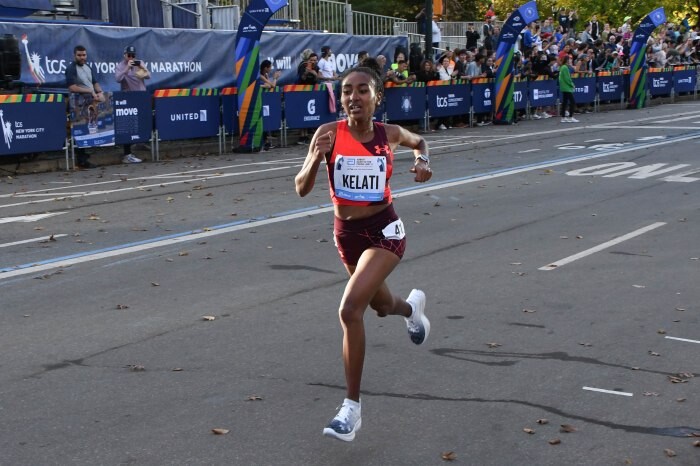
All three arrive in New York with impressive credentials built across track, cross country and shorter road races, creating one of the most intriguing groups of marathon debutants in this year’s field.
Kelati will enter the 26.2-mile challenge after establishing herself as one of America’s leading distance runners. The U.S. Olympian owns a 1:06:04 half-marathon personal best, an American record, and has already demonstrated the combination of endurance and speed required to compete at the highest level. Her transition to the marathon will be closely watched as she begins a new chapter in her career on one of the sport’s biggest stages.
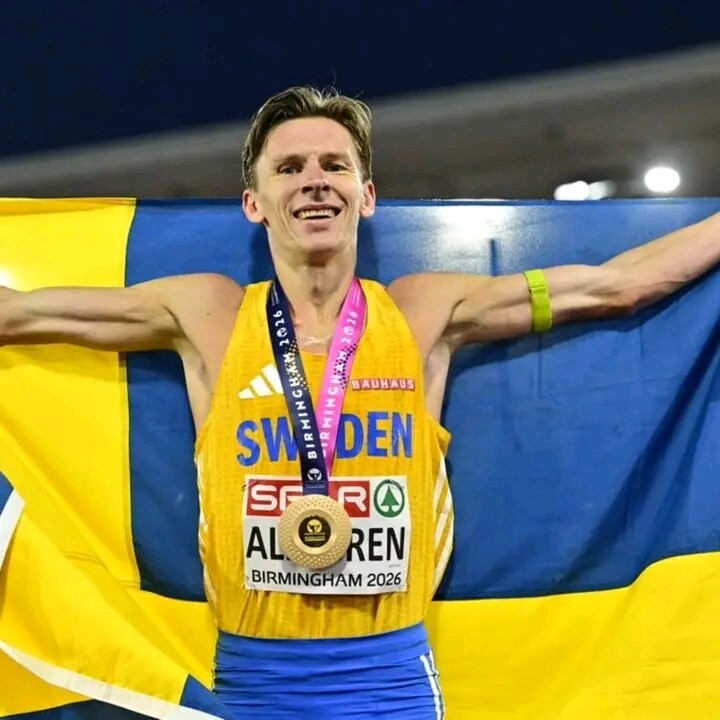
Almgren brings perhaps even more explosive speed to his first marathon. The Swedish star owns a remarkable 58:41 half-marathon personal best, a national and European record at the time it was achieved, while his track résumé includes world-class performances over 3,000m and 5,000m. His ability to sustain that extraordinary speed over 42.195 kilometres will be one of the central questions surrounding his New York debut.
Then there is Patrick Kiprop, who will carry Kenya’s hopes into his first marathon after building an impressive reputation during a decorated collegiate career in the United States.
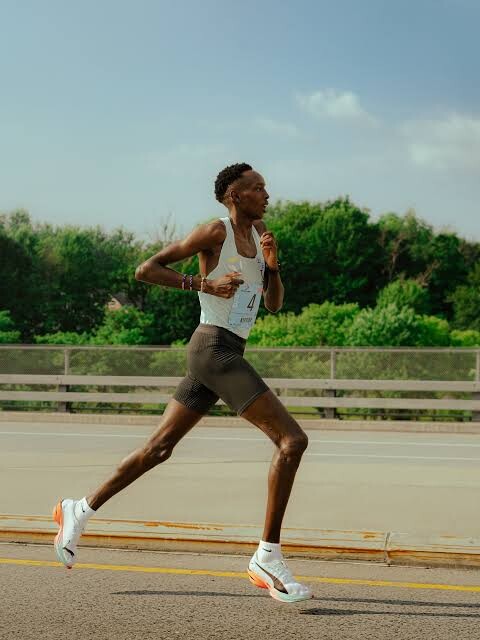
Kiprop enjoyed a standout spell with the Arkansas Razorbacks, collecting five First-Team NCAA All-America honours across cross country, indoor and outdoor track. He became a two-time NCAA South Central Region Cross Country champion in 2022 and 2023 before adding an SEC Outdoor 5,000m title in 2024 and a silver medal in the 10,000m.
He also etched his name into Arkansas history by breaking the university’s 5,000m school record. His American collegiate journey began at Fresno Pacific University, where he was named the Sunbird Male Newcomer of the Year in 2021 before transferring to Arkansas.
Following his collegiate success, Kiprop made the transition to professional running and joined the On Athletics Club Global, placing himself within one of the sport’s leading international training environments. His attention has increasingly shifted toward road racing, with the half marathon becoming an important bridge toward the marathon.
Kiprop has already shown that his speed can translate successfully to the roads, winning the professional division at the prestigious Bolder Boulder 10K. Now, New York presents a considerably bigger challenge and an opportunity to discover how his considerable distance-running ability translates to the full marathon.
For Kelati, Almgren and Kiprop, November 1 will represent more than simply another race. It will be the beginning of their marathon careers.
The New York City Marathon is notoriously demanding, combining multiple bridges, relentless changes in rhythm and a difficult closing stretch through Manhattan. Add enormous crowds and the pressure of a global audience, and the course provides an unforgiving introduction to 42.195 kilometres.
Yet that is precisely what makes these three debuts so fascinating.
Kelati arrives with American-record speed. Almgren brings European-record-level half-marathon credentials and extraordinary track ability. Kiprop brings a decorated NCAA background, Kenyan distance-running pedigree and growing experience on the roads.
None of them needs to prove that they possess speed. New York will determine whether they can transform that speed into marathon strength.
With an already star-studded 2026 field, the arrival of these three rising stars adds another compelling storyline to race day.
The future of marathon running is coming to New York—and on November 1, Kelati, Almgren and Kiprop will discover what they can do over 26.2 miles.
by Erick Cheruiyot for My Best Runs.
Login to leave a comment
TCS New York City Marathon
The first New York City Marathon, organized in 1970 by Fred Lebow and Vince Chiappetta, was held entirely in Central Park. Of 127 entrants, only 55 men finished; the sole female entrant dropped out due to illness. Winners were given inexpensive wristwatches and recycled baseball and bowling trophies. The entry fee was $1 and the total event budget...
more...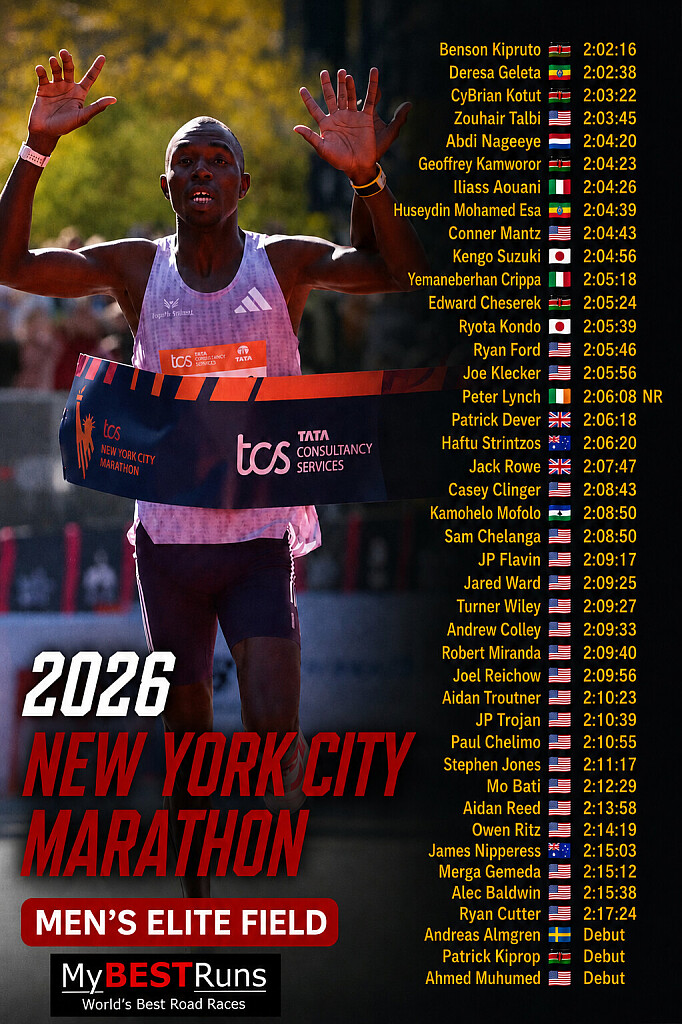
New York Marathon Set For Blockbuster Showdown As America’s Two Fastest Men Collide
The 2026 TCS New York City Marathon is shaping up to be one of the most anticipated editions in recent history, with New York Road Runners unveiling a remarkable men’s professional field that brings together the two fastest American marathoners ever on the same starting line.
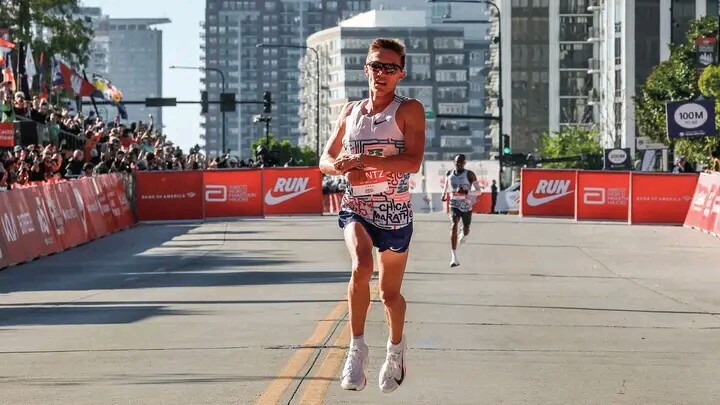
The race, scheduled for November 1, will feature American record-holder Conner Mantz (2:04:43) and Zouhair Talbi (2:03:45), whose performance at the 2026 Boston Marathon is the fastest marathon ever run by an American by clock time. However, because Boston is not a record-eligible course, Talbi’s mark does not replace Mantz’s official American record.
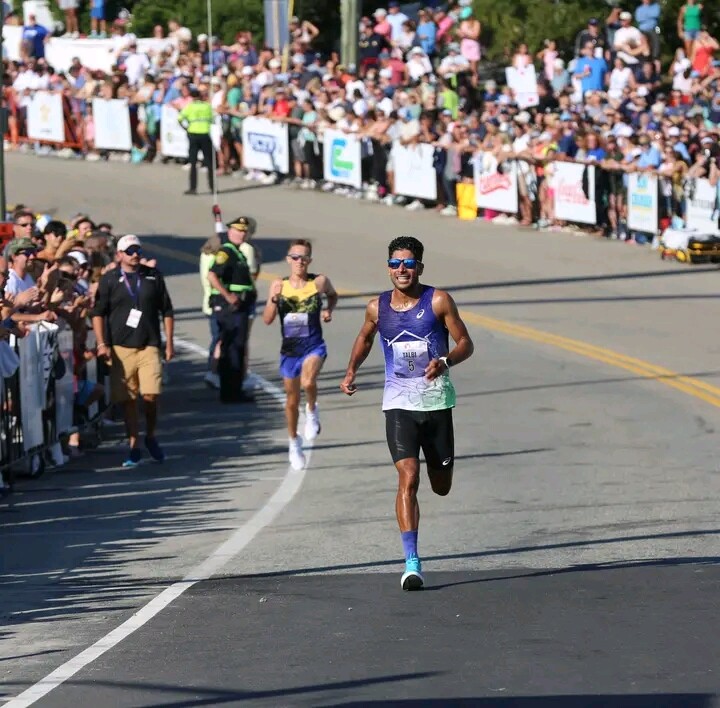
Mantz established the American record with his 2:04:43 fourth-place finish at the 2025 Chicago Marathon, breaking a national record that had stood since 2002. Talbi went even faster in Boston in April, crossing the line fifth in 2:03:45 and adding another extraordinary chapter to the rapid evolution of American marathon running.
That makes New York particularly intriguing. For the first time, the two men who occupy the top two positions on the all-time American marathon performance list will have the opportunity to race each other over a record-eligible course, with the streets of New York providing the stage.
And the American showdown will be only one part of a much bigger battle.
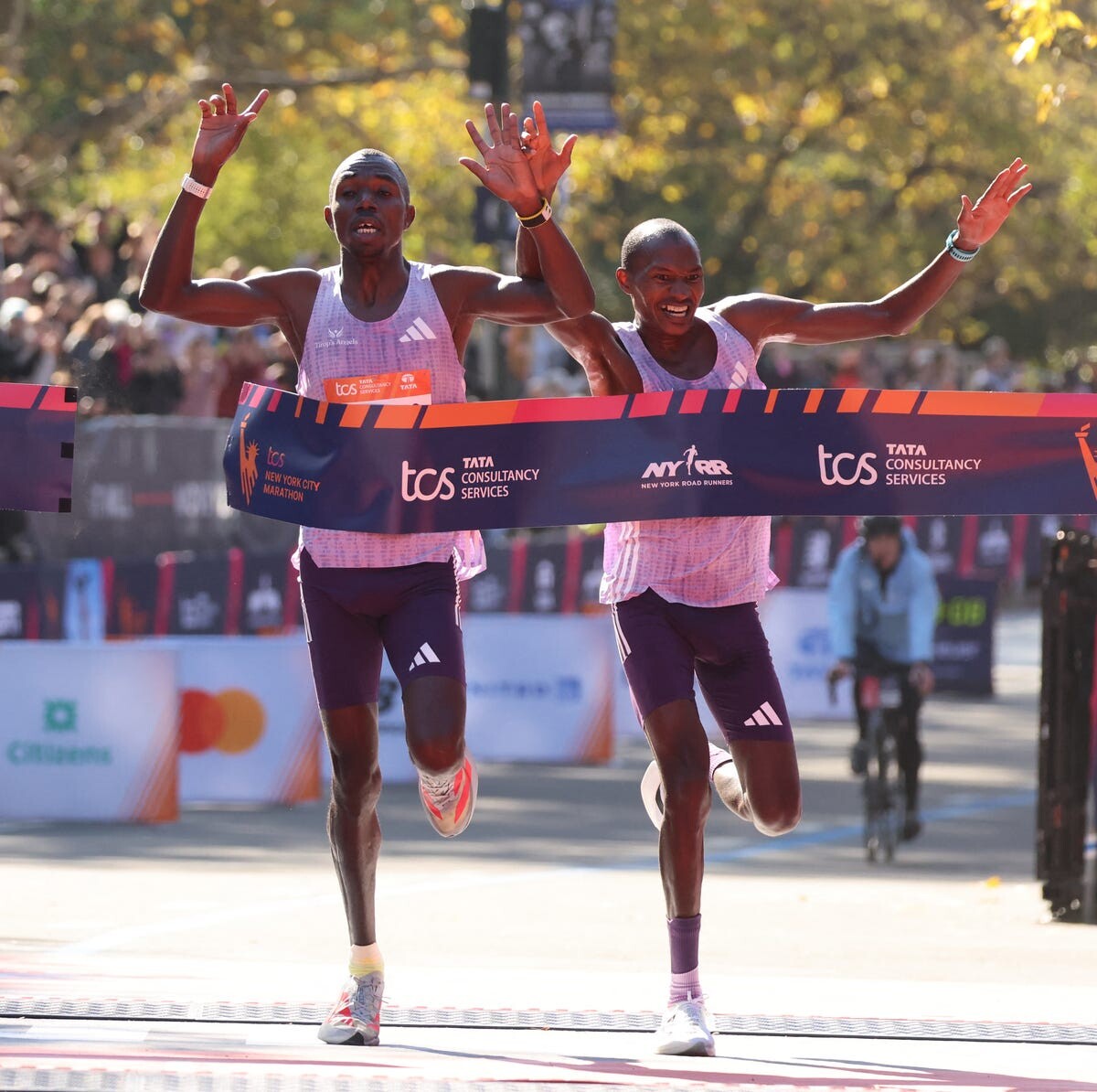
The international challenge is formidable. Defending champion Benson Kipruto (2:02:16) leads the field, followed by Ethiopia’s Deresa Geleta (2:02:38) and Kenya’s CyBrian Kotut (2:03:22). The lineup also includes the Netherlands’ Abdi Nageeye (2:04:20), Kenya’s Geoffrey Kamworor (2:04:23), Italy’s Iliass Aouani (2:04:26) and Ethiopia’s Huseydin Mohamed Esa (2:04:39).
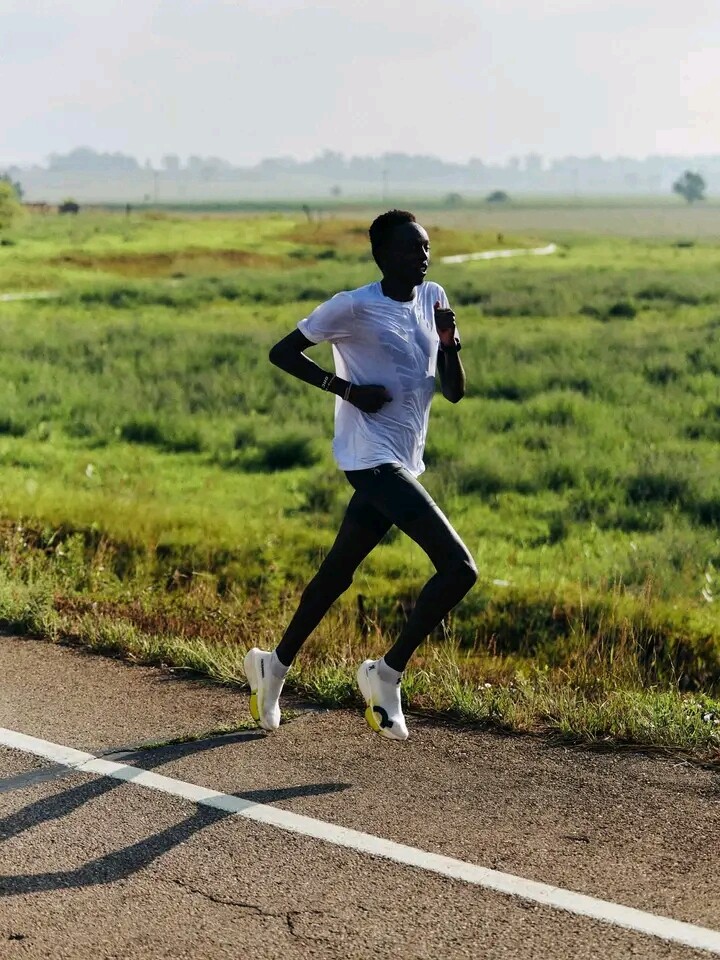
Just behind that group is Japan’s Kengo Suzuki (2:04:56), Italy’s Yemaneberhan Crippa (2:05:18), Kenya’s Edward Cheserek (2:05:24) and Japan’s Ryota Kondo (2:05:39). Ireland’s Peter Lynch (2:06:08), Great Britain’s Patrick Dever (2:06:18), Australia’s Haftu Strintzos (2:06:20) and Britain’s Jack Rowe (2:07:47) further strengthen a field that possesses extraordinary depth.
The American contingent is just as fascinating. Alongside Mantz and Talbi are Ryan Ford (2:05:46), Joe Klecker (2:05:56), Casey Clinger (2:08:43), Sam Chelanga (2:08:50), JP Flavin (2:09:17), Jared Ward (2:09:25), Turner Wiley (2:09:27), Andrew Colley (2:09:33), Robert Miranda (2:09:40) and Joel Reichow (2:09:56).
The depth continues with Aidan Troutner (2:10:23), JP Trojan (2:10:39), Paul Chelimo (2:10:55), Stephen Jones (2:11:17), Mo Bati (2:12:29), Aidan Reed (2:13:58), Owen Ritz (2:14:19), Merga Gemeda (2:15:12), Alec Baldwin (2:15:38) and Ryan Cutter (2:17:24). Australia’s James Nipperess (2:15:03) and Lesotho’s Kamohelo Mofolo (2:08:50) are also on the start list.
Three athletes will make their marathon debuts in New York: Sweden’s Andreas Almgren, Kenya’s Patrick Kiprop and American Ahmed Muhumed. Almgren, in particular, brings tremendous track credentials into his first attempt at 26.2 miles after winning the European 10,000m title in Birmingham in a championship-record 27:23.44.
The numbers tell the story of just how deep this field is. Ten men have personal bests faster than the existing New York City Marathon course record of 2:04:58, set by Tamirat Tola in 2023. Remarkably, Tola himself is not entered, nor is Alexander Mutiso, who finished runner-up to Kipruto in last year’s dramatic race.
For Mantz and Talbi, however, the stakes extend beyond the American record books. No American man has won the New York City Marathon since Meb Keflezighi in 2009, meaning the American contingent will arrive carrying a 17-year wait for another homegrown champion. Mantz and Talbi will have to overcome a formidable international field if either is to end that drought.
New York’s course will add another layer of difficulty. The bridges, sharp turns, rolling sections and notoriously demanding final miles toward Central Park have humbled some of the world’s fastest marathoners. Raw personal-best times will matter, but so will patience, positioning, tactical intelligence and the ability to produce a decisive move when the race reaches its most unforgiving stages.
With the official American record-holder, the fastest American by clock time, a defending champion, multiple 2:04 marathoners and a host of world-class contenders all converging on the Big Apple, the 2026 New York City Marathon has the ingredients of a classic.
On November 1, the streets of New York could become the setting for another extraordinary chapter in marathon history.
by Erick Cheruiyot for My Best Runs.
Login to leave a comment
TCS New York City Marathon
The first New York City Marathon, organized in 1970 by Fred Lebow and Vince Chiappetta, was held entirely in Central Park. Of 127 entrants, only 55 men finished; the sole female entrant dropped out due to illness. Winners were given inexpensive wristwatches and recycled baseball and bowling trophies. The entry fee was $1 and the total event budget...
more...
Faith Kipyegon Delivers Emotional Injury Update: “I’ll Be Back”
Kenyan athletics fans have been handed a worrying update from one of the country’s biggest sporting stars, with Faith Kipyegon revealing that her recovery from a hamstring injury will take longer than she had initially hoped.
The three-time Olympic champion and multiple world champion has been managing the injury for several weeks, and she has now made it clear that she will not rush her return to competition.
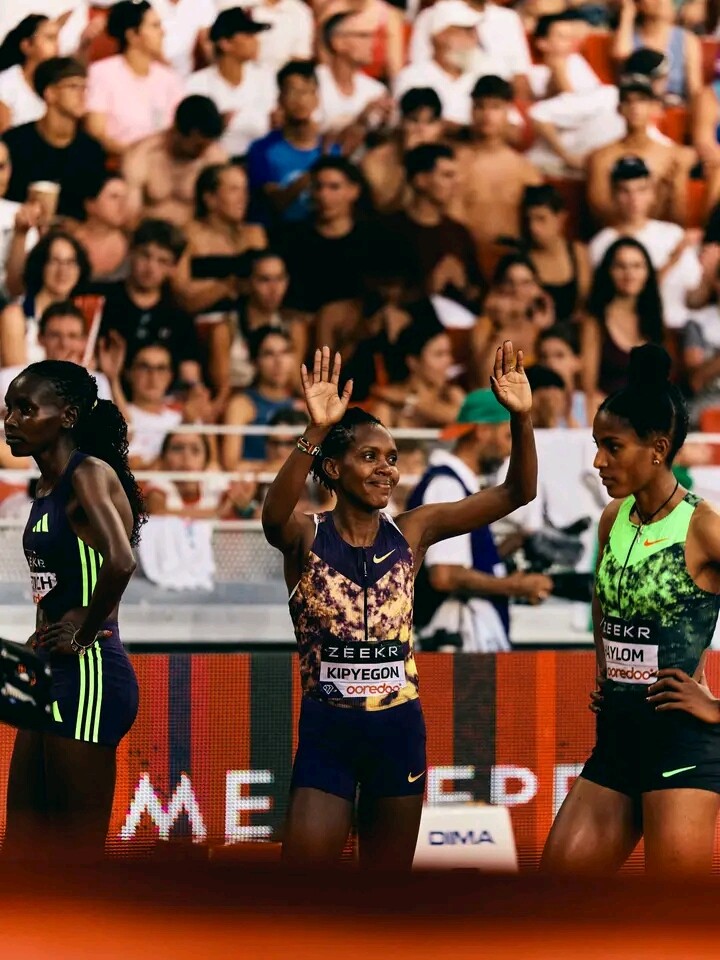
Kipyegon opened up about the setback in an emotional message to her followers, acknowledging the difficult balance elite athletes must maintain between pushing their bodies to the limit and protecting themselves from injury.
“As athletes, we ask a lot from our bodies. There is always a thin line between being fit and the risk of injury.”
The Kenyan superstar said she has been dealing with the hamstring problem since the end of May and admitted that the recovery process has proved slower than she anticipated.
“Since the end of May, I have been dealing with a hamstring injury and unfortunately it needs a bit longer to recover than I had hoped.”
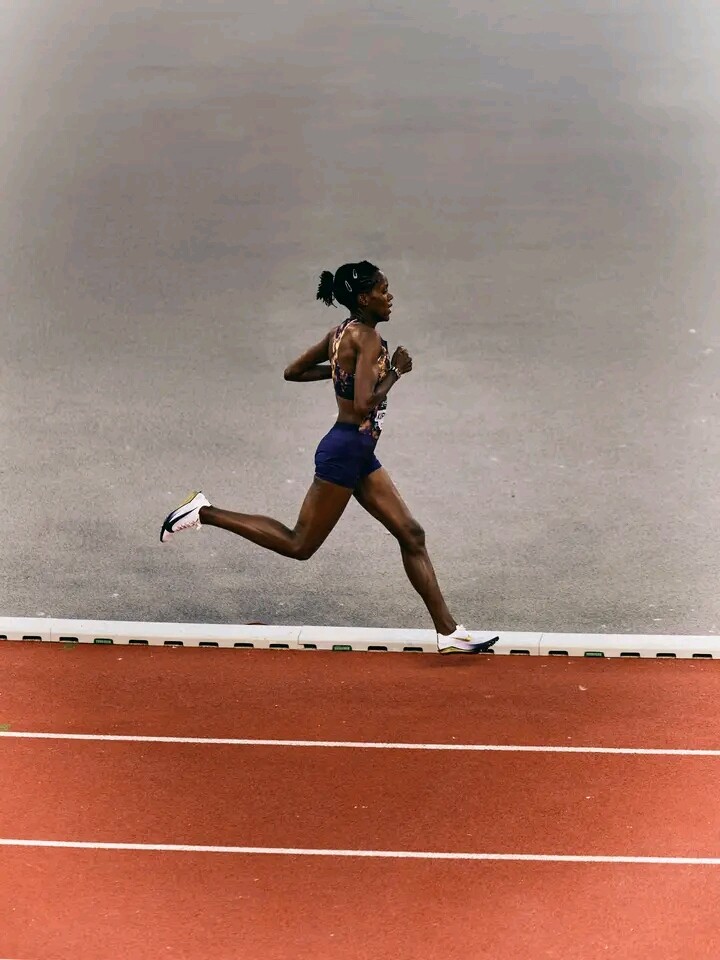
Rather than forcing an early comeback, Kipyegon has chosen to give her body the time it needs to heal properly. For an athlete accustomed to competing at the highest level and delivering spectacular performances on the biggest stages, the enforced break will undoubtedly be frustrating.
But the 32-year-old understands that patience now could be crucial to her long-term return.
“I know that taking care of it now is the most important thing I can do to come back at my best.”
Kipyegon’s decision is particularly significant given the extraordinary standards she has maintained throughout her career. She has dominated the women’s 1,500m for more than a decade, collecting Olympic and world titles while repeatedly rewriting the record books.
She currently owns the women’s world records for both the 1,500m and the mile. Her latest 1,500m world record of 3:48.68, set in Eugene in July 2025, made her the first woman to break 3:49 for the distance. Her mile world record stands at 4:07.64.
Her absence will nevertheless be felt across the athletics world. Kipyegon remains one of the defining figures of modern middle-distance running and one of Kenya’s most decorated athletes. Although she once held the women’s 5,000m world record, that mark now belongs to compatriot Beatrice Chebet, who ran 13:58.06 in Eugene in July 2025 to become the first woman to break 14 minutes over the distance.
For now, however, Kipyegon’s focus is firmly on recovery.
“So for now, I will take the time to heal, recover and get stronger. I’ll be back.”
Those final three words will resonate strongly with her supporters.
“I’ll be back.”
It is a simple message, but one that carries enormous weight. Kipyegon has built her career on resilience, discipline and an extraordinary ability to respond when expectations are at their highest.
This time, the challenge is different. There is no finish line to chase and no championship medal at stake—only the patience required to get her body right.
Kenyan fans may have to wait a little longer to see their champion back on the track, but Kipyegon’s message is unmistakable: the comeback has not been abandoned—it is simply being given the time it deserves.
by Erick Cheruiyot for My Best Runs.
Login to leave a comment
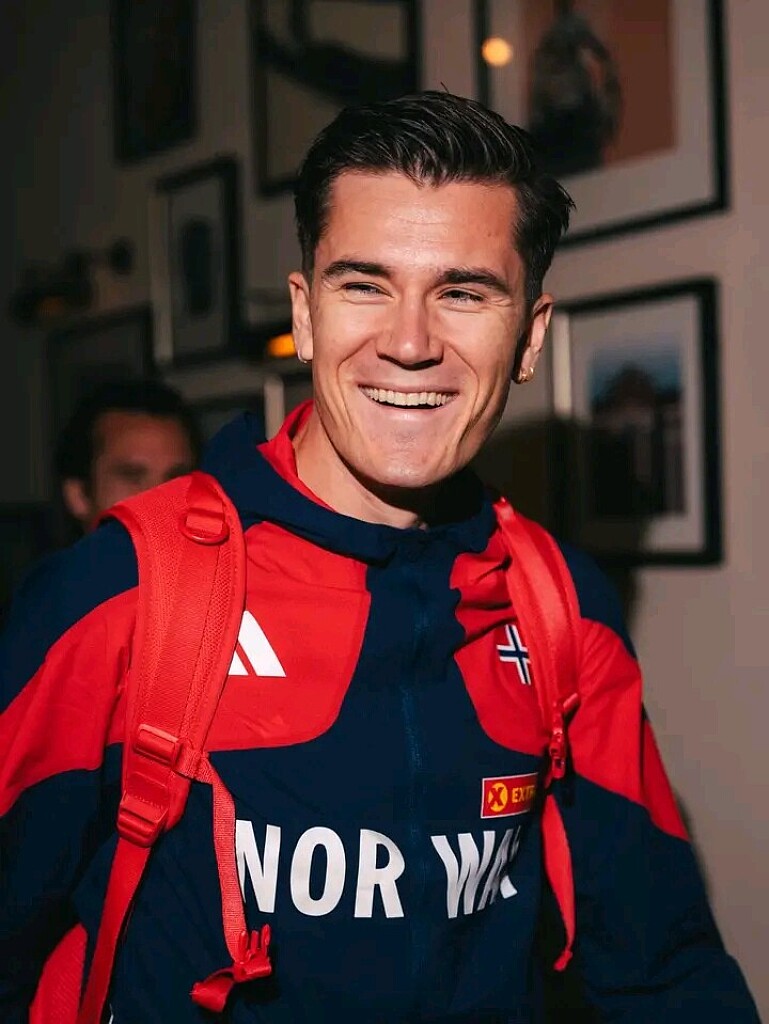
Jakob Ingebrigtsen Returns To Silesia: Can The Norwegian Reclaim The 1500m Throne?
Silesia has become a special chapter in Jakob Ingebrigtsen’s remarkable career, and on August 23, the Norwegian middle-distance superstar will return to the Diamond League with a question hanging over his comeback: can he return to the top of the 1500m?
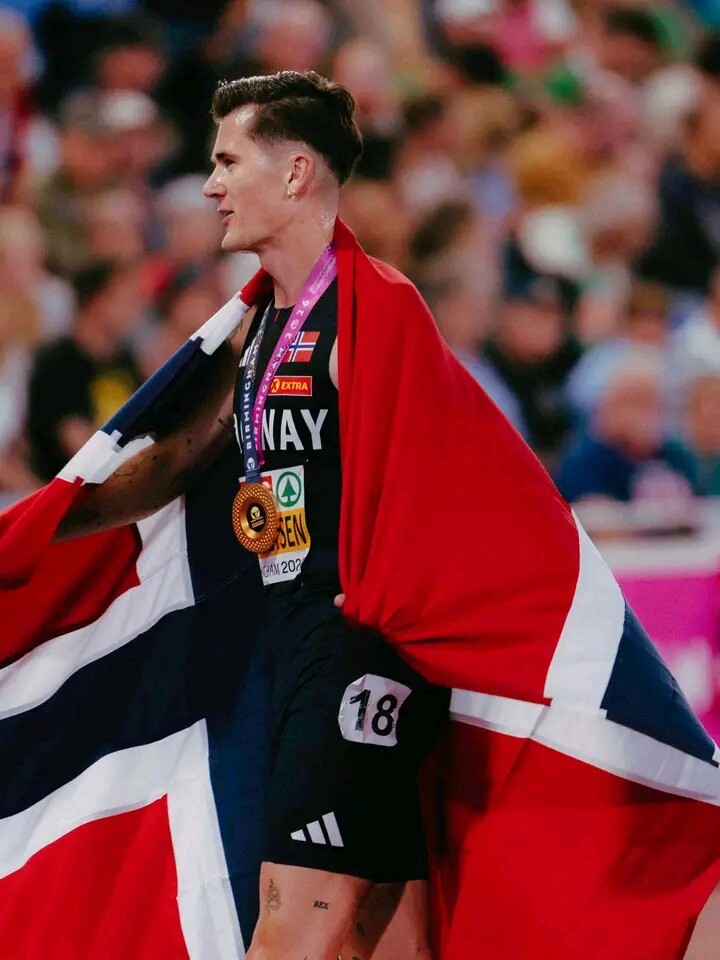
Ingebrigtsen is set to race his first 1500m since the 2025 World Athletics Championships, making his appearance at the Silesia Diamond League one of the most anticipated moments of the meeting.
The Norwegian’s return comes after a fascinating two-year stretch filled with major victories, record-breaking performances and unexpected setbacks.
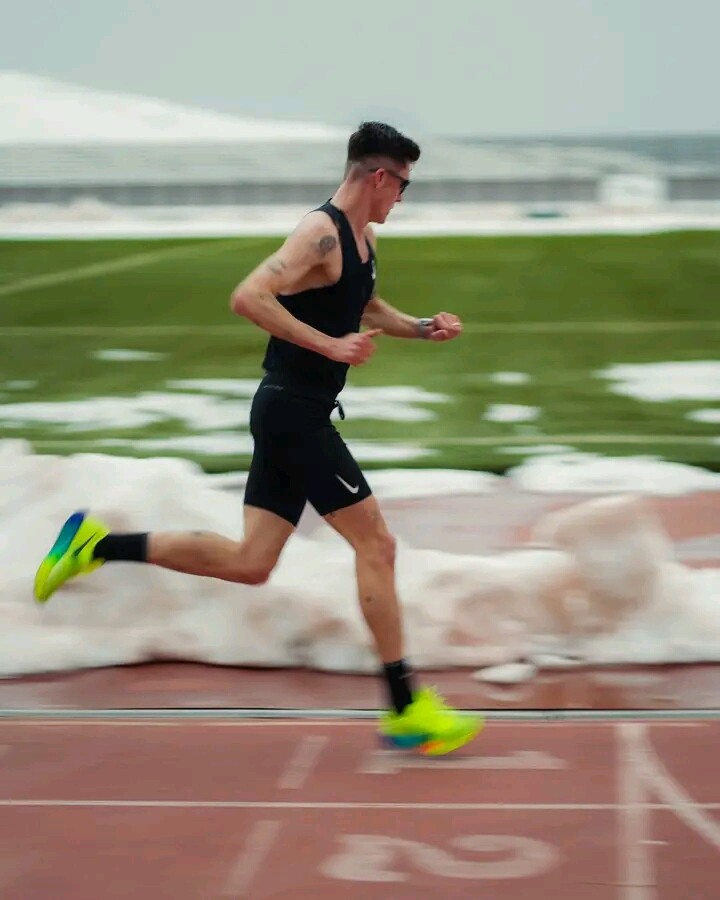
Since the 2024 Paris Olympics, Ingebrigtsen has experienced almost every side of elite middle-distance running. At the Paris Games, he finished fourth in the 1500m, narrowly missing the podium before quickly responding with a victory in the Diamond League Final later that year.
He then began 2025 in spectacular fashion, breaking the indoor mile world record before going on to claim the world indoor title in the 3000m.
However, his outdoor campaign brought a different challenge. At the 2025 World Championships, Ingebrigtsen failed to advance from the 1500m heats, bringing an unexpected early end to his campaign in the event.
Now, nearly a year later, the 25-year-old is ready to return to the distance that has defined so much of his career.
And Silesia could hardly be a more fitting place for his comeback.
The last time Ingebrigtsen raced at the Polish venue, he produced a performance for the history books. He stormed to 7:17.55 in the 3000m, destroying the 28-year-old world record and once again demonstrating his extraordinary ability to combine speed with endurance.
This time, however, the focus shifts back to the 1500m.
The race will offer Ingebrigtsen an opportunity to measure himself against the world’s best after an extended absence from the event. His tactical instincts, finishing speed and ability to handle a fast pace will all come under the spotlight.
For a runner who has spent years setting the standard in the 1500m, this is more than simply another Diamond League appearance. It is a chance to begin writing the next chapter.
Can Jakob Ingebrigtsen return to the top?
Silesia will provide the stage. August 23 will provide the answer.
by Erick Cheruiyot for My Best Runs.
Login to leave a comment
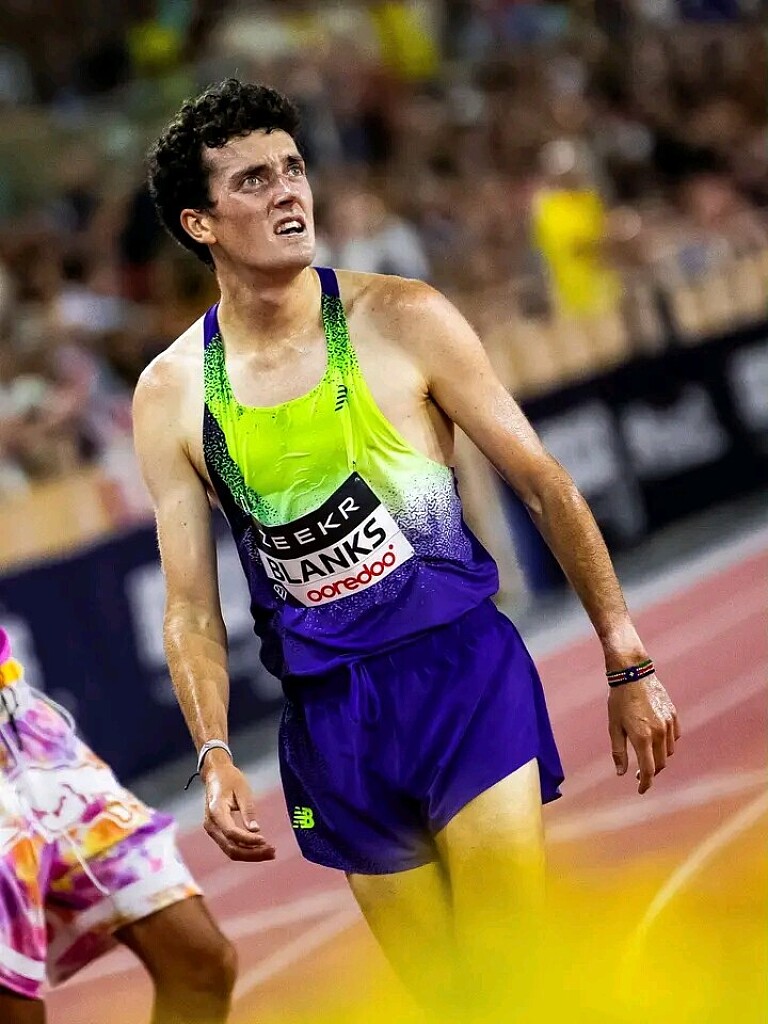
Americans Bring The Heat As Lausanne Diamond League Sets Up A Fierce 5000m Showdown
The Wanda Diamond League returns to action on Friday, August 21, and the men’s 5000m in Lausanne promises to be one of the evening’s most compelling distance races, with a strong American quartet ready to take on a deep international field.
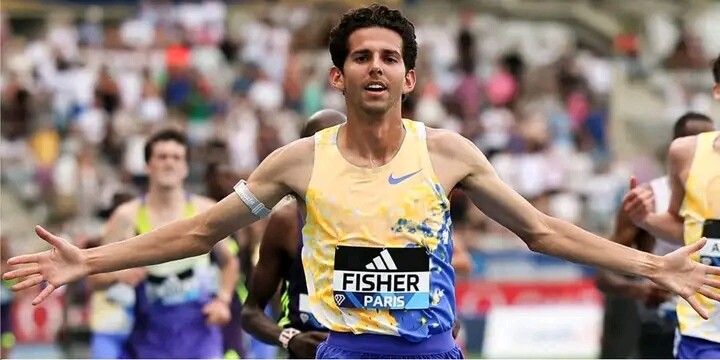
Graham Blanks, Grant Fisher, Parker Wolfe and Nico Young will carry the American challenge at Athletissima, where they will line up against a formidable group featuring athletes from Kenya, Ethiopia, Bahrain, Eritrea, Burundi, Switzerland, Uruguay, Slovenia and Mexico.
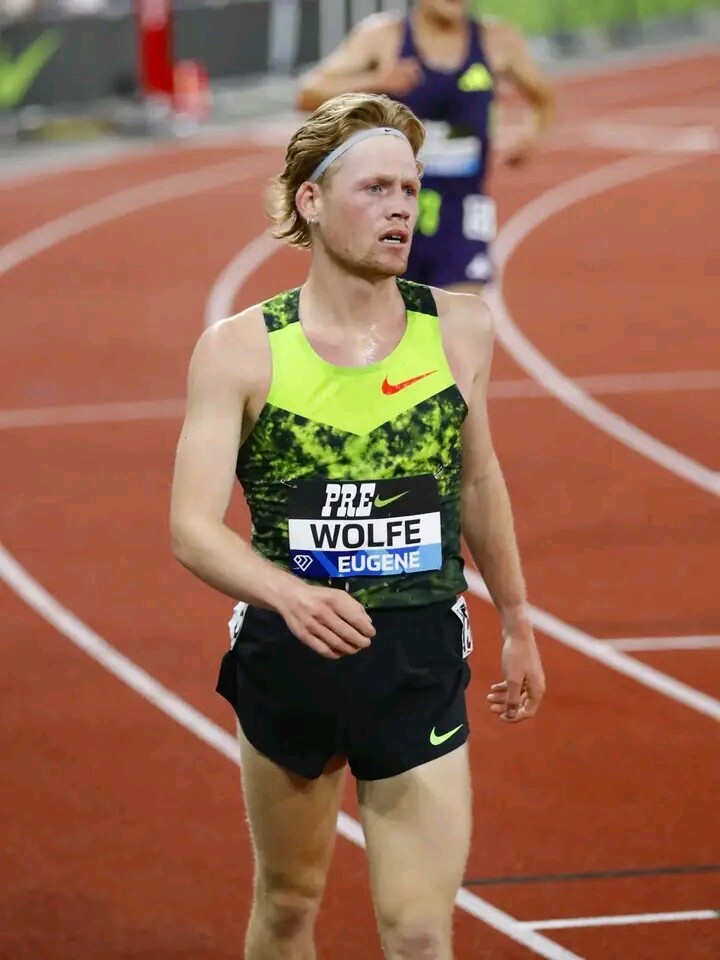
The Lausanne meeting marks an important point in the 2026 Diamond League campaign, with the Road to the Final entering its decisive stages ahead of the series finale in Brussels on September 4-5. Lausanne is followed just two days later by the Silesia meeting, before the series heads to Zurich for the final regular-season stop.
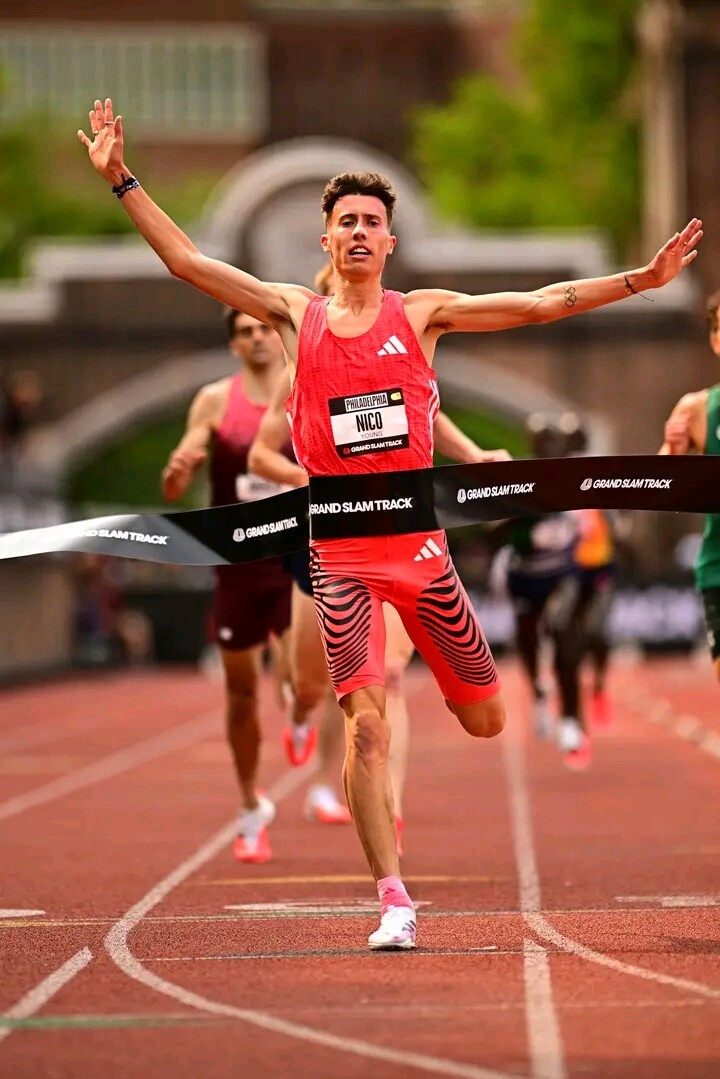
Fisher arrives as one of the most established names in the field. The American Olympic bronze medallist has already produced a 12:49.61 season best over 5000m in Oslo and also won the 3000m in Paris earlier this season. His experience at the highest level makes him a major contender when the pace accelerates over the closing laps.
Blanks is another American to watch closely. Ranked among the leading 5000m athletes in the world, he has continued to establish himself as one of the United States’ most exciting young distance runners. World Athletics’ rankings placed him eighth globally in the event as of July 26, with Fisher sixth.
Wolfe and Young add further depth to an American lineup that could make the race particularly tactical. With four athletes capable of competing at a high level, the United States will have several cards to play as the race develops.
But the Americans will have no easy path to victory.
Bahrain’s Birhanu Balew headlines the international opposition and entered the season among the world’s highest-ranked 5000m runners. Kenya will be represented by Jacob Krop, Edwin Kurgat, Cornelius Kemboi, Charles Kiboina, Mathew Kipchumba Kipsang and Laban Kiptoo Kosgei, giving the race a powerful Kenyan presence.
Ethiopia also brings considerable strength, with Khairi Bejiga, Kuma Girma, Shimelis Niguse, Mezgebu Sime and Getnet Wale all listed in the field. Eritrea’s Abderezak Suleman, Burundi’s Egide Ntakirutimana, Switzerland’s Dominic Lokinyomo Lobalu, Uruguay’s Santiago Catrofe, Slovenia’s Žan Rudolf and Mexico’s Eduardo Herrera complete a truly international lineup.
The Lausanne 5000m is therefore shaping up as much more than an American showcase. It is a meeting of contrasting strengths: American depth, Kenyan distance tradition, Ethiopian endurance and a collection of international contenders eager to make their mark on one of the sport’s biggest stages.
With the Diamond League season moving rapidly toward its final stretch, every position and every point carries added importance. The question now is whether the American quartet can convert its collective strength into a victory—or whether the international field will once again prove too deep to control.
One thing is certain: when the Lausanne 5000m gets underway, the pace is expected to be hot, the competition fierce and the final laps unforgettable.
by Erick Cheruiyot for My Best Runs.
Login to leave a comment
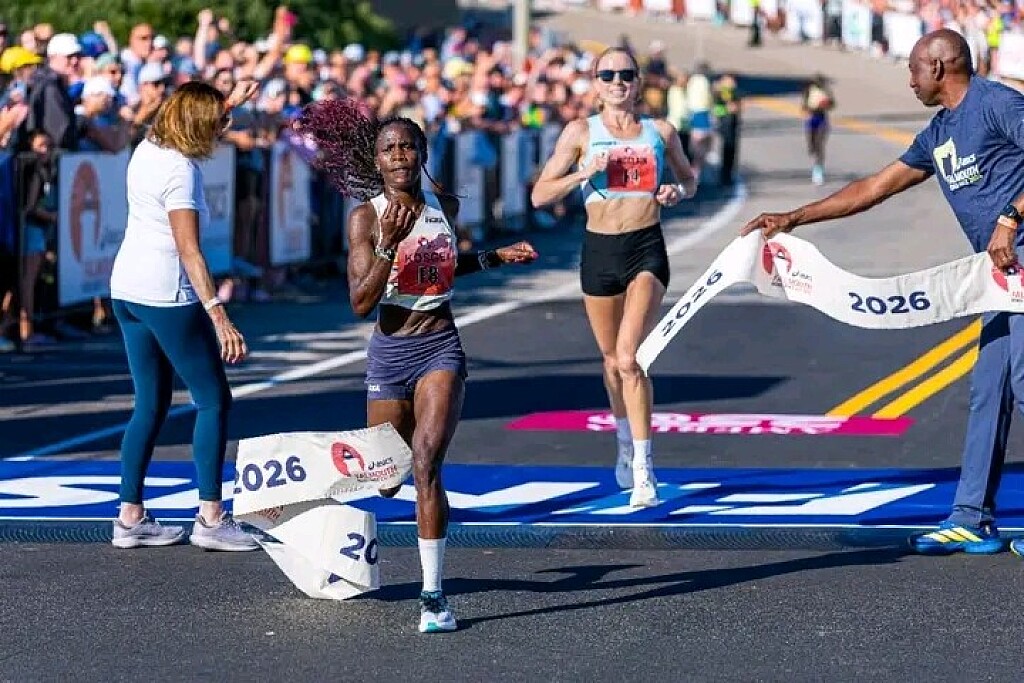
Pamela Kosgei Triumphs In Thrilling Falmouth Road Race 7-Mile Finish
Pamela Kosgei delivered a breathtaking performance to capture the 2026 Falmouth Road Race 7-mile title, producing a perfectly timed finish to edge American challenger Jessica McClain in a dramatic battle that went right down to the wire.
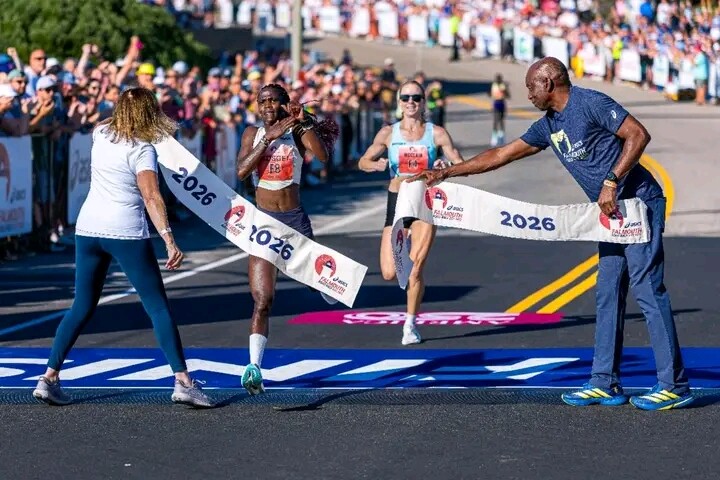
Kosgei and McClain both stopped the clock at 35:25, but the Kenyan had just enough of an advantage at the finish to secure the coveted victory. It was a remarkable display of composure and determination, with neither athlete willing to surrender an inch in the closing stages of the seven-mile contest.
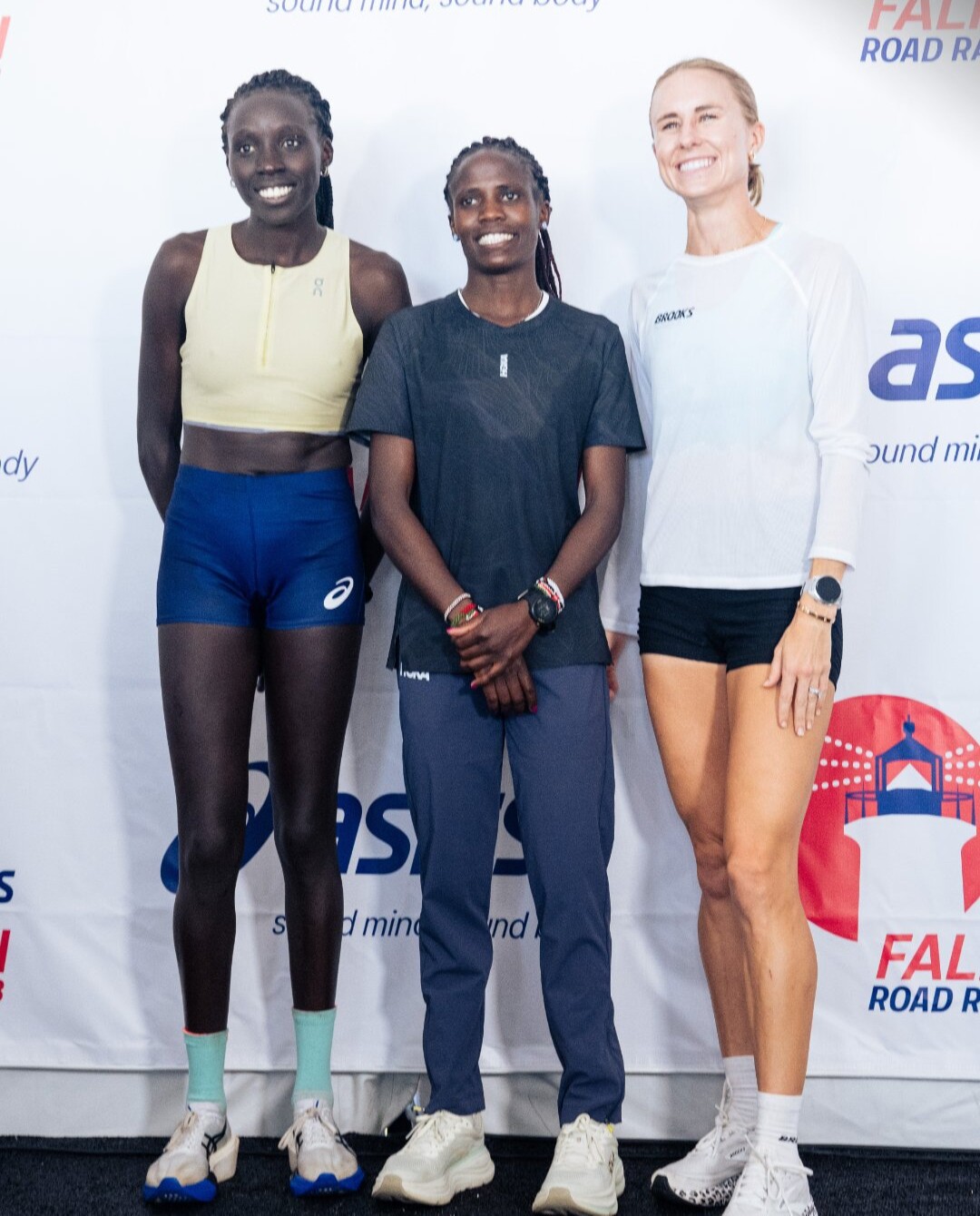
The victory adds another impressive chapter to what has already been a remarkable rise for Kosgei. At the 2025 Outdoor NCAA Championships, she captured both the 5000m and 10,000m titles, earning valuable points for the University of New Mexico Lobos during her freshman campaign. Her success on the track has now translated beautifully onto the roads.
Remarkably, Kosgei has only recently begun testing herself over the roads. Making her road debut just a few weeks ago, she announced herself in emphatic fashion by winning the Beach to Beacon Road Race. She then carried that winning momentum into Falmouth, producing another confident performance against a strong international field.
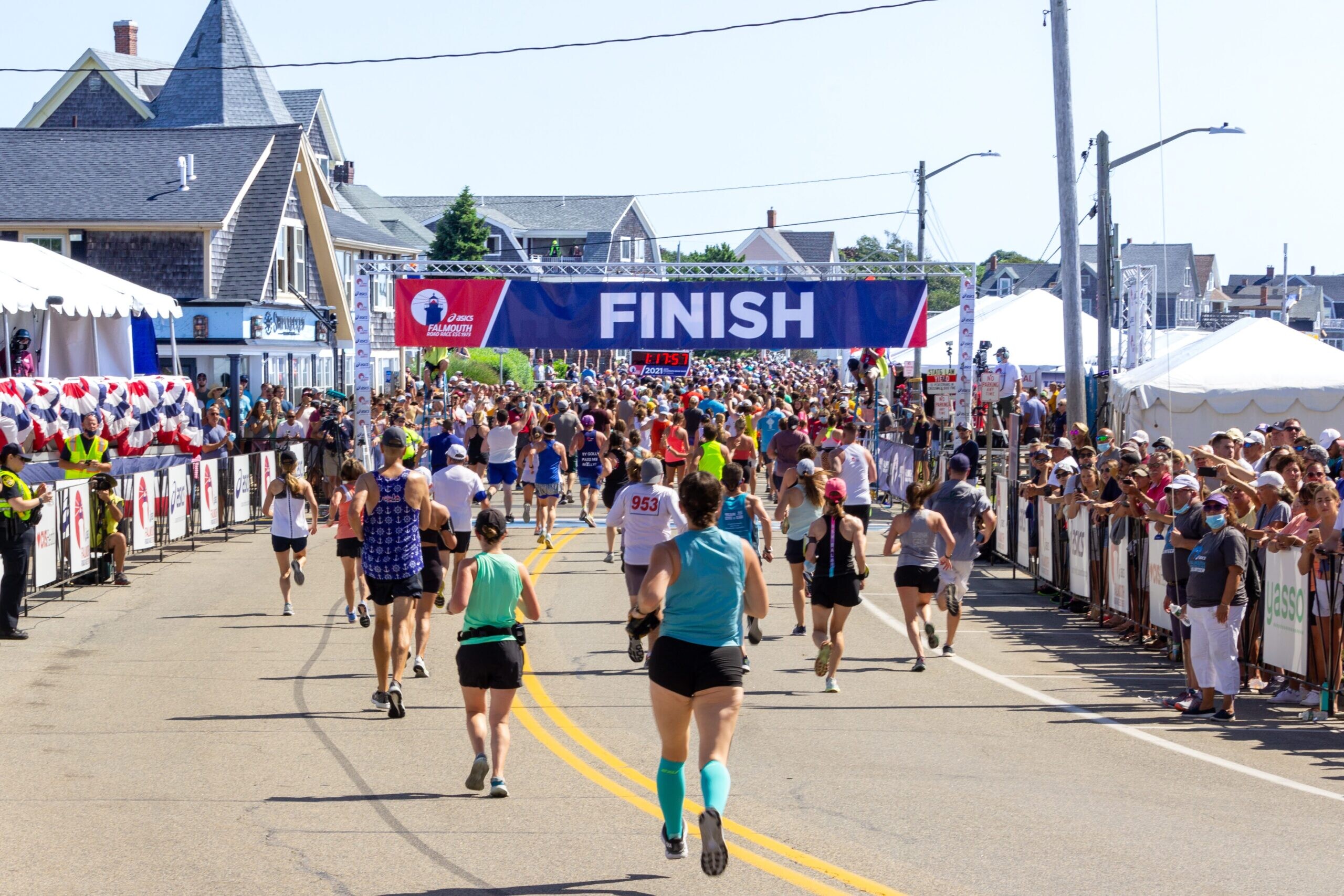
The Kenyan triumph was made even sweeter by Everlyn Kemboi, who stormed into third place in 35:34, giving Kenya a powerful double presence on the podium. Behind them, America's Emma Grace Hurley produced a solid run to finish fourth in 35:36, while Kenya's Mercy Chelangat completed the top five in 35:55.
Kosgei's rise also carries a remarkable family legacy. Her older sister, Brigid Kosgei, is an Olympic silver medallist in the marathon and a former marathon world-record holder. With Pamela now making her own mark across the track and roads, the Kosgei name continues to shine brightly in elite distance running.
It was a race filled with speed, suspense and relentless determination, with the leading athletes separated by only seconds. Kosgei's victory was ultimately forged through her ability to remain composed under immense pressure and produce the decisive effort when it mattered most.
The victory also carried a special touch of excellence, as Kosgei stood proudly at the summit while McClain and Kemboi strengthened the depth among the leading finishers. Together, the performances painted a beautiful picture of determination, resilience and the unmistakable fighting spirit that continues to make distance running so captivating around the world.
For Kosgei, this was more than simply another road-racing victory. It was a statement of strength, resilience and competitive maturity on an international stage. From NCAA champion to emerging road-racing star, her rapid transition has been nothing short of impressive—and Falmouth may only be the beginning of an exciting new chapter.
Top 5 Finishers
1. Pamela Kosgei — Kenya — 35:25
2. Jessica McClain — USA — 35:25
3. Everlyn Kemboi — Kenya — 35:34
4. Emma Grace Hurley — USA — 35:36
5. Mercy Chelangat — Kenya — 35:55
With a thrilling finish, the Falmouth Road Race once again showcased the beauty and competitiveness of elite distance running, bringing together determined athletes from different backgrounds and nations. Kosgei's victory, McClain's fierce challenge and the strong performances throughout the field combined to create a memorable contest that will linger long after the finish line.
by Erick Cheruiyot for My Best Runs.
Login to leave a comment

Falmouth Road Race
The Falmouth Road Race was established in 1973 and has become one of the premier running events of the summer season. Each year the race draws an international field of Olympians, elite runners and recreational runners out to enjoy the scenic 7-mile seaside course. The non-profit Falmouth Road Race organization is dedicated to promoting health and fitness for all in...
more...
Michael Roeger’s Long Road Back to the Marathon World Record — and Now Sydney Awaits
On August 30, approximately 35,000 runners will line up at Miller Street in North Sydney for the 2026 TCS Sydney Marathon. Among them will be an athlete who already owns a piece of marathon history: Michael Roeger, the Australian T46 marathon world-record holder and one of the most remarkable endurance athletes of his generation.
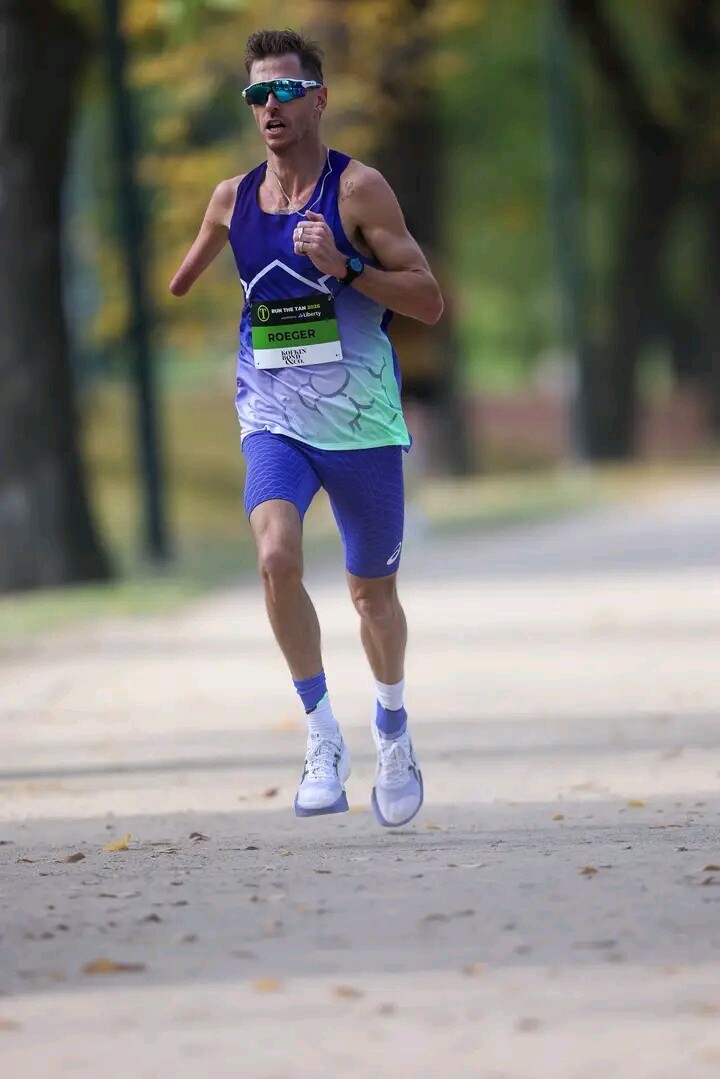
At 38, Roeger returns to the marathon with a career shaped by persistence, reinvention and an extraordinary ability to keep moving forward whenever circumstances have threatened to derail him.
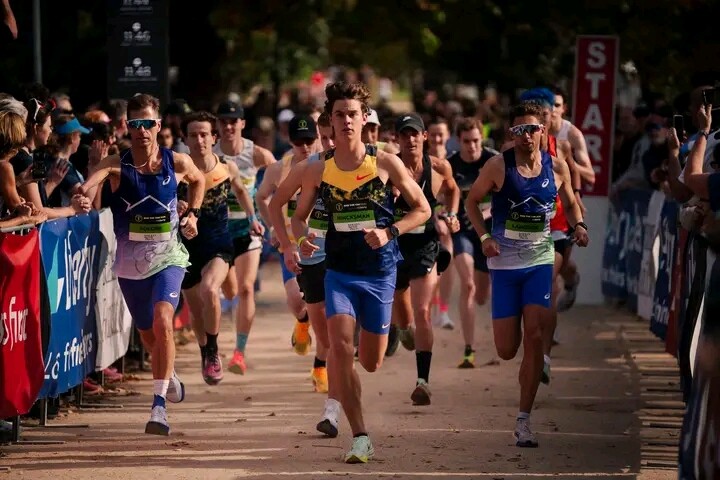
Sydney is a fitting stage for the next chapter. The marathon, now part of the Abbott World Marathon Majors, takes runners through some of the city's most recognisable landmarks, beginning in North Sydney, crossing the Harbour Bridge and eventually finishing near the Opera House. For Roeger, however, this is about far more than another marathon.
He is returning to the distance in the city where he set the fastest T46 marathon ever recorded.
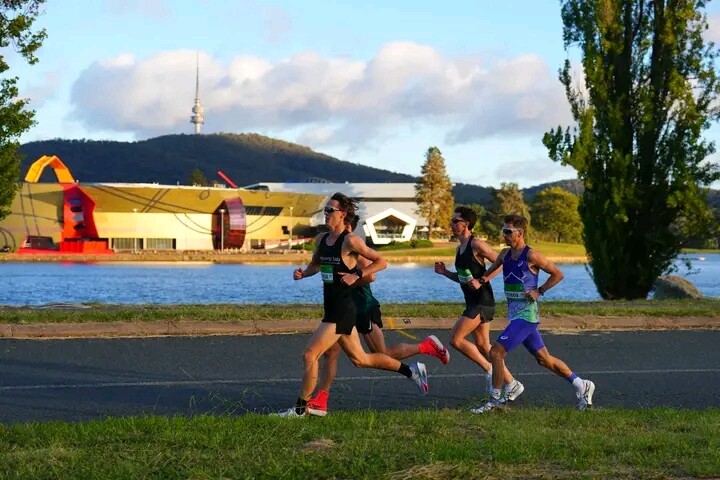
Roeger grew up in Langhorne Creek, a small South Australian community about 55 kilometres south of Adelaide. Born without the lower half of his right arm, he discovered Para athletics after Paralympian Neil Fuller visited his school when Roeger was 12.
What began as an introduction to sport eventually developed into a career spanning five Paralympic Games, world championships, major medals and multiple world records.
His T46 classification covers athletes with an arm amputation or comparable upper-limb difference. Yet describing Roeger's performances simply through his classification fails to capture the complexity of what he has achieved.
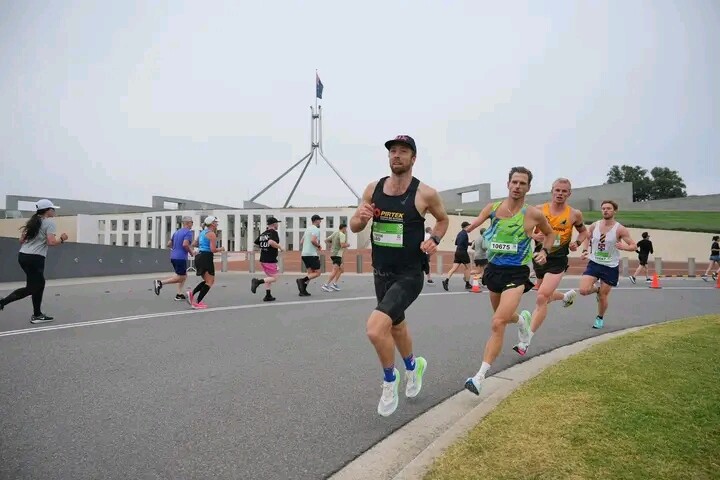
Running is an intricate coordination of the entire body. The arms contribute to balance, rhythm and control, helping the torso manage the rotational forces created by every stride. Over 42.195 kilometres, maintaining efficient movement is an enormous physical and technical challenge.
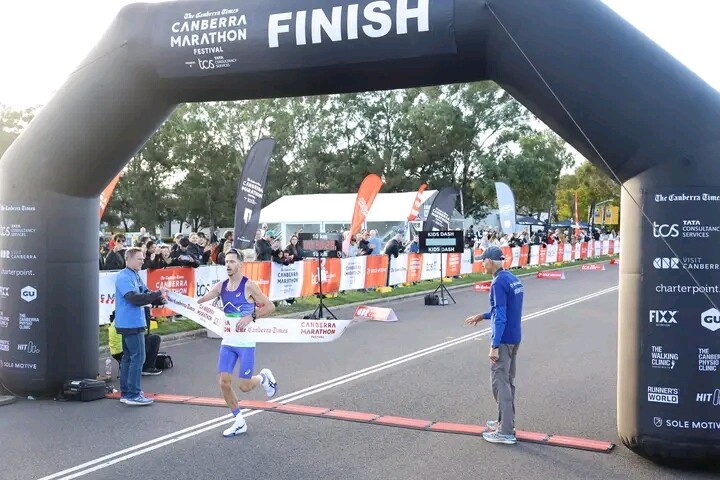
Roeger's marathon performances therefore represent much more than a number attached to a classification. They are elite endurance performances in their own right.
His transition to the marathon was remarkably rapid. Roeger made his marathon debut at the Melbourne Marathon in October 2018, running 2:23:31. The performance was faster than the existing T46 world record at the time, although it was not ratified as a world record because the race did not have the necessary status.
Six months later, he returned to the distance at the 2019 London Marathon, where the World Para Athletics Marathon Championships were staged within the race.
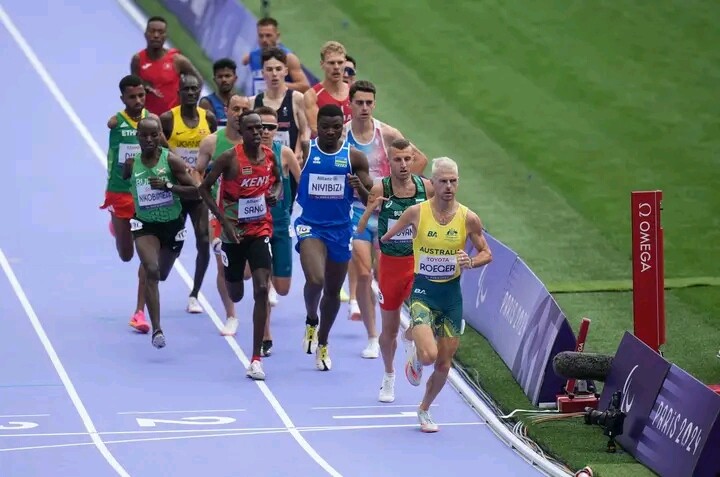
This time, everything came together.
Roeger won the T46 world title in 2:22:51, lowering the ratified world record and establishing himself as the world's leading marathoner in the classification. Even when cramp began to trouble him during the closing stages, he held on to become a world champion.
The progression continued.
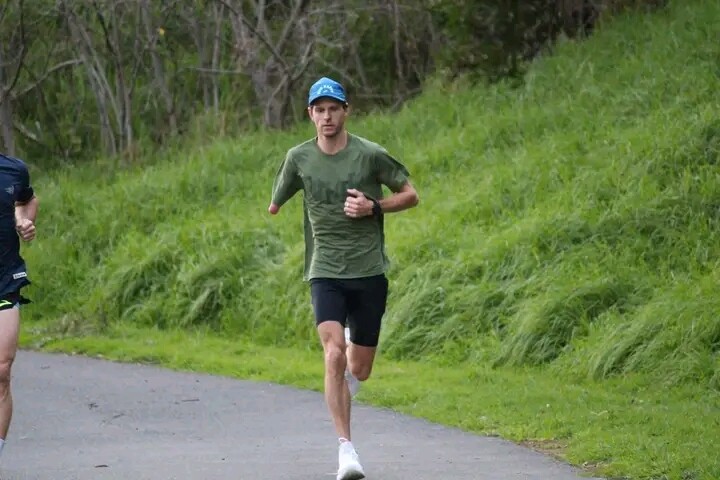
At the 2020 Chevron Houston Marathon, Roeger ran 2:19:33, becoming the first ambulant Para athlete to break the 2:20 barrier and once again lowering his own world record.
But his most significant breakthrough came back in Australia.
On April 25, 2021, Roeger lined up in Sydney for the Athletics Australia Tokyo Qualifying Marathon. He produced the fastest marathon of his career, crossing the finish line in 2:18:53.
That performance remains the T46 marathon world record.
The progression is remarkable. From 2:23:31 in Melbourne to 2:22:51 in London, 2:19:33 in Houston and finally 2:18:53 in Sydney, Roeger repeatedly moved the benchmark forward.
It was almost five minutes of improvement across four marathon performances.
But the record is only one part of the story.
Roeger's career has never followed a smooth upward trajectory. At the 2008 Beijing Paralympic Games, aged only 20, he contested the 800m, 1500m and 5000m T46 events, with seventh place in the 1500m his best finish.
Four years later in London, he arrived with genuine medal ambitions. Instead, gastrointestinal bleeding struck on the eve of the T46 800m. He still started the race but was forced to withdraw after one lap.
Rio 2016 finally delivered a Paralympic medal, with Roeger winning bronze in the 1500m. That success helped convince him to move towards the longer distances and eventually make the marathon his primary focus.
Then came another major setback.
Six weeks before the Tokyo 2020 Paralympic Games, Roeger suffered a stress fracture in his lower leg, destroying much of his preparation for the marathon. Despite the injury, he travelled to Tokyo and made the start line.
He finished sixth in 2:34:45, a time far outside the level he had demonstrated before the Games.
For most athletes, such a setback could have marked the end of the road. For Roeger, it became another chapter in a career defined by adaptation.
Before the Paris 2024 Paralympic Games, another obstacle emerged when the T46 marathon was removed from the programme. The event in which Roeger had become a world-record holder was no longer available at the Games.
His only remaining distance was the 1500m.
So he adapted once again.
Roeger returned to the track and competed in Paris, ultimately adding another Paralympic medal to his collection with silver in the T46 1500m.
Now the marathon is calling again.
The 2026 TCS Sydney Marathon will provide a very different challenge from the flat courses on which many of the world's fastest marathon times are produced. The route begins in North Sydney, crosses the Sydney Harbour Bridge and winds through the city before finishing at the Opera House.
The course features substantial elevation changes, with approximately 313 metres of climbing across the 42.195 kilometres. It is a course that rewards strength, patience and the ability to maintain efficient form when the legs are already carrying the fatigue of a long marathon.
For Roeger, that challenge will be amplified by the quality of the field around him.
The Australian elite field includes a strong collection of domestic marathoners, while the international men's race features considerable depth, with numerous athletes holding personal bests below 2:10.
Roeger will therefore not be lining up in isolation as a Para athlete. He will be part of a major international marathon field, surrounded by runners pursuing national titles, personal bests and elite honours.
That is also central to the way he has approached his career.
Roeger has long resisted the idea that Para athletes should be viewed as fundamentally separate from their able-bodied counterparts. His philosophy has been simple: once the starting gun goes, the competition is about running.
That attitude has helped him move comfortably between Para athletics and open elite competition, and Sydney 2026 offers another opportunity to do exactly that.
His partnership with coach Dr Philo Saunders has been particularly important throughout his career, helping him develop into a world-class athlete across multiple distances.
Yet perhaps the most impressive part of Roeger's story is not any individual medal or record.
It is the number of times he has had to begin again.
From a small South Australian town to five Paralympic Games. From disappointment in Beijing and London to a medal in Rio. From the track to the marathon. From a devastating injury before Tokyo to a world-record performance. From losing his marathon event before Paris to returning to the 1500m and winning another Paralympic medal.
Every time the route has changed, Roeger has found another way forward.
Now, at 38, he is returning to the marathon once more.
And there could hardly be a more fitting destination than Sydney.
It is the city where he produced his 2:18:53 world record in 2021. Five years later, he will return to the same city carrying the experience of a career that has tested his resilience at almost every turn.
The world record is already in his name.
On August 30, Michael Roeger will have another chance to show the world what remains in the legs of the man who refused to let setbacks define the limits of his career.
by Erick Cheruiyot for My Best Runs.
Login to leave a comment
Sydney Marathon
The Sydney Marathon is a marathon held annually in Sydney, Australia. The event was first held in 2001 as a legacy of the 2000 Summer Olympics, which were held in Sydney. In addition to the marathon, a half marathon, 9 kilometres (5.6 mi) "Bridge Run", and a 3.5 kilometres (2.2 mi) "Family Fun Run" are also held under the banner...
more...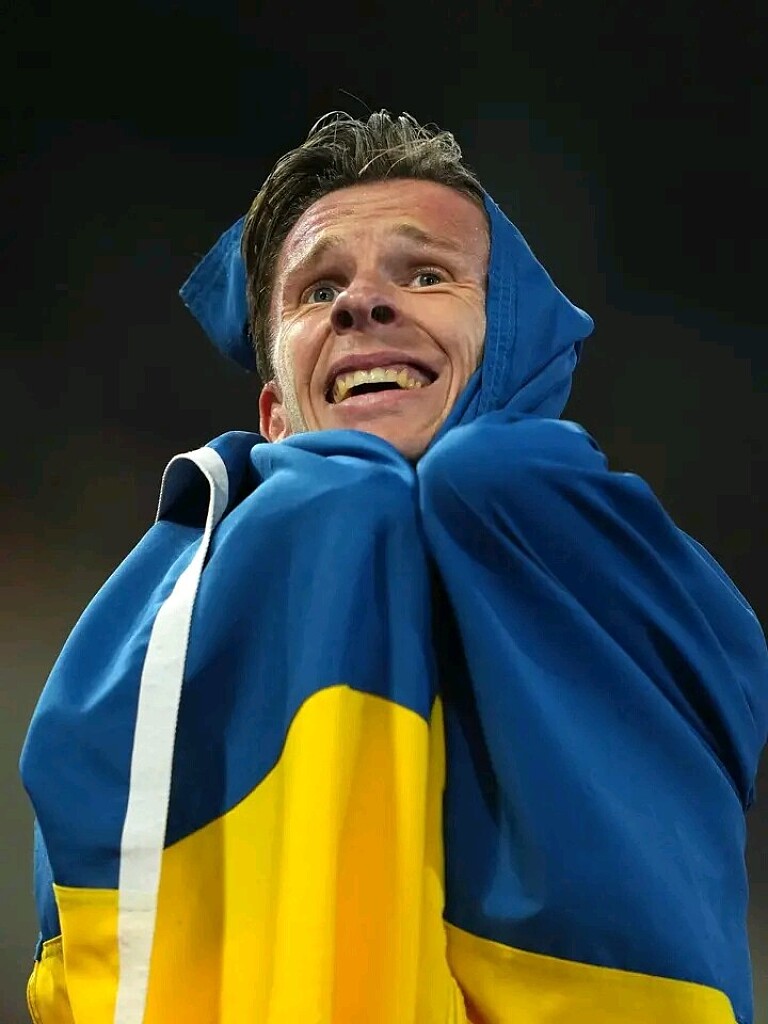
Andreas Almgren Dominates European 10,000m Final with Championship Record
Sweden’s Andreas Almgren produced a breathtaking performance in the European 10,000m final, powering to the continental title in a championship-record 27:23.44.
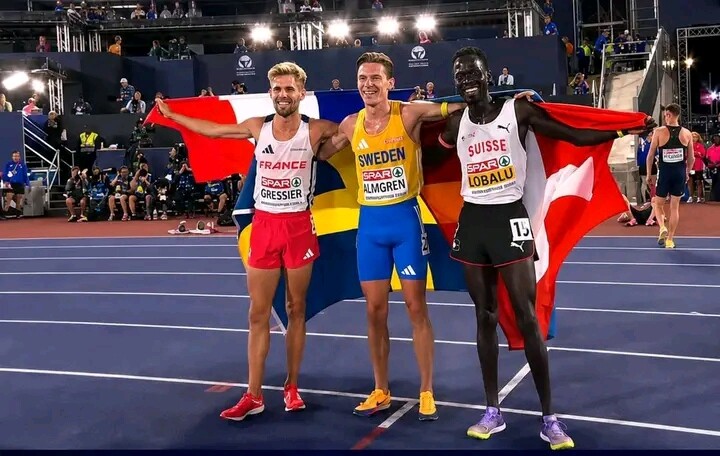
After making a strong impression on the roads earlier this season, Almgren transferred that form to the track with a display of sustained speed, patience and control. The Swede gradually established a decisive advantage before breaking clear in the closing stages, turning the race into a one-sided contest.
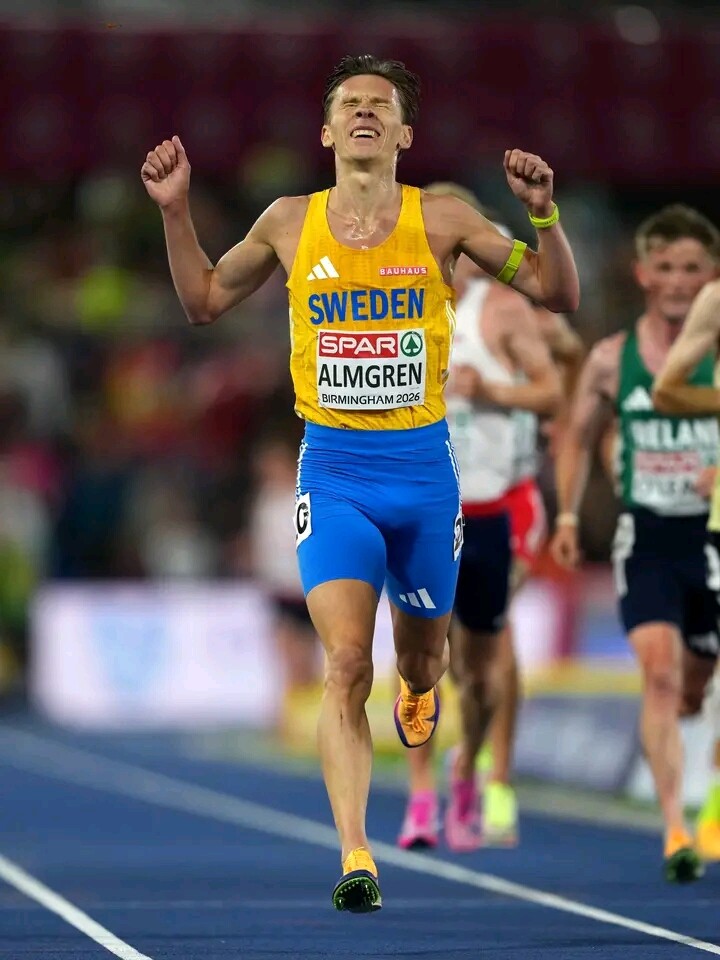
Almgren crossed the finish line almost 20 seconds ahead of his nearest challenger, underlining the scale of his superiority. His winning time of 27:23.44 also erased the oldest championship record in the event, surpassing the mark that had stood since 1978.
The victory carried additional historical significance for Swedish athletics. It was Almgren’s first European Championship title and made him the first Swedish athlete to win the European 10,000m crown.
Dominic Lokinyomo Lobalu produced a strong performance to secure the silver medal in 27:42.67, finishing well clear of the rest of the field as Almgren raced alone at the front.
Jimmy Gressier also secured a place on the European 10,000m podium after a hard-fought battle with Italy’s Yemaneberhan Crippa. The French world champion maintained his composure through the closing stages to claim bronze in 28:07.90, adding another major championship medal to his growing collection. His determined performance ensured France had a presence on the podium as Almgren and Lobalu dominated the race for gold and silver.
For Almgren, the triumph represents another major milestone in an increasingly impressive season. Having already demonstrated his ability over longer distances on the roads, he has now confirmed that his strength and endurance translate just as effectively to championship racing on the track.
His 27:23.44 will now stand as one of the defining performances of the Birmingham championships, combining a historic championship record with a landmark first European title for both Almgren and Sweden.
by Erick Cheruiyot for My Best Runs.
Login to leave a comment

European Athletics Champioships
The27thEuropean Athletics Championshipswill be held from 10 to 16 August 2026 at theAlexander StadiuminBirmingham, United Kingdom.[1] This is the first time that a British city will have staged the European Athletics Championships although Birmingham has hosted many high-profile events, including the2007 European Athletics Indoor Championships, the2003and2018 IAAF World Indoor Championshipsand the2022 Commonwealth Games. Alexander Stadium was renovated between 2019 and...
more...
Nairobi Makes History the Prize as Kenya Bids to Bring 2029 World Athletics Championships to Africa
Nairobi has formally entered the race to host the 2029 World Athletics Championships, placing Kenya at the centre of a historic contest that could bring the sport’s premier global track and field event to African soil for the first time.
Nairobi has formally submitted its bid to host the 2029 World Athletics Championships, with the Kenyan capital facing competition from London, Rome and Munich. Four cities are now in contention for one historic decision, with World Athletics expected to announce the successful host after the inaugural World Athletics Ultimate Championships conclude in Budapest next month.
For Nairobi, however, this is about far more than securing another major sporting event. A successful bid would break a decades-long geographical barrier: despite Africa’s enormous influence on global athletics, the World Athletics Championships have never been staged on the continent.
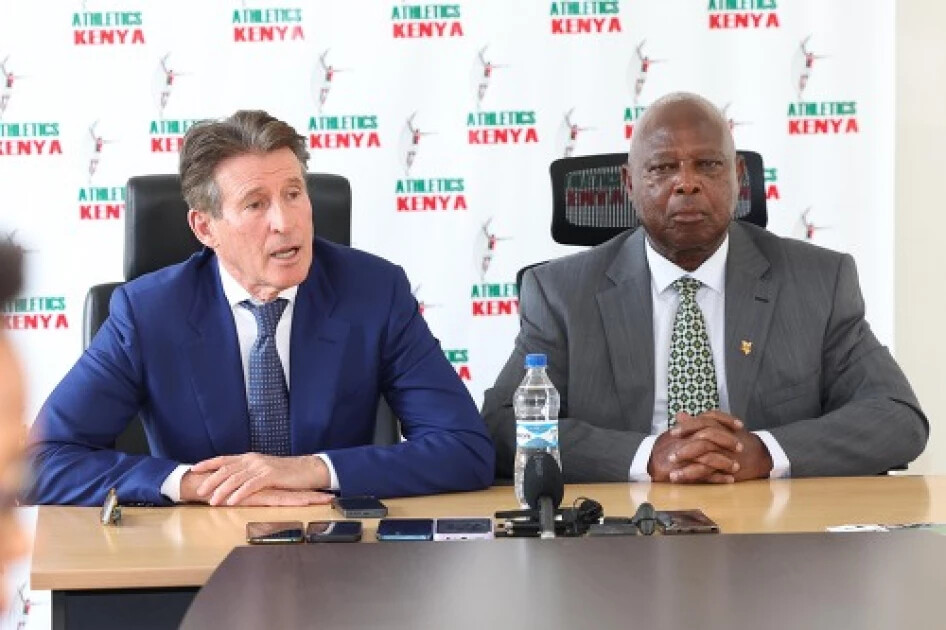
A Nairobi victory would bring the World Athletics Championships to Africa for the first time in the event’s 50-year history and stage the global showpiece at an altitude of approximately 1,800 metres. The proposed venue is Moi International Sports Center Kasarani Stadium, which has a capacity of 48,063, while the Kenyan government has committed full backing for infrastructure, security and event delivery. Kenya’s athletics credentials are equally compelling, with 17 current world records and 72 World Championships gold medals, making it the second-most successful nation in championship history.
The significance of Nairobi’s bid is amplified by Kenya’s extraordinary place in the history of the sport. The country has produced generations of world-class distance runners and currently holds 17 recognised world records across middle- and long-distance events.

Kenya is also the second-most successful nation in World Athletics Championships history by gold medals, with 72 titles after the 2025 edition. At the Tokyo 2025 championships, Kenya claimed five gold medals, including victories by Beatrice Chebet in the 5,000m and 10,000m.
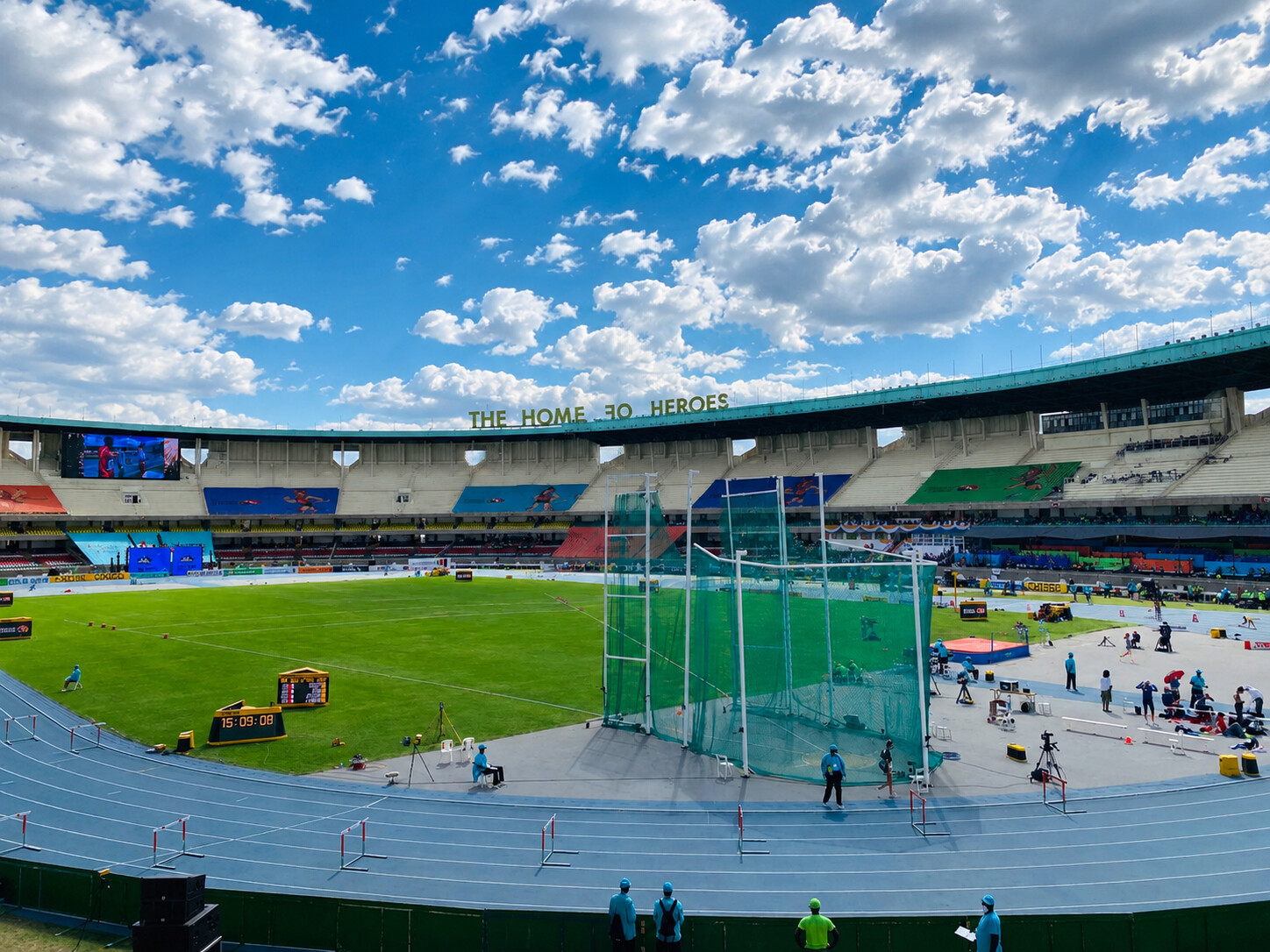
The country also has recent experience staging major international athletics competitions. Nairobi hosted the 2017 World U18 Championships and the 2021 World U20 Championships, while Kenya previously staged the 2007 World Cross Country Championships in Mombasa and the 2010 African Athletics Championships in Nairobi.
A Nairobi victory would therefore carry a powerful symbolism: the athletes who have helped define modern distance running on African soil could finally compete for world titles at home, in front of a Kenyan crowd.
The competition, however, will be formidable. London is seeking a return to the city that hosted the highly successful 2017 World Championships, while Rome and Munich bring their own strong European sporting traditions and established event infrastructure.
Yet Nairobi offers something none of its rivals can match — the opportunity to open an entirely new chapter in the history of the championships.
The World Athletics Championships have travelled across Europe, Asia, North America and the Middle East, but Africa has remained the missing continent on the event’s hosting map. Kenya’s bid seeks to change that.
With the formal bid now submitted and the final presentation and defence completed, Nairobi’s campaign enters its decisive phase. September will determine whether the championships finally make their long-awaited debut on African soil.
Four cities. One host. One potentially historic decision.
In September, World Athletics will decide whether the world’s greatest track and field athletes will converge on Nairobi in 2029 — and whether Africa will finally get its moment on the biggest stage of all.
by Erick Cheruiyot for My Best Runs.
Login to leave a comment
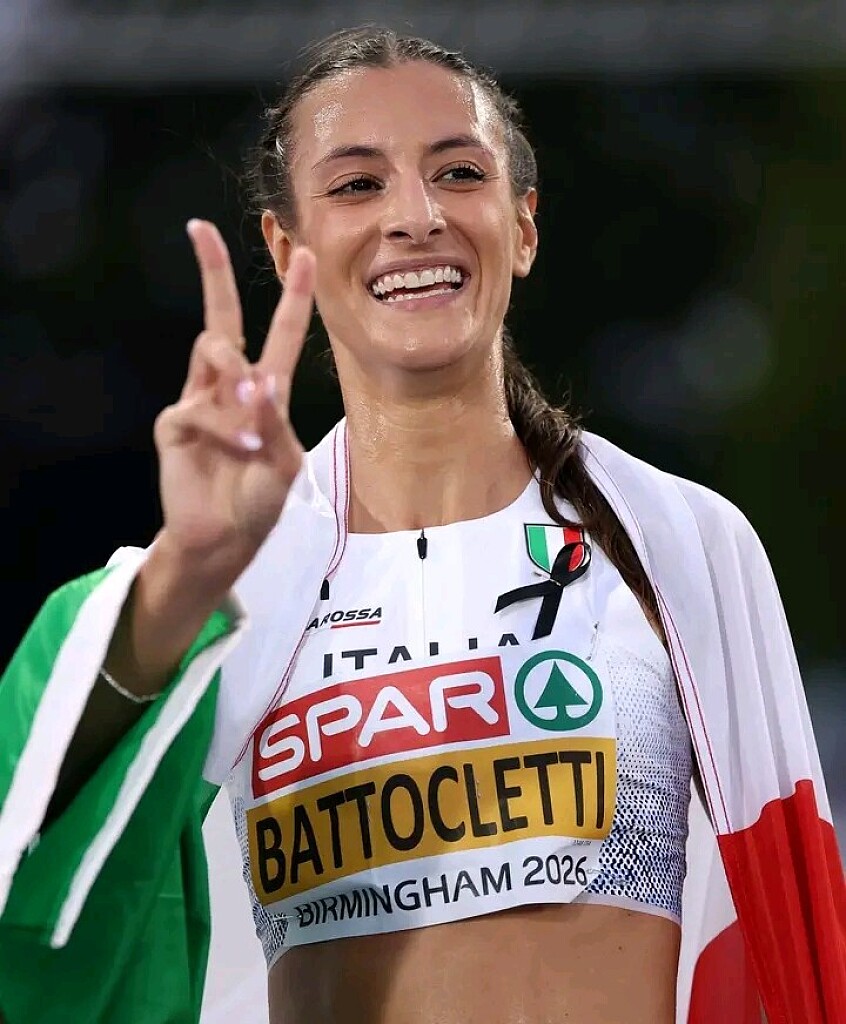
Nadia Battocletti Completes Golden Double to Reign Supreme in European Distance Running
Nadia Battocletti has once again stamped her authority on European distance running, producing a composed and decisive performance to win the women’s 10,000m at the 2026 European Athletics Championships in Birmingham.
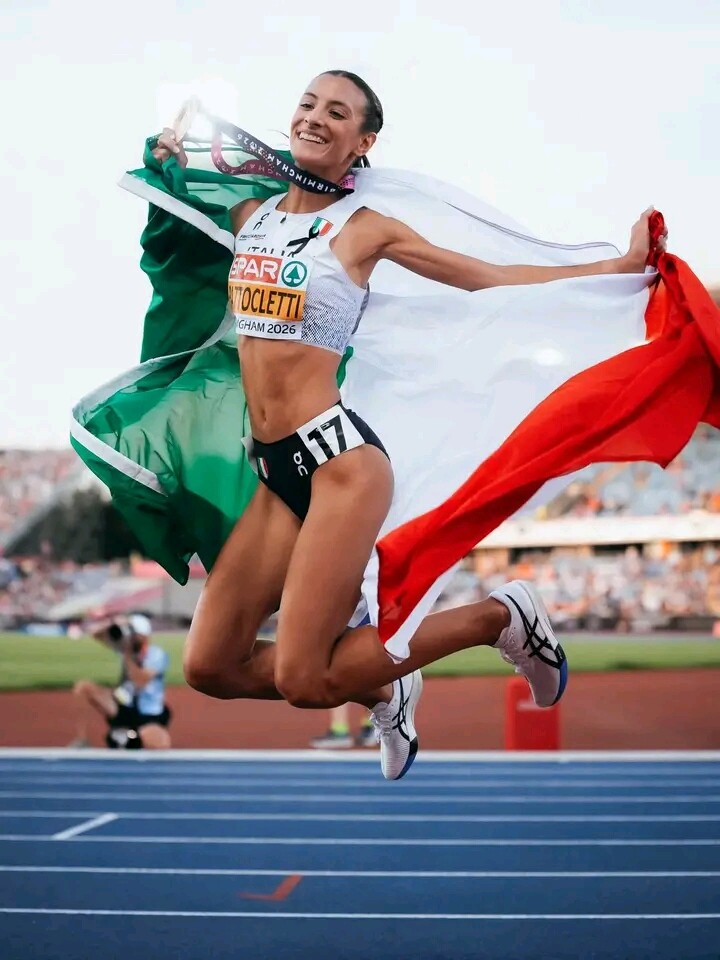
The Italian crossed the line in 31:41.17 to successfully defend her European 10,000m title and complete a remarkable 5000m–10,000m golden double at the championships. Her latest triumph further underlines her status as one of the continent’s outstanding long-distance runners.
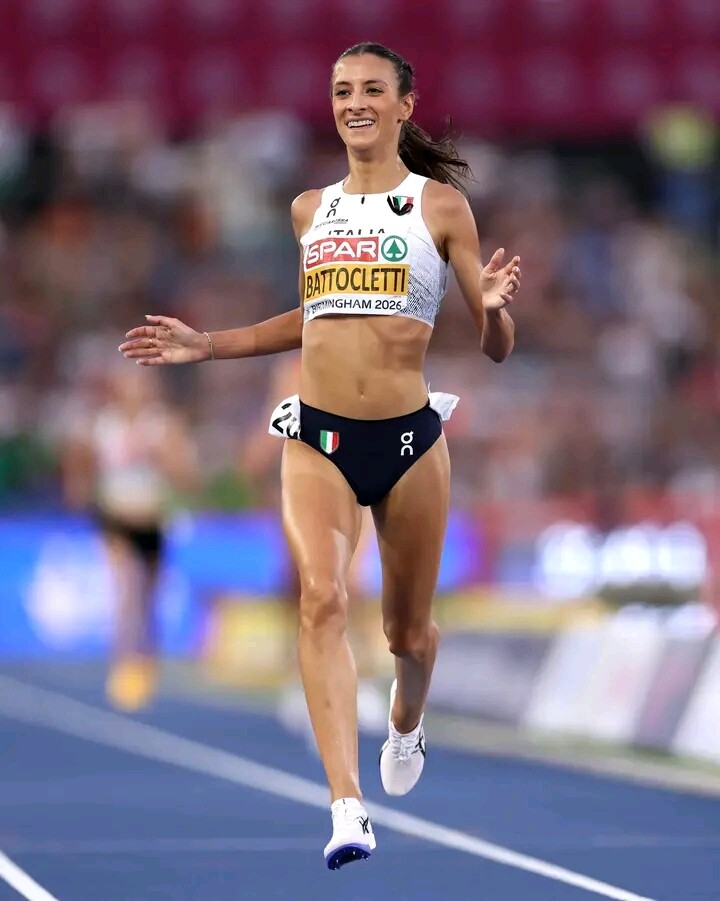
Battocletti had already demonstrated her exceptional class earlier in the championships by retaining the women’s 5000m title. She returned to the Alexander Stadium with another major challenge ahead, but once again displayed the tactical intelligence, patience and finishing strength that have become hallmarks of her racing.
The 10,000m final developed into a fiercely contested battle, with Battocletti having to withstand strong challenges from Maureen Koster of the Netherlands and Belgium’s Jana van Lent. In the decisive stages, however, the Italian found the extra gear required to break clear and secure another European crown.
Koster produced an outstanding performance to take silver in 31:45.76, while Van Lent completed the podium with bronze in 31:47.81.
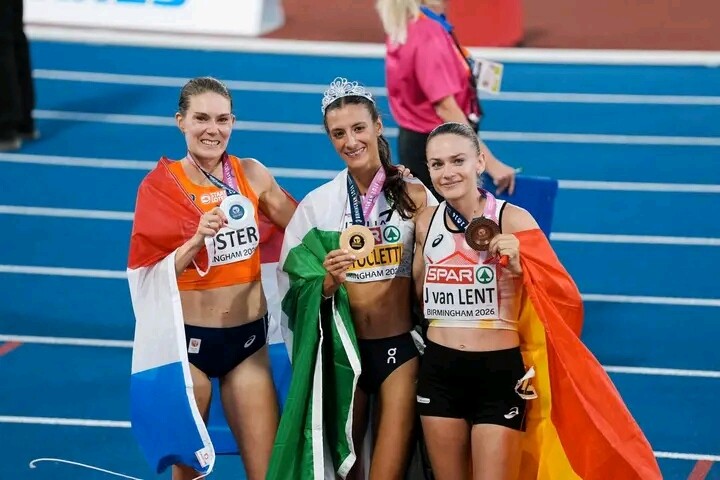
Spain’s Idaira Prieto was fourth in an impressive 31:59.84, setting a personal best, while Italy enjoyed further success as Elisa Palmero and Federica del Buono finished fifth and sixth respectively in 32:00.06 and 32:01.42. The result gave Italy an impressive three athletes inside the top six.
Maruša Mišmaš Zrimšek of Slovenia finished seventh in 32:02.57, followed by Great Britain’s Megan Keith in 32:04.81, a season best. Germany’s Lisa Merkel was ninth in 32:09.07, while Belgium’s Lisa Rooms completed the top 10 with a personal-best 32:10.22.
The depth of the final was reflected throughout the field, with Chloé Herbiet of Belgium recording a season best of 32:11.71, Slovenia’s Klara Lukan running a season-best 32:18.16, and several other athletes producing performances around the 32-minute barrier.
For Battocletti, though, the night belonged entirely to her.
Winning one European title is a remarkable achievement. Winning two individual distance titles at the same championships is a statement of extraordinary consistency, endurance and competitive maturity. By completing the 5000m and 10,000m double, Battocletti has reinforced her position at the summit of European distance running and added another defining chapter to her rapidly growing legacy.
Her Birmingham campaign has therefore become more than a collection of medals. It has been a demonstration of control, versatility and championship excellence from an athlete who continues to thrive when the stakes are highest.
Women’s 10,000m final — Birmingham 2026
1. Nadia Battocletti (Italy) — 31:41.17
2. Maureen Koster (Netherlands) — 31:45.76
3. Jana van Lent (Belgium) — 31:47.81
4. Idaira Prieto (Spain) — 31:59.84 PB
5. Elisa Palmero (Italy) — 32:00.06
6. Federica del Buono (Italy) — 32:01.42
7. Maruša Mišmaš Zrimšek (Slovenia) — 32:02.57
8. Megan Keith (Great Britain) — 32:04.81 SB
9. Lisa Merkel (Germany) — 32:09.07
10. Lisa Rooms (Belgium) — 32:10.22 PB
11. Chloé Herbiet (Belgium) — 32:11.71 SB
12. Elzbieta Glinka (Poland) — 32:16.65
13. Klara Lukan (Slovenia) — 32:18.16 SB
14. Mariana Machado (Portugal) — 32:27.09
15. Hanne Mjøen Maridal (Norway) — 32:32.12
16. Izzy Fry (Great Britain) — 32:37.22
17. Anna Marie Nordengen Sirevåg (Norway) — 32:41.21
18. Jennifer Gulikers (Netherlands) — 32:48.71
19. Carla Gallardo (Spain) — 33:02.58
20. Fiona Everard (Ireland) — 33:08.60
21. Alessia Zarbo (France) — 33:13.10
22. Eva Dieterich (Germany) — 33:32.38
23. Poppy Tank (Great Britain) — 34:03.99
Did not finish: Niamh Allen (Ireland), Diane van Es (Netherlands)
Did not start: Ilona Mononen (Finland)
Battocletti’s double is now one of the defining performances of Birmingham 2026 — a golden statement from Italy’s distance-running queen.
by Erick Cheruiyot for My Best Runs.
Login to leave a comment
European Athletics Champioships
The27thEuropean Athletics Championshipswill be held from 10 to 16 August 2026 at theAlexander StadiuminBirmingham, United Kingdom.[1] This is the first time that a British city will have staged the European Athletics Championships although Birmingham has hosted many high-profile events, including the2007 European Athletics Indoor Championships, the2003and2018 IAAF World Indoor Championshipsand the2022 Commonwealth Games. Alexander Stadium was renovated between 2019 and...
more...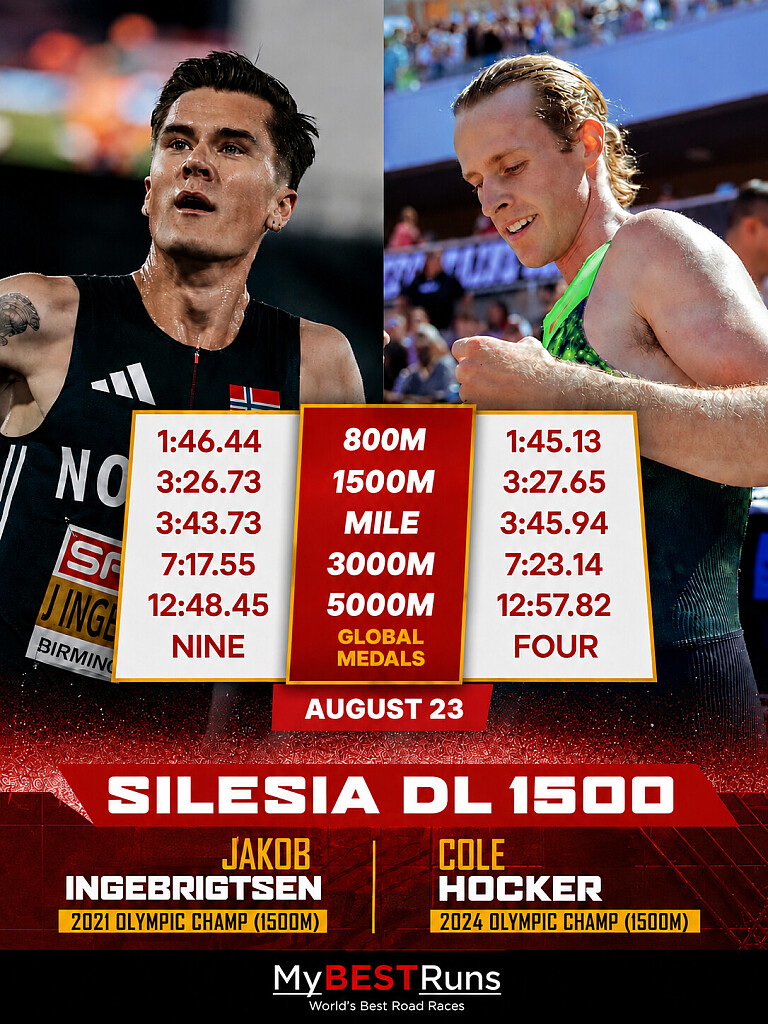
Ingebrigtsen vs Hocker: Silesia Set for a Blockbuster 1500m Showdown
A mouthwatering 1500m showdown is brewing at the Silesia Diamond League on August 23, with two of the biggest names in middle-distance running set to go head-to-head.
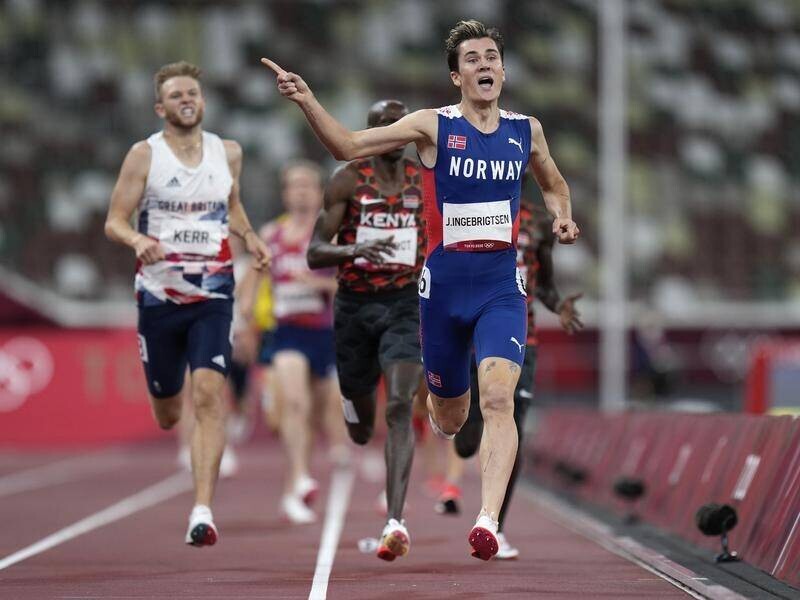
Norway’s Jakob Ingebrigtsen is set to make his return to the Wanda Diamond League in Silesia, where he will face Cole Hocker, the reigning Olympic 1500m champion. The meeting will bring together two athletes who have already shared one of the most memorable 1500m battles of recent years.
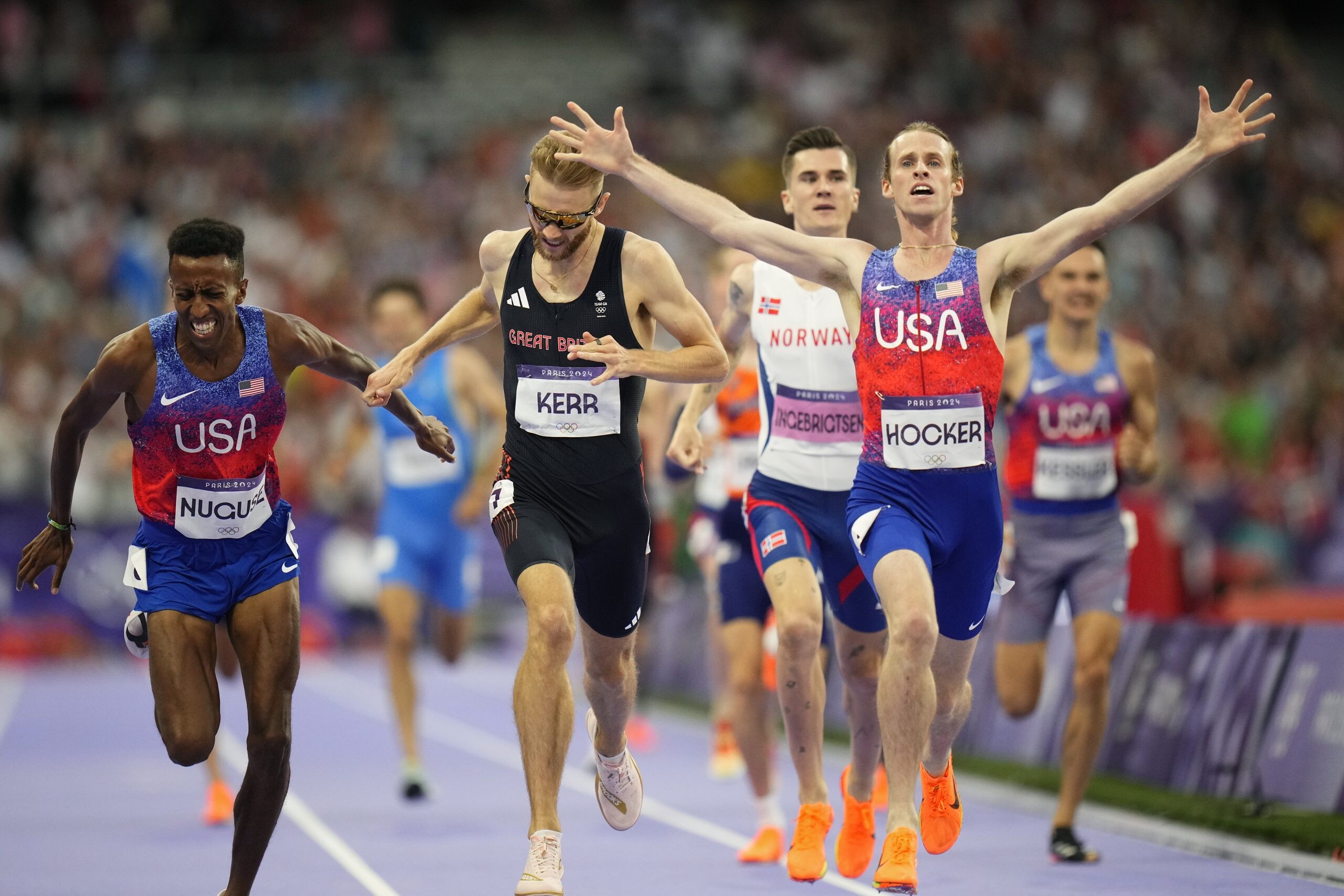
At the Paris 2024 Olympic Games, Hocker produced a sensational finish to take the gold medal in an Olympic-record 3:27.65, while Ingebrigtsen finished fourth in 3:28.24.
More than two years later, the two stars are preparing to meet again, adding another intriguing chapter to their rivalry.
For Ingebrigtsen, the Silesia race will come shortly after his long-awaited return to competition following an injury layoff. The Norwegian made his comeback in impressive fashion at the 2026 European Athletics Championships in Birmingham, successfully defending his European 5000m title.
Ingebrigtsen clocked 13:15.29 to win the 5000m, immediately reminding the athletics world of his extraordinary championship pedigree and competitive instincts after his extended absence.
Hocker, meanwhile, arrives in Silesia as one of the most formidable 1500m runners in the world. His Olympic triumph in Paris established him as the reigning Olympic champion, while his 3:27.65 personal best ranks him among the fastest athletes ever over the distance.
Ingebrigtsen and Hocker bring remarkable credentials to the Silesia showdown. Hocker enters the race as the reigning Olympic 1500m champion with a personal best of 3:27.65, while Ingebrigtsen owns an even faster lifetime best of 3:26.73 and a long list of Olympic and European championship honours. With both athletes capable of producing extraordinary speed over the final stages, the Silesia meeting could deliver another memorable chapter in their growing rivalry.
The Norwegian will also be looking to sharpen his 1500m form after beginning his comeback over 5000m, while Hocker will have the confidence that comes with being the reigning Olympic champion.
That combination makes the Silesia clash particularly compelling. Will Ingebrigtsen's strength and proven championship experience prevail, or can Hocker once again produce the decisive finishing speed that delivered Olympic gold?
One thing is certain: Silesia is set for a 1500m battle that distance-running fans will not want to miss.
Jakob Ingebrigtsen vs Cole Hocker. August 23. The stage is set.
by Erick Cheruiyot for My Best Runs.
Login to leave a comment
Beatrice Chepkoech Sets Her Sights on Sub-15 Glory at Inaugural Antrim Coast 5K
Kenya’s Beatrice Chepkoech is set to bring her world-class pedigree to the inaugural Antrim Coast 5K on Sunday, August 23, with the world 3000m steeplechase record holder targeting a remarkable sub-15-minute performance on the fast Northern Irish course.
For Chepkoech, the race represents more than another appearance on the road. It is an opportunity to test her speed and endurance over 5 kilometres while pursuing a time that would underline the extraordinary range of one of Kenya’s most accomplished distance athletes.
The former world champion has built her reputation through years of excellence on the track, most notably in the 3000m steeplechase, where her world-record performance established her among the finest athletes the event has ever produced. Her move to the Antrim Coast 5K adds another intriguing chapter to her already distinguished career.
A sub-15-minute clocking would be a significant statement on the road, particularly given the calibre of athlete attempting it. Chepkoech will arrive with the experience, competitive instinct and proven finishing speed required to make the challenge compelling, while the fast nature of the Antrim Coast course could provide the ideal platform for an ambitious performance.
However, the Kenyan star will not have the spotlight to herself.
The men’s race is expected to provide its own major attraction, with Ethiopia’s Ermais Girma among the headline names in a strong international field. His presence adds further depth to an event designed to bring together elite athletes and ambitious teams on a course where fast racing is expected to be at the heart of the action.
Ireland and Scotland will also add an international dimension, fielding teams that will turn the inaugural event into much more than a straightforward individual contest. With athletes competing for personal ambitions while representing their respective teams, the Antrim Coast 5K promises a fascinating race within a race.
For Chepkoech, though, the equation is simple: arrive ready, embrace the pace and chase the clock.
A sub-15-minute performance would give the Kenyan superstar another impressive mark to her name and provide a fitting headline for the first edition of the Antrim Coast 5K. With her reputation for attacking races and her ability to deliver under pressure, all eyes will be on Chepkoech when the field takes to the fast Antrim Coast course.
Sunday’s race could therefore become an important showcase of just how much speed remains in the legs of one of Kenya’s most celebrated champions—and whether Chepkoech can turn her bold sub-15 ambition into reality.
by Erick Cheruiyot for My Best Runs.
Login to leave a comment
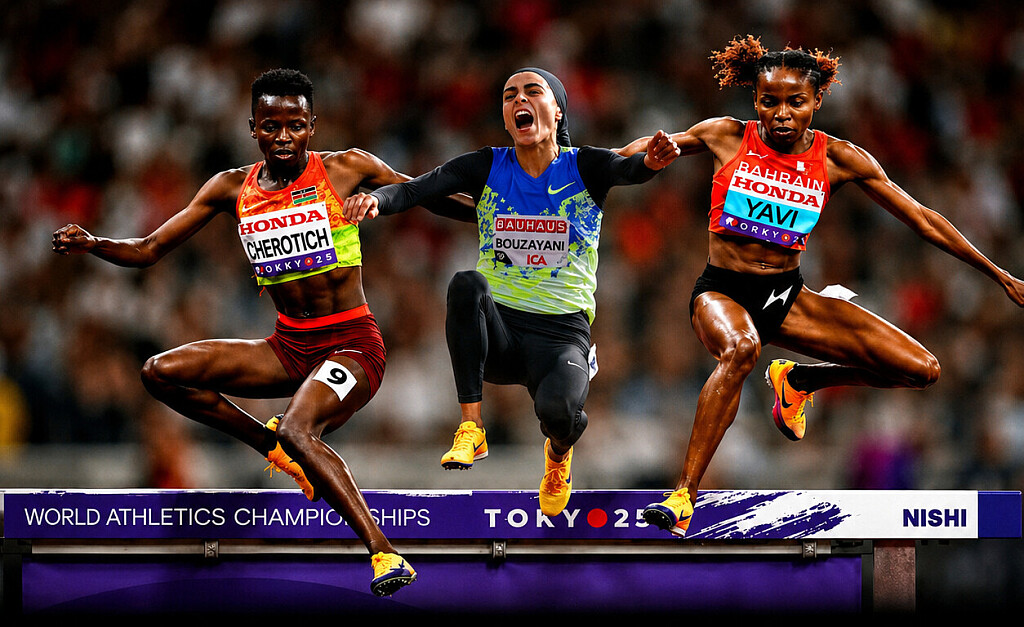
Cherotich, Yavi and Bouzayani Set for Lausanne Diamond League Steeplechase Showdown
The women’s 3000m steeplechase is shaping up as one of the most enticing distance events at the 2026 Athletissima Lausanne Diamond League, with Kenya’s Faith Cherotich, Bahrain’s Winfred Yavi and Tunisia’s Marwa Bouzayani confirmed for a mouth-watering clash on 21 August. The meeting will bring together three athletes who have each made a strong impression on the international steeplechase scene this season.
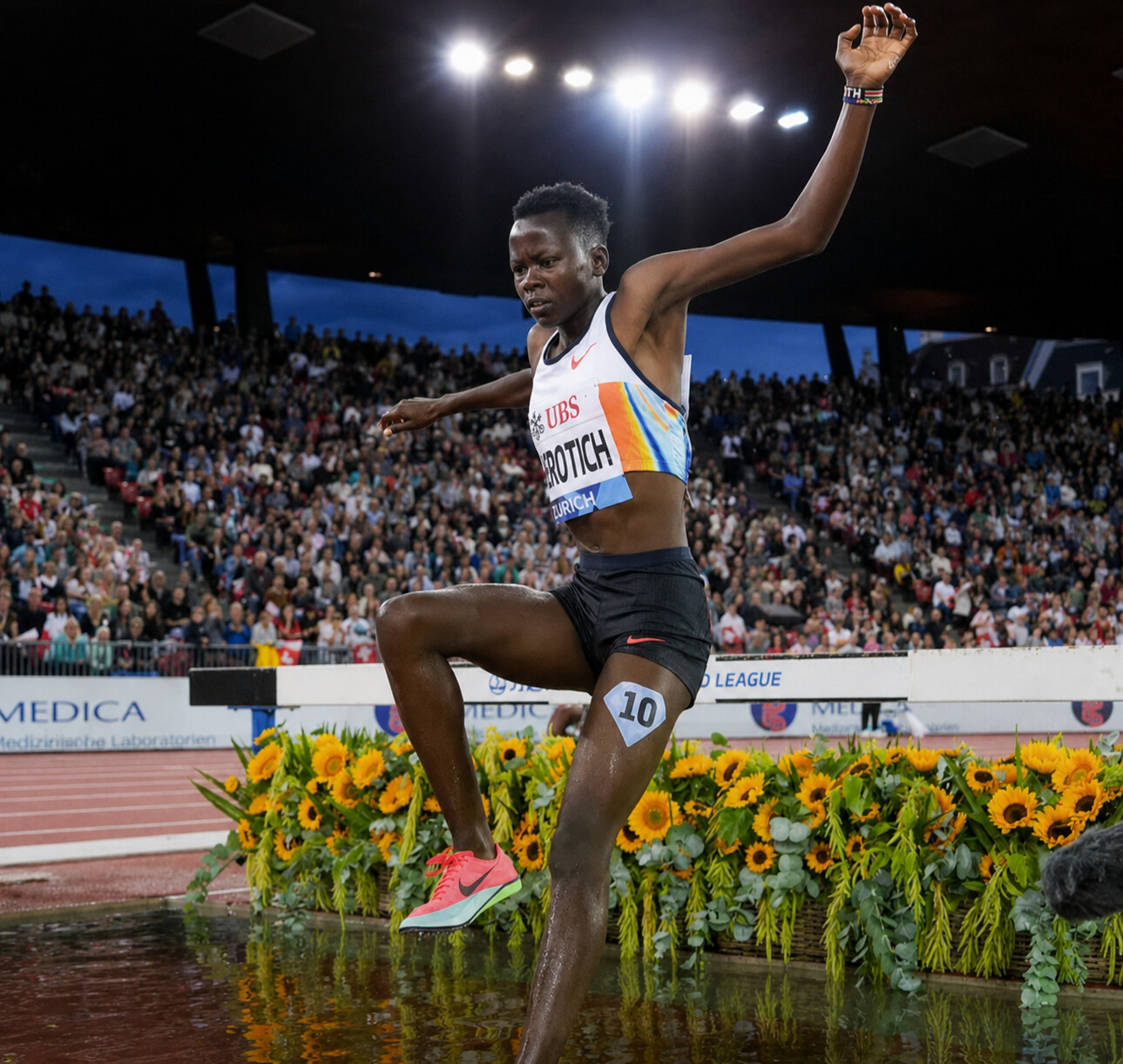
Cherotich heads to Lausanne with formidable credentials. The Kenyan is the reigning world champion and two-time Diamond League champion, and she has continued to show her class in 2026. She opened her Diamond League campaign with 8:51.48 for second place in Shanghai/Keqiao before producing a winning 8:51.74 at the Prefontaine Classic in Eugene.
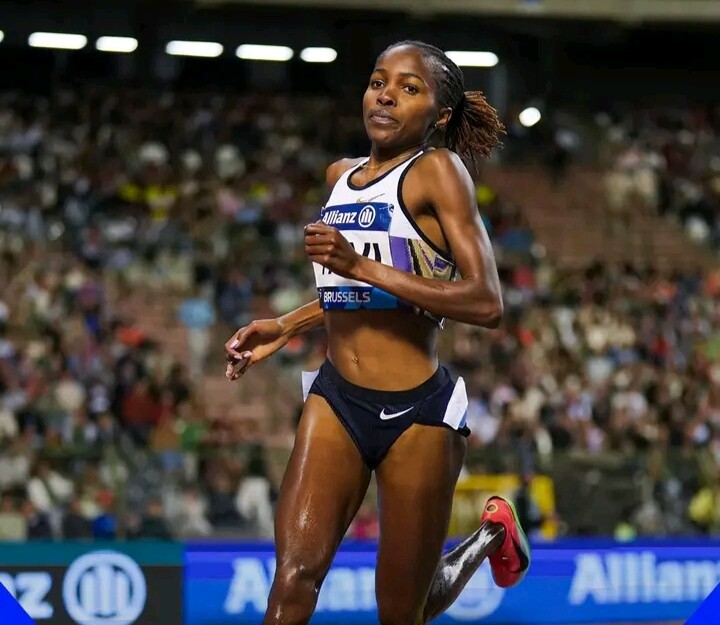
Standing in her way will be Yavi, the Paris 2024 Olympic champion and one of the most accomplished steeplechasers of her generation. The Bahrain star has developed a compelling rivalry with Cherotich, with the two repeatedly pushing each other towards extraordinary performances. Their encounters have become a highlight of the Diamond League season, making their latest meeting in Lausanne particularly intriguing.
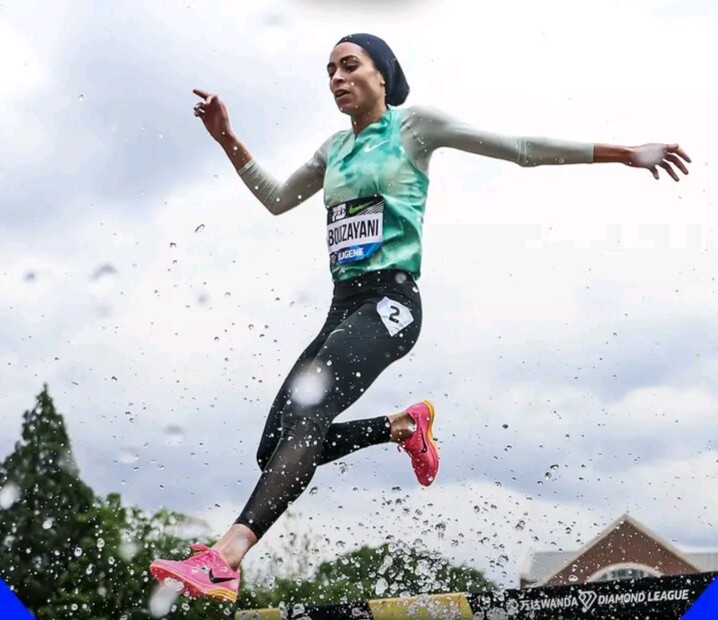
Bouzayani, meanwhile, arrives with perhaps the biggest surge in confidence. The Tunisian produced a spectacular breakthrough in Stockholm in June, winning her first Diamond League steeplechase in a meeting-record 8:59.28. That came after she had already shattered the Tunisian record with 8:58.09 in Shanghai/Keqiao, becoming the first Tunisian woman to break nine minutes for the event.
Her progress has transformed Bouzayani from an emerging challenger into a genuine contender capable of mixing it with the world’s best. Her performance in Eugene further underlined that development, as she ran a national record 8:54.32 for third behind Cherotich and Yavi. The three athletes were separated by less than three seconds, setting the stage for another fascinating contest in Switzerland.
Lausanne could therefore provide another beautiful chapter in an increasingly captivating steeplechase story. Cherotich brings the authority of a world champion, Yavi the experience and confidence of an Olympic champion, while Bouzayani carries the momentum of a breakthrough season. Over 3,000 metres of barriers, water jumps and relentless racing, the smallest details could decide who emerges strongest when the final straight arrives.
With the three stars now set to share the same starting line, anticipation is already building for what could be a swift, elegant and fiercely contested battle under the Swiss lights. For fans of distance running, Lausanne promises a race where every barrier clearance, every surge and every final stride could carry the weight of victory.
by Erick Cheruiyot for My Best Runs.
Login to leave a comment
Battocletti’s Blistering Finish Delivers Back-to-Back European 5000m Gold in Birmingham
Nadia Battocletti produced a superb championship performance in Birmingham to retain her European 5000m title for the second consecutive time, powering to gold in 15:37.84 after unleashing a devastating late kick that left her rivals scrambling for the remaining medals.
The Italian distance-running star remained composed through the race before turning on the speed when it mattered most. With the field tightly packed heading into the closing stages, Battocletti launched a breathtaking attack over the final 200 metres, producing a surge of exceptional quality that ultimately decided the championship.
The decisive moment came in the final 200 metres, when Battocletti unleashed a ferocious finishing kick that dramatically changed the complexion of the race. With the medals still within reach for several athletes, the Italian surged through the final bend with tremendous purpose, her acceleration proving simply too tough to match. She drove relentlessly down the home straight, opening the crucial gap and powering away from her closest challengers to seal a richly deserved European title.
Her closing speed was extraordinary. Battocletti covered the final 400m in 59.2 seconds, including a remarkable 28.2-second final 200m, as she accelerated away from her challengers and powered down the home straight. It was a superb display of strength, speed and championship composure, earning her another European crown in emphatic fashion.
Behind her, Spain’s Marta García fought brilliantly to claim silver in a season’s best of 15:39.98, while Italy’s Micol Majori completed an Italian 1-3 with bronze in 15:40.65.
For Majori, the bronze medal represented a particularly special milestone as she celebrated her first international senior medal on a major championship stage. Her breakthrough performance added another layer to an unforgettable night for Italy.
Ireland’s Sarah Healy narrowly missed the podium, finishing fourth in 15:40.95, just 0.30 seconds behind Majori. Great Britain’s Hannah Nuttall was fifth in 15:41.27, followed by the Netherlands’ Maureen Koster in 15:41.51.
Amina Maatoug of the Netherlands finished seventh in 15:44.03, while Spain’s María Forero completed the top eight in 15:44.25.
Battocletti’s Birmingham triumph now sets up another title defence. The Italian will return to the track on Friday for the women’s 10,000m, where she will once again look to extend her European dominance.
For now, though, the spotlight belongs to Battocletti and that extraordinary finish — a 28.2-second final 200m that transformed a tightly contested 5000m final into another golden chapter in her championship career.
by Erick Cheruiyot for My Best Runs.
Login to leave a comment
European Athletics Champioships
The27thEuropean Athletics Championshipswill be held from 10 to 16 August 2026 at theAlexander StadiuminBirmingham, United Kingdom.[1] This is the first time that a British city will have staged the European Athletics Championships although Birmingham has hosted many high-profile events, including the2007 European Athletics Indoor Championships, the2003and2018 IAAF World Indoor Championshipsand the2022 Commonwealth Games. Alexander Stadium was renovated between 2019 and...
more...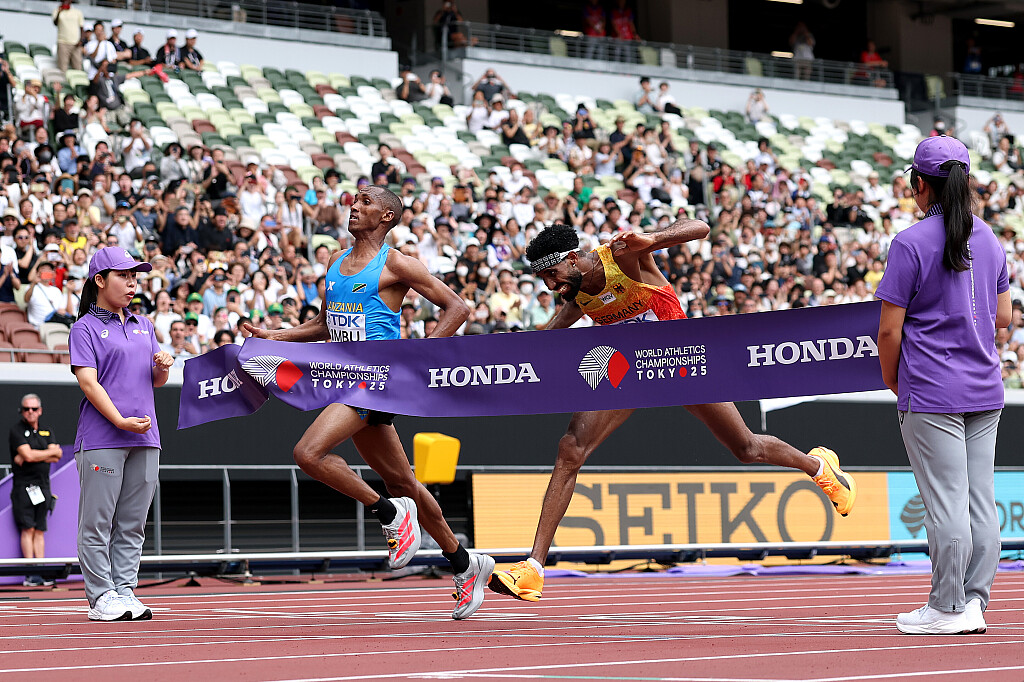
Can Amanal Petros Finally Turn Heartbreak into European Gold in Birmingham?
All eyes will be on Amanal Petros when the men’s marathon takes centre stage at the 2026 European Athletics Championships in Birmingham, with the German star chasing the major championship title that has repeatedly slipped through his fingers.
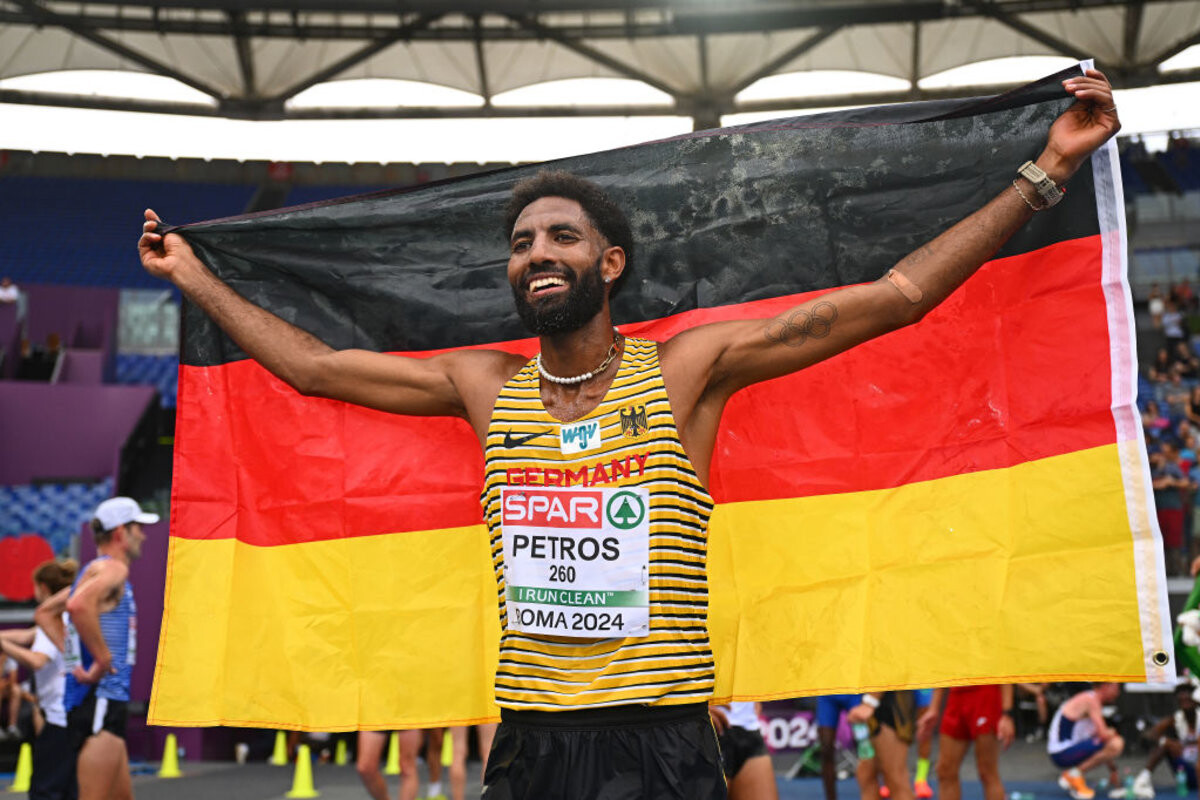
Petros arrives with one of the strongest résumés in the field and the credentials to challenge for gold. At 2:04:03, he is the third-fastest European marathoner of all time, behind Belgium’s Bashir Abdi (2:03:36) and France’s Morhad Amdouni (2:03:47). That level of performance underlines Petros’ ability to compete with the very best, although his career has also been marked by agonisingly narrow defeats on the biggest stages.
His most recent heartbreak came at the 2025 World Athletics Championships in Tokyo, where Tanzania’s Alphonce Simbu edged him out by just 0.03 seconds in one of the closest finishes in championship history. That defeat underlined both Petros’ quality and the fine margins that have prevented him from claiming an individual global title.
The European Championships have also brought frustration. At the 2024 European Athletics Championships, Petros took bronze in the half marathon after being beaten in a three-way finish by Italy’s Yemaneberhan Crippa. Two years earlier in Munich, he was unable to stay with the medal contenders during the decisive stages of the marathon.
Now Birmingham presents another opportunity—and Petros has every reason to believe this could finally be his moment.
His season-best of 2:08:31 does not tell the full story. At the London Marathon, Petros passed halfway in a blistering 61:16, initially targeting Bashir Abdi’s European record of 2:03:36, before easing during the latter stages. His 2:04:03 runner-up performance at the Valencia Marathon last December is arguably a much better indication of his true potential.
Standing in his way will be a strong German contingent, led alongside Petros by defending European champion Richard Ringer. Ringer produced one of the most memorable performances of the 2022 championships in Munich, unleashing a dramatic late surge during the final kilometre to overtake three athletes—including Petros—and snatch a remarkable victory.
At 37, Ringer continues to compete at an exceptional level. He produced the fastest marathon of his career in April, running 2:04:47 at the Boston Marathon to finish eighth overall while recording the fastest European time in the race.
Germany’s strength does not end there. Samuel Fitwi has been even faster in 2026, recording a personal best of 2:04:45 when finishing second at the Hamburg Marathon. That performance makes him the fastest athlete on the Birmingham entry list based on season’s bests.
With Petros, Ringer and Fitwi forming a formidable German trio, the team will have serious ambitions of collecting individual medals while also challenging for the team title. Their depth could prove particularly valuable in a championship marathon, where tactical racing and team strength can be just as important as raw personal-best times.
France’s Emmanuel Roudolff is among the principal threats to the German challenge. He established a personal best of 2:05:58 when finishing sixth at the Paris Marathon and has the speed to remain in contention if the race develops into a fast affair.
Veteran Kaan Kigen Özbilen will also bring considerable experience to the starting line. The Kenyan-born Turkish athlete, who once held the European record with 2:04:16, remains capable of competing at the highest level. He ran 2:05:59 for fifth in Barcelona earlier this year.
Israel will also arrive with a strong team, having won the marathon team title in Munich four years ago. Maru Teferi and Gashau Ayale, who claimed silver and bronze respectively in Munich, return with valuable championship experience and will hope to challenge for more medals in Birmingham.
Italy’s hopes will centre on Pietro Riva. With Crippa focusing on the 10,000m and Iliass Aouani sidelined by shin problems, Riva becomes Italy’s leading marathon contender. He finished second behind Crippa and ahead of Petros in the half marathon at the 2024 European Championships, giving him another opportunity to challenge the German favourite on the European stage.
For the home crowd, one of the most intriguing stories will be Mahamed Mahamed, who could give Britain a realistic shot at its first men’s European marathon medal in decades.
Great Britain has not won a men’s marathon medal at these championships since Ian Thompson claimed gold in Rome in 1974. Mahamed has emerged as a genuine contender after producing a lifetime best of 2:06:14 at the London Marathon in April. That performance made him the second-fastest British marathoner in history behind Mo Farah, while also placing him fourth among the Birmingham entrants based on 2026 season’s bests.
With a home crowd behind him and confidence gained from his breakthrough performance in London, Mahamed could become one of the most dangerous outsiders in the field.
Birmingham therefore promises a fascinating battle between proven championship performers, emerging German strength and a collection of experienced international challengers. Petros, however, remains the man at the centre of the story.
He has already come agonisingly close to major championship glory. He possesses the speed, experience and proven ability to run under 2:05. What remains is to produce the decisive performance when the medals are on the line.
After years of near misses, Birmingham could finally be the stage where Amanal Petros turns silver and heartbreak into European gold.
by Erick Cheruiyot for My Best Runs.
Login to leave a comment
European Athletics Champioships
The27thEuropean Athletics Championshipswill be held from 10 to 16 August 2026 at theAlexander StadiuminBirmingham, United Kingdom.[1] This is the first time that a British city will have staged the European Athletics Championships although Birmingham has hosted many high-profile events, including the2007 European Athletics Indoor Championships, the2003and2018 IAAF World Indoor Championshipsand the2022 Commonwealth Games. Alexander Stadium was renovated between 2019 and...
more...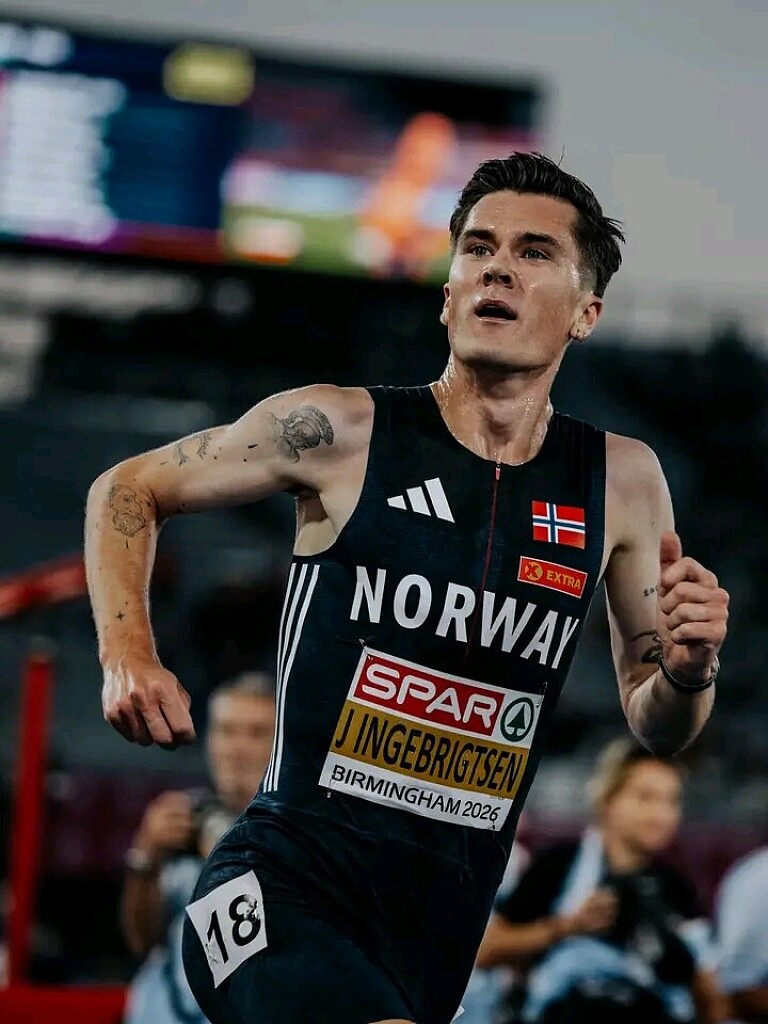
Jakob Ingebrigtsen Returns In Style With Fourth Straight European 5000m Gold
After 11 months away from competitive racing, Jakob Ingebrigtsen reminded the athletics world exactly why he remains one of distance running’s most formidable forces.
The Norwegian superstar made a spectacular return at the European Athletics Championships in Birmingham, producing a trademark finishing surge to capture his fourth consecutive European 5000m title in 13:15.29.
Making his first competitive appearance since 2025 following an Achilles injury and surgery earlier this year, Ingebrigtsen approached the race with patience. Rather than forcing the pace early, the Olympic champion remained composed through the opening stages, conserving energy for the decisive moments.
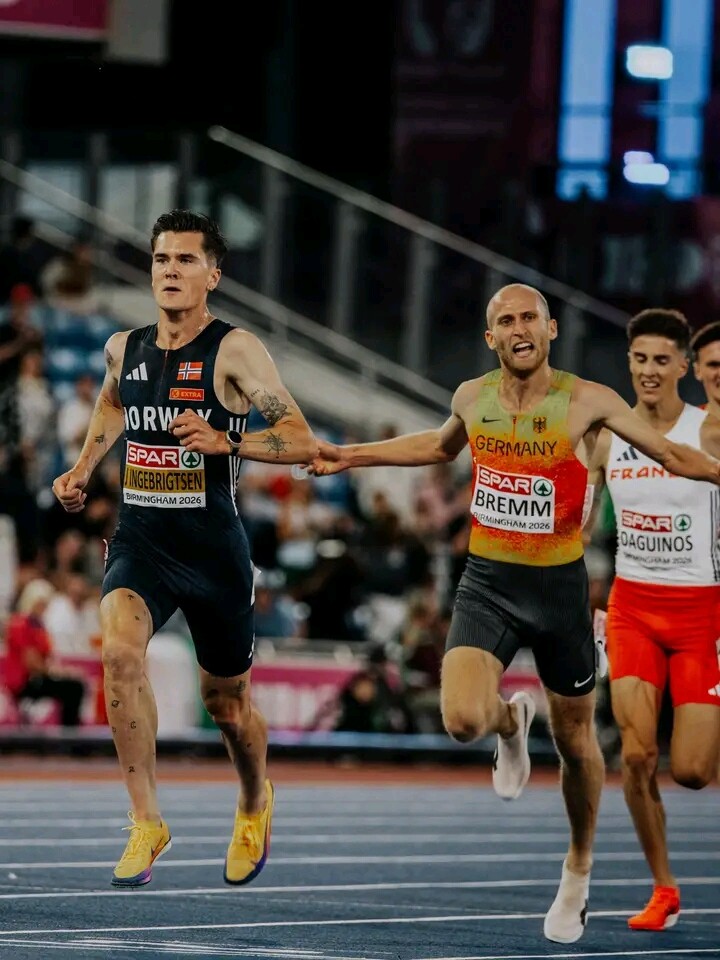
With the field still tightly packed entering the closing stages, the race came down to a final-lap battle. Ingebrigtsen moved into contention around the final bend before unleashing a devastating kick over the closing 100 metres.
Jimmy Gressier of France and Germany’s Florian Bremm were among those fighting for the medals, but neither could match the Norwegian’s acceleration. Ingebrigtsen powered clear to cross the line first in 13:15.29, with Bremm taking silver and France’s Etienne Daguinos claiming bronze.
The victory extends an extraordinary European Championships record for Ingebrigtsen. He has now won the 5000m title at four consecutive editions, while his latest gold also further strengthens his status as the most successful male athlete in the history of the European Athletics Championships.
What made the performance even more remarkable was the uncertainty surrounding his return. Ingebrigtsen had not raced at all during the 2026 season as he worked his way back from Achilles surgery. His participation in Birmingham was only confirmed in late July, with his management stressing that the decision would depend on his readiness.
Yet when the moment arrived, the 25-year-old delivered in familiar fashion — staying calm, trusting his strength and producing an explosive finish when the medals were on the line.
The comeback victory also sets up an intriguing next chapter. Ingebrigtsen is scheduled to return to the Diamond League circuit at the Weltklasse Zürich meeting on August 27, where he is expected to contest the 1500m alongside a formidable field that includes Olympic champion Cole Hocker, Yared Nuguse and Isaac Nader. The Zürich meeting is scheduled for August 27.
After nearly a year away, Jakob Ingebrigtsen is back — and his first race of the comeback has already produced another European title.
The next test will come over 1500 metres in Zürich, where the Norwegian will face a very different challenge and an entirely different level of speed.
For now, though, one message rings loud across European athletics:
Jakob Ingebrigtsen is back.
by Erick Cheruiyot for My Best Runs.
Login to leave a comment
European Athletics Champioships
The27thEuropean Athletics Championshipswill be held from 10 to 16 August 2026 at theAlexander StadiuminBirmingham, United Kingdom.[1] This is the first time that a British city will have staged the European Athletics Championships although Birmingham has hosted many high-profile events, including the2007 European Athletics Indoor Championships, the2003and2018 IAAF World Indoor Championshipsand the2022 Commonwealth Games. Alexander Stadium was renovated between 2019 and...
more...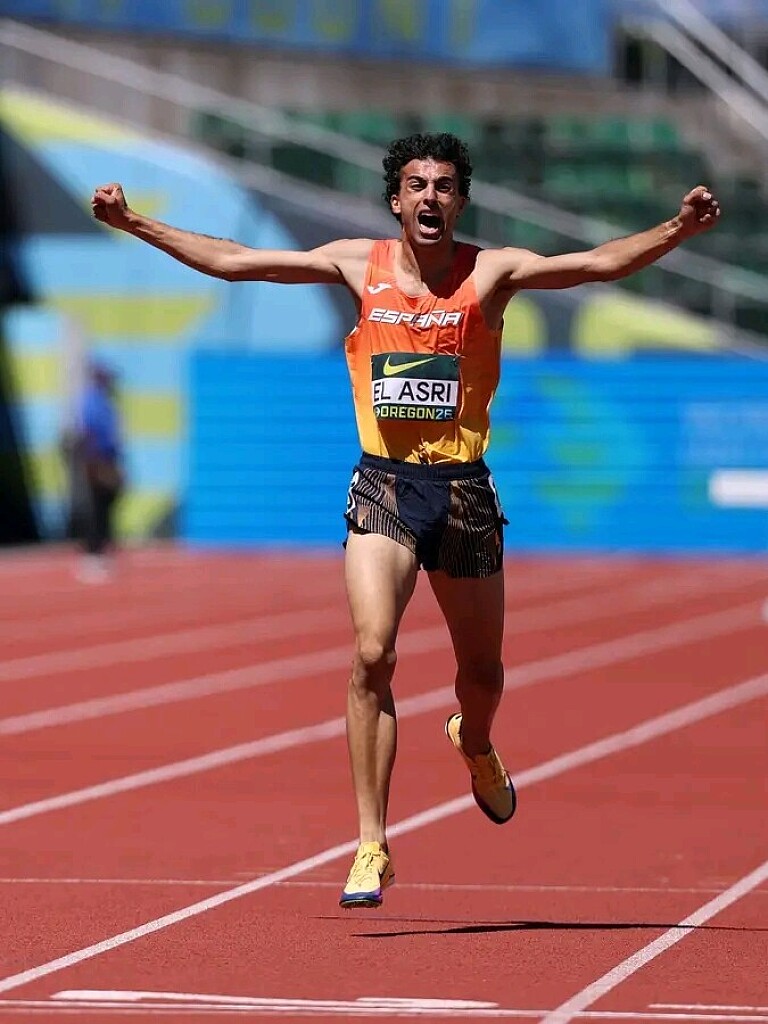
El Asri Sets European U20 Record As Lemiso Takes Silver And Losiwareng Fights Back For Dramatic Bronze
Kenya secured a double podium finish in a fiercely contested men’s 3000m steeplechase final at the World Athletics U20 Championships in Eugene, with Emmanuel Lemiso Someki taking silver and Nicholas Kitum Losiwareng battling his way to bronze.
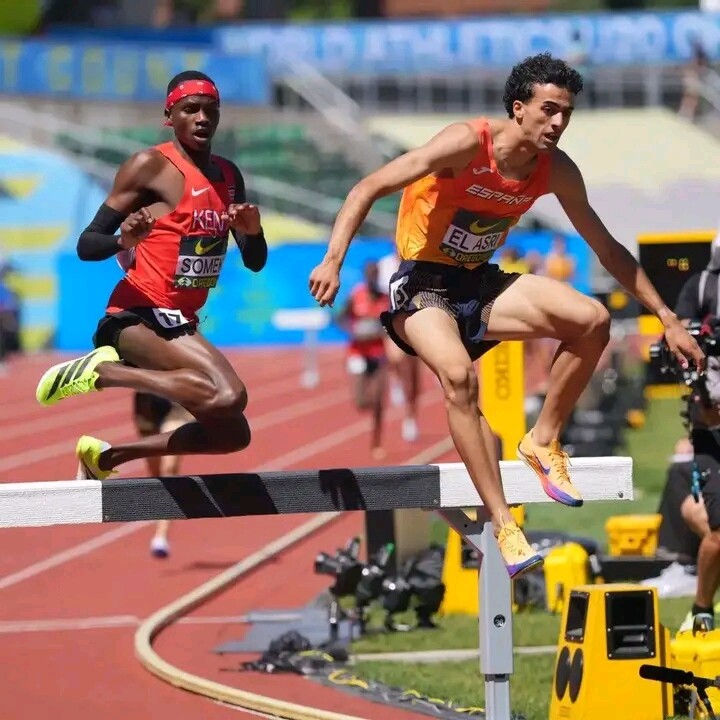
Spain’s Bakr El Asri Mohsine produced the decisive move when it mattered most, surging away in the closing stages to claim the gold medal in 8:28.35 and set a new European U20 area record.
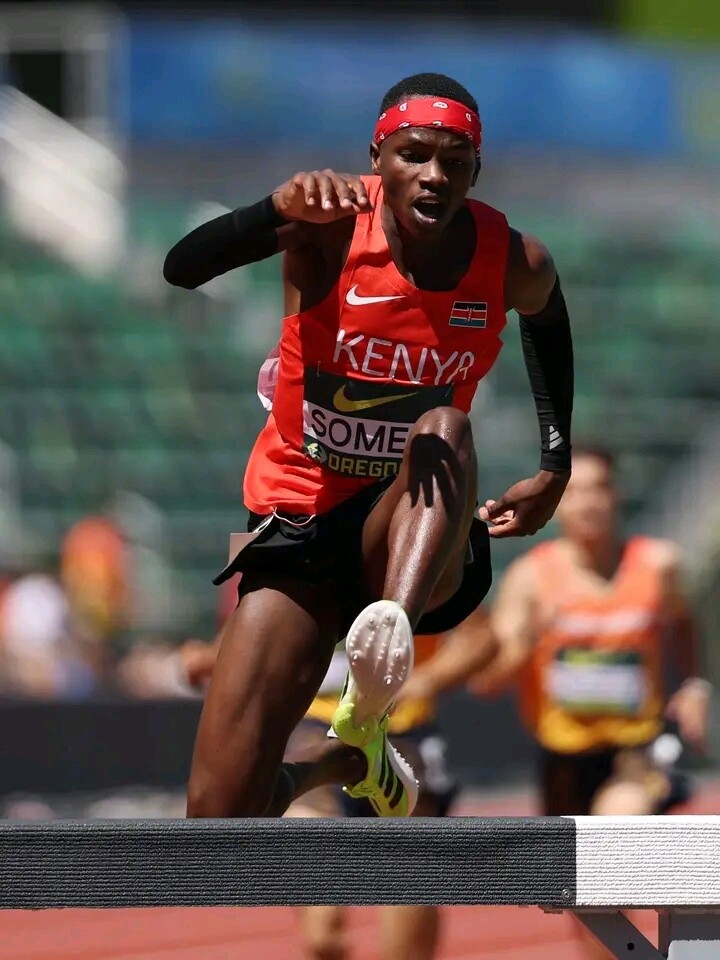
Lemiso, the African U20 champion, had positioned himself at the front of the race and moved into the lead around the 2,300-metre mark as Kenya looked capable of producing another major championship sweep in the event.
But El Asri remained within striking distance. With two laps remaining, the Spaniard began to close the gap before unleashing a powerful finishing surge that ultimately carried him clear of Lemiso and towards the biggest victory of his young career.
Lemiso refused to surrender his position, holding on strongly for silver in a personal-best 8:32.81. It was a significant performance from the Kenyan, who converted his front-running effort into a world U20 championship medal.
Behind him, the battle for bronze delivered perhaps the most dramatic moment of the race.
Losiwareng appeared to lose valuable ground after a stumble at one of the barriers late in the race. Rather than allowing the mistake to end his medal hopes, however, the Kenyan regrouped and launched an aggressive sprint over the final 100 metres.
That charge brought him back into contention with Spain’s Martí Torregrossa. The two athletes fought all the way to the line, with Losiwareng eventually securing third in 8:38.05, just 0.08 seconds ahead of his Spanish rival.
The result gave Kenya two medals from a race that had threatened to slip away in the final stages. Lemiso’s silver and Losiwareng’s bronze also underlined the depth of Kenya’s young steeplechase talent on the international stage.
For El Asri, the victory marked a breakthrough performance, while Kenya could take considerable encouragement from placing two athletes on the podium despite missing out on the title.
The final standings were:
1. Bakr El Asri Mohsine (Spain) — 8:28.35, European U20 Area Record
2. Emmanuel Lemiso Someki (Kenya) — 8:32.81, Personal Best
3. Nicholas Kitum Losiwareng (Kenya) — 8:38.05
In a race decided by the final two laps, El Asri had the speed to take gold, Lemiso had the strength to secure silver, and Losiwareng had the resilience to fight back from adversity and complete Kenya’s double podium finish.
by Erick Cheruiyot for My Best Runs.
Login to leave a comment

Josh Kerr’s Mile Mastery Could One Day Lead Him To The London Marathon
Josh Kerr has conquered one of athletics’ most historic distances. Yet, remarkably, the Scottish star is already dreaming about a challenge that sits more than 25 miles beyond the distance that has made him a global track sensation.
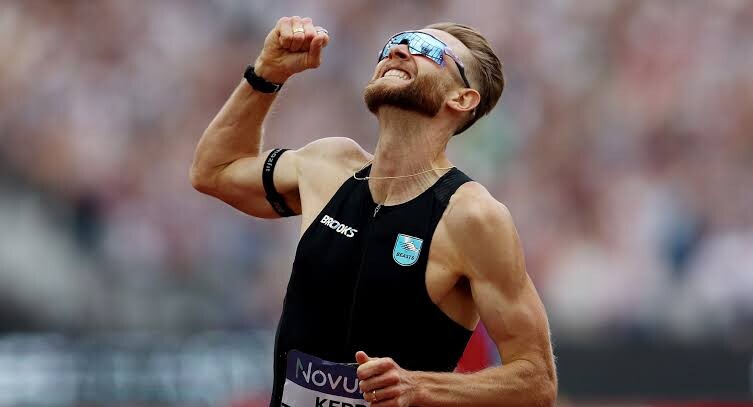
Kerr produced one of the defining performances of his career on July 18, 2026, at the London Stadium, storming to a sensational 3:42.66 in the Emsley Carr Mile to shatter Hicham El Guerrouj’s world record. The Moroccan’s 3:43.13 had stood untouched since 1999, but Kerr finally brought the 27-year-old mark down by 0.47 seconds.
The performance confirmed Kerr’s place among the greatest milers of his generation, but his ambitions extend well beyond the track.
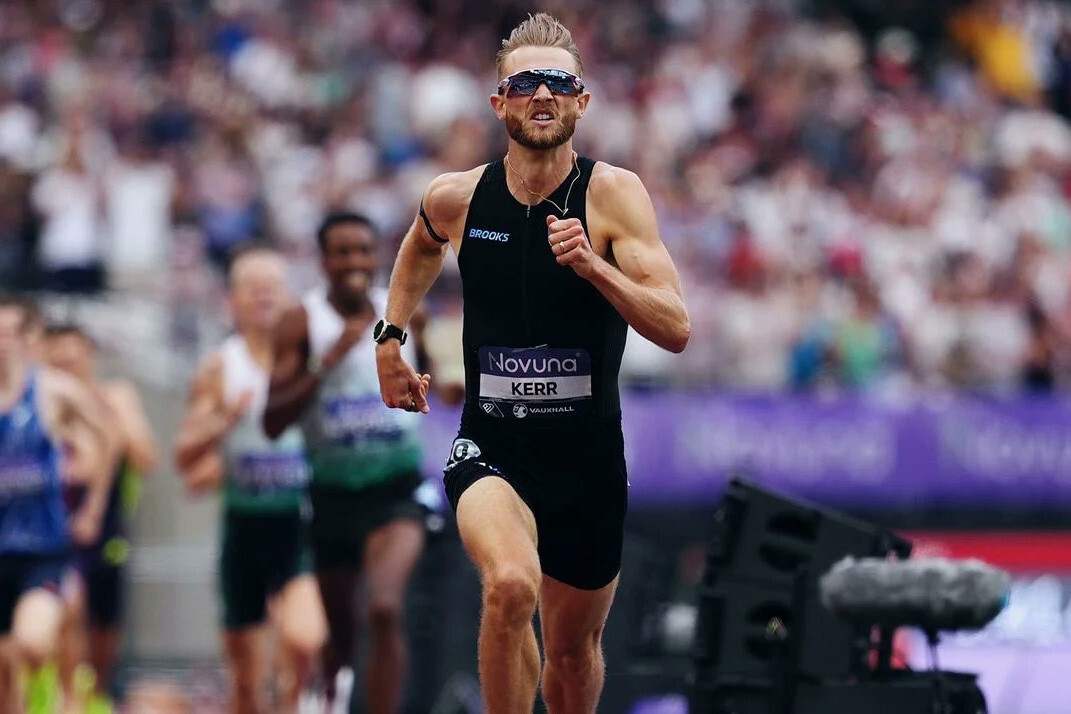
Speaking after his historic achievement, the 28-year-old revealed that the marathon is a distance he has become increasingly fascinated by, with the London Marathon occupying a particularly special place in his long-term imagination. For Kerr, the ultimate attraction would not necessarily be a world-class time, but the possibility of one day winning the race.
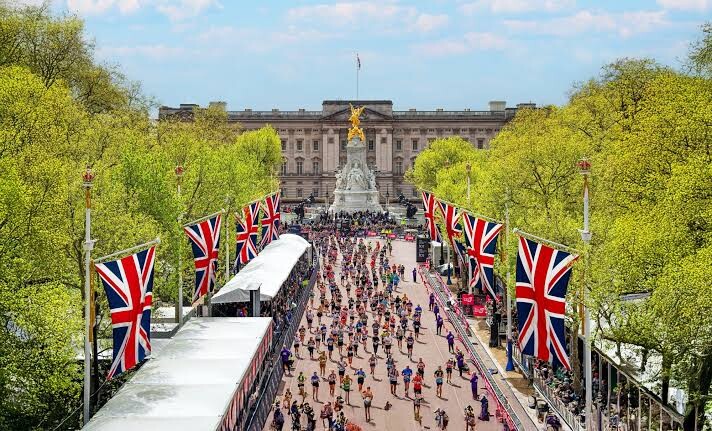
He remains realistic about how distant that ambition is. Kerr has made it clear that there is still important work to be completed on the track, with the Los Angeles 2028 Olympic Games among his major objectives. His marathon dream, therefore, belongs to the future rather than the immediate present.
That patience could prove crucial.
The transition from the mile to the marathon is one of the most demanding changes an elite distance runner can make. It requires far more than simply possessing exceptional aerobic fitness. The marathon places extraordinary demands on endurance, efficiency, energy management and the ability to maintain a high pace for more than two hours.
History, however, has shown that a world-class track runner can successfully make the leap when the timing is right.
Sifan Hassan provides perhaps the most spectacular modern example. After establishing herself as one of the most versatile distance runners in history, competing successfully from 1,500m through 10,000m, the Dutchwoman made her marathon debut at the 2023 London Marathon. She won in 2:18:33 after producing a remarkable finishing sprint, then went on to claim Olympic marathon gold the following year.
Her ability to change gears late in races became one of her greatest weapons. It is also an attribute Kerr knows particularly well.
Kerr has built his reputation around devastating finishing speed. Whether competing over 1,500m or the mile, his ability to accelerate when others are already approaching their physical limits has repeatedly separated him from the field. The question is whether that same weapon could eventually become a decisive advantage over the marathon distance.
Mo Farah's journey offers a more complicated lesson.
The British legend spent years dominating the 5,000m and 10,000m before turning his attention to the marathon. Despite possessing an extraordinary endurance base, Farah discovered that the marathon demanded an entirely different level of preparation. He finished eighth on his London Marathon debut in 2014 in 2:08:21 before eventually improving the British record to 2:06:22 in 2018.
Farah later explained that mastering the marathon took considerable time, underlining just how different the event is from even the longest Olympic track distances.
For Kerr, the physiological challenge would be even greater because his speciality is the mile.
The mile rewards an athlete who can combine enormous aerobic power with exceptional speed. The marathon, by contrast, demands the ability to operate efficiently for a prolonged period below maximum aerobic capacity. Running economy, lactate-threshold ability, endurance and the capacity to preserve energy deep into a race become increasingly important.
That transformation cannot be rushed.
And the marathon landscape Kerr would eventually enter is becoming more extraordinary by the year.
The 2026 London Marathon demonstrated just how far the event has evolved. Kenya’s Sabastian Sawe made history by becoming the first athlete to officially break the two-hour barrier in a competitive marathon, winning in 1:59:30. Ethiopia’s Yomif Kejelcha also finished inside two hours, while three men ultimately finished faster than the previous world record.
That is the standard waiting for Kerr if his distant ambition eventually becomes reality.
For now, however, there is no need to hurry. Kerr has already rewritten the mile record books, becoming the first man to break 3:43 and ending one of the longest-standing world records in modern athletics.
His next chapter is still firmly rooted on the track, where Olympic glory remains a major target. But somewhere beyond those ambitions lies a different challenge: 26.2 miles of London roads, a distance more than 25 miles longer than the event in which he currently reigns supreme.
It may sound improbable today, but Kerr is not dismissing the possibility.
“I promise I will try it.”
And if the day eventually comes when the world mile record-holder lines up on The Mall with the London Marathon title in his sights, it could become one of the most intriguing distance-running transitions the sport has ever witnessed.
by Erick Cheruiyot for My Best Runs.
Login to leave a comment
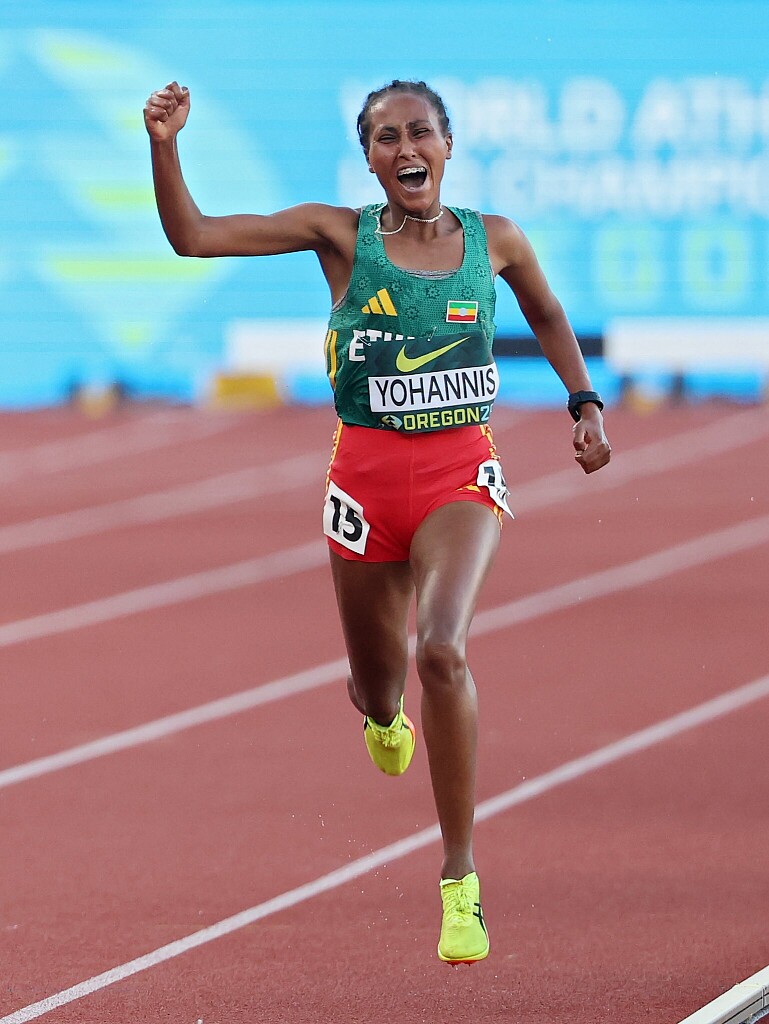
Almaz Yohannis Leads Ethiopian 1-2 in Spectacular World U20 Steeplechase Triumph
Ethiopia produced a spectacular display of emerging talent as Almaz Yohannis was crowned world champion in the women’s 3000m steeplechase at the 2026 World Athletics U20 Championships in Oregon, powering to a commanding victory in 9:15.81.
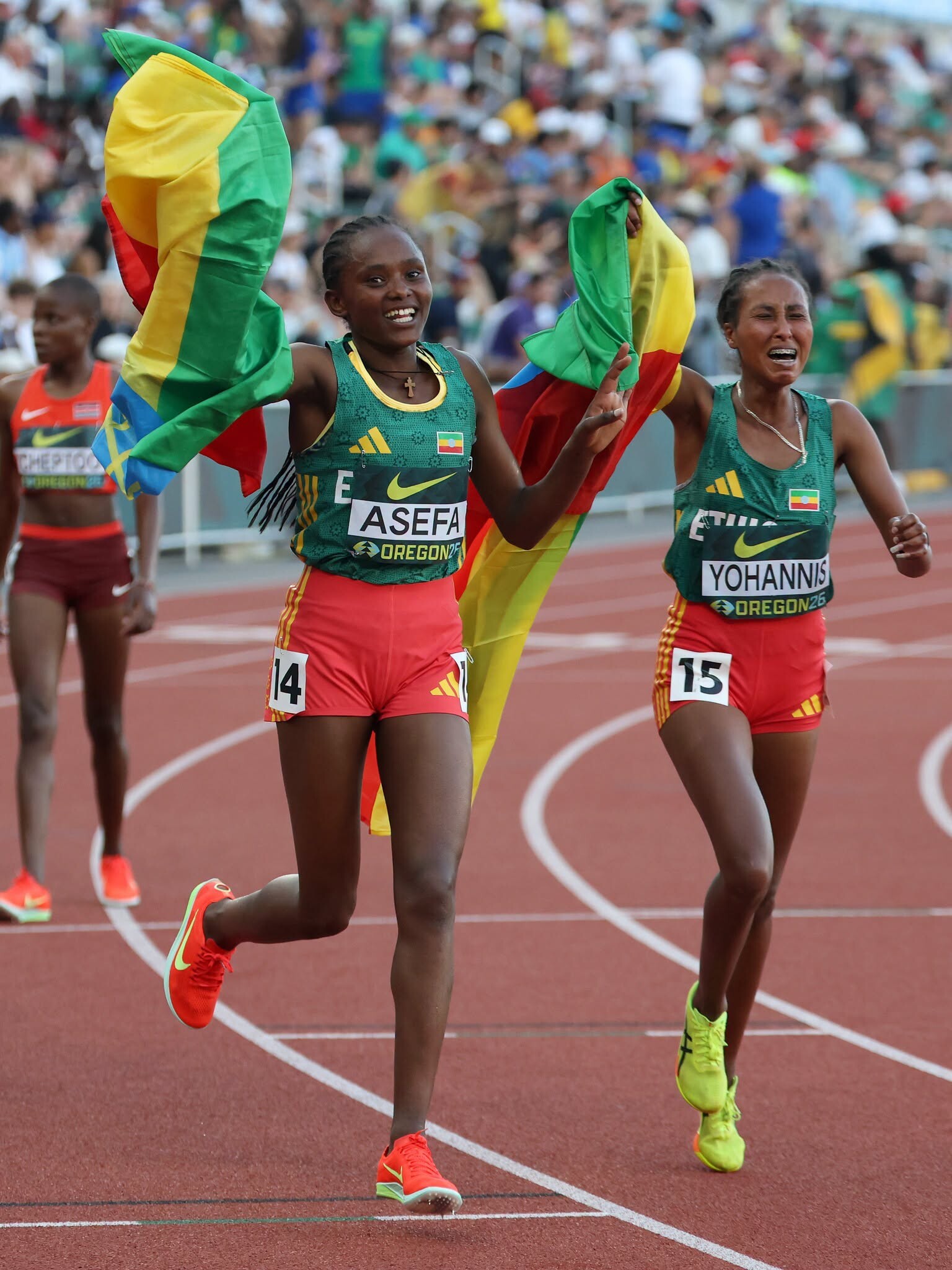
Yohannis delivered a superb performance to secure the gold medal and, in the process, recorded a World U20 Leading time (WU20L), underlining the strength of her performance on the global junior stage.
The young Ethiopian established herself as the athlete to beat, maintaining her composure and strength throughout the demanding eight-lap steeplechase before crossing the finish line well clear of the field. Her winning mark of 9:15.81 provided a fitting reward for a dominant championship performance.
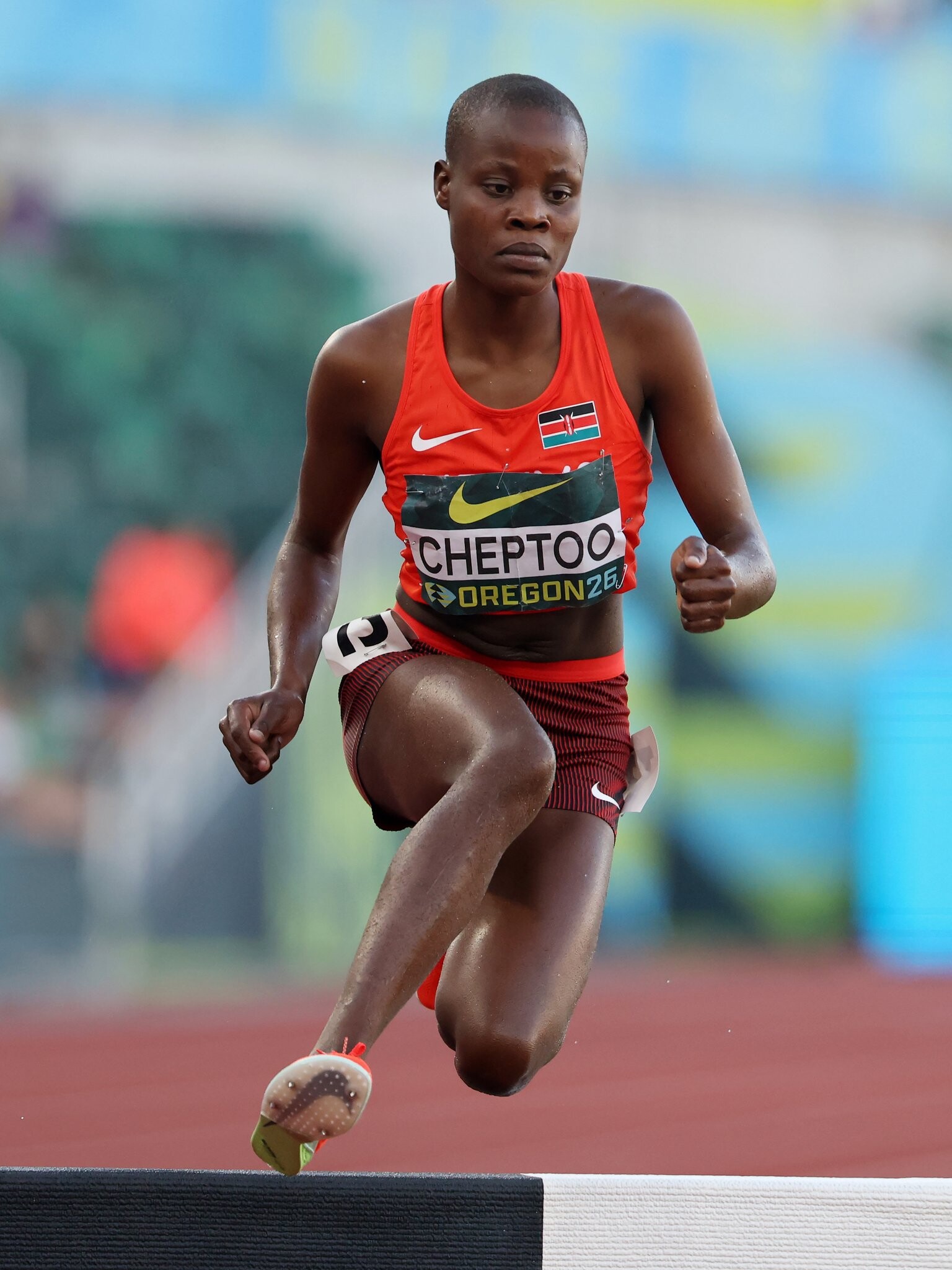
Ethiopia’s celebrations were doubled when Wosane Asefa secured the silver medal in 9:30.50, producing a season’s best (SB) and completing an impressive Ethiopian one-two.
Kenya’s Anatasha Cheptoo ensured there was East African representation on all three steps of the podium, fighting her way to the bronze medal in 9:37.18.
Behind the medalists, Sweden’s Majken Söderlund Larsson finished fourth in 9:48.01, setting a national U20 record (NU20R), while Czech Republic’s Ema Berková followed in fifth with 9:49.06, also recording a national U20 record.
Sweden’s Fanny Szalkai placed sixth in 9:55.06, a personal best, while Greece’s Anna Dafni Almyroudi Stroumpou finished seventh in 10:00.63, another national U20 record.
Egypt’s Malak Abdelghany Abdalla Ibrahim crossed eighth in 10:04.52, also establishing a national U20 record. Slovakia’s Anna Švrček was ninth in 10:05.91, followed by Japan’s Rei Taya in 10:12.37.
Portugal’s Lara Roque finished 11th in 10:15.69, setting a national U20 record, while Poland’s Zuzanna Szymańska took 12th in 10:15.94, a personal best. Great Britain’s Ava James was 13th in 10:18.96, followed by American Sierra Wall in 14th with 10:21.21.
Poland’s Michalina Thamm completed the finishers in 15th place in 10:39.01.
Kenya’s Mercy Chepngeno Koskey, who had also lined up as part of the Kenyan challenge, was unfortunately unable to finish the race.
The final podium therefore belonged to three of East Africa’s rising stars, with Yohannis and Asefa delivering a memorable Ethiopian one-two, while Cheptoo secured bronze for Kenya.
Women’s 3000m Steeplechase — Official Results
1. Almaz Yohannis (Ethiopia) — 9:15.81 (WU20L)
2. Wosane Asefa (Ethiopia) — 9:30.50 (SB)
3. Anatasha Cheptoo (Kenya) — 9:37.18
4. Majken Söderlund Larsson (Sweden) — 9:48.01 (NU20R)
5. Ema Berková (Czech Republic) — 9:49.06 (NU20R)
6. Fanny Szalkai (Sweden) — 9:55.06 (PB)
7. Anna Dafni Almyroudi Stroumpou (Greece) — 10:00.63 (NU20R)
8. Malak Abdelghany Abdalla Ibrahim (Egypt) — 10:04.52 (NU20R)
9. Anna Švrček (Slovakia) — 10:05.91
10. Rei Taya (Japan) — 10:12.37
11. Lara Roque (Portugal) — 10:15.69 (NU20R)
12. Zuzanna Szymańska (Poland) — 10:15.94 (PB)
13. Ava James (Great Britain) — 10:18.96
14. Sierra Wall (United States) — 10:21.21
15. Michalina Thamm (Poland) — 10:39.01
DNF: Mercy Chepngeno Koskey (Kenya)
Yohannis’ victory marked the highlight of a brilliant Ethiopian performance, with her 9:15.81 World U20-leading mark setting the tone for a memorable championship final and announcing another exciting young talent onto the international athletics scene.
by Erick Cheruiyot for My Best Runs.
Login to leave a comment
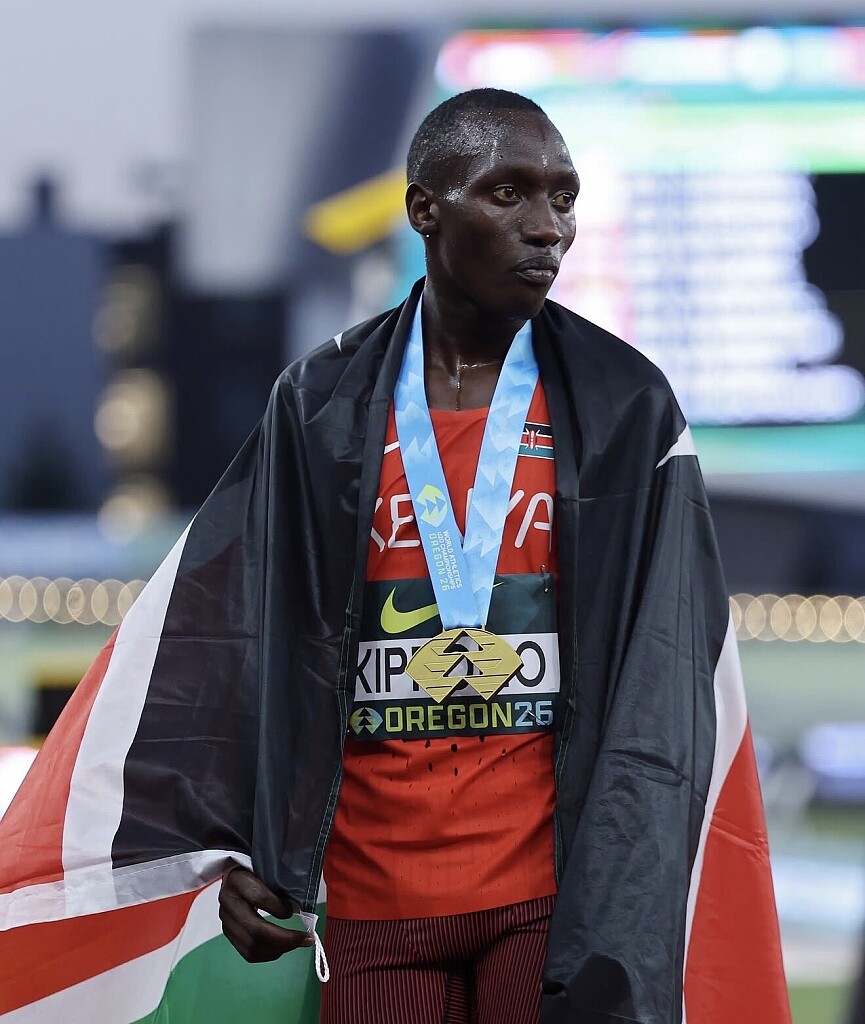
Emmanuel Kiprono Storms to World U20 3,000m Gold in Championship-Record 7:28.28
Kenya’s Emmanuel Kiprono has announced himself as one of the brightest young distance-running talents in the world after producing a sensational solo performance to win the men’s 3,000 metres gold medal at the World Athletics U20 Championships in a championship-record 7:28.28.
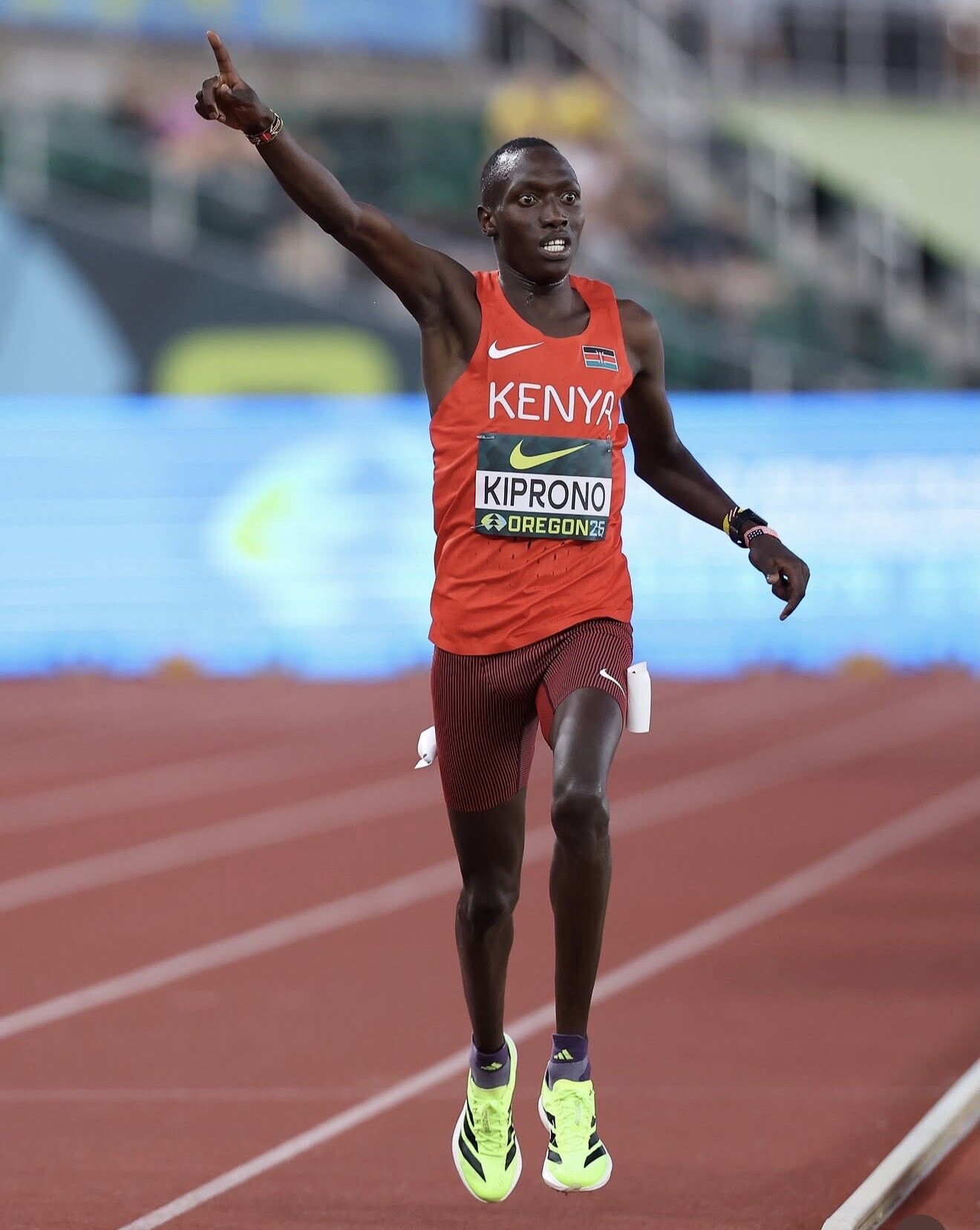
Just 17 years old, Kiprono took control from the opening metres and never looked back. Running completely alone for virtually the entire race, the Kenyan dictated the tempo with remarkable confidence and gradually transformed the final into a one-man race.
Kiprono passed 1,000 metres in 2:26.52, reached 1,600 metres in 3:54.58, and continued his relentless charge through 2,000 metres in 4:55.43. With every lap, the gap behind him grew larger as his rivals struggled to match his extraordinary pace.
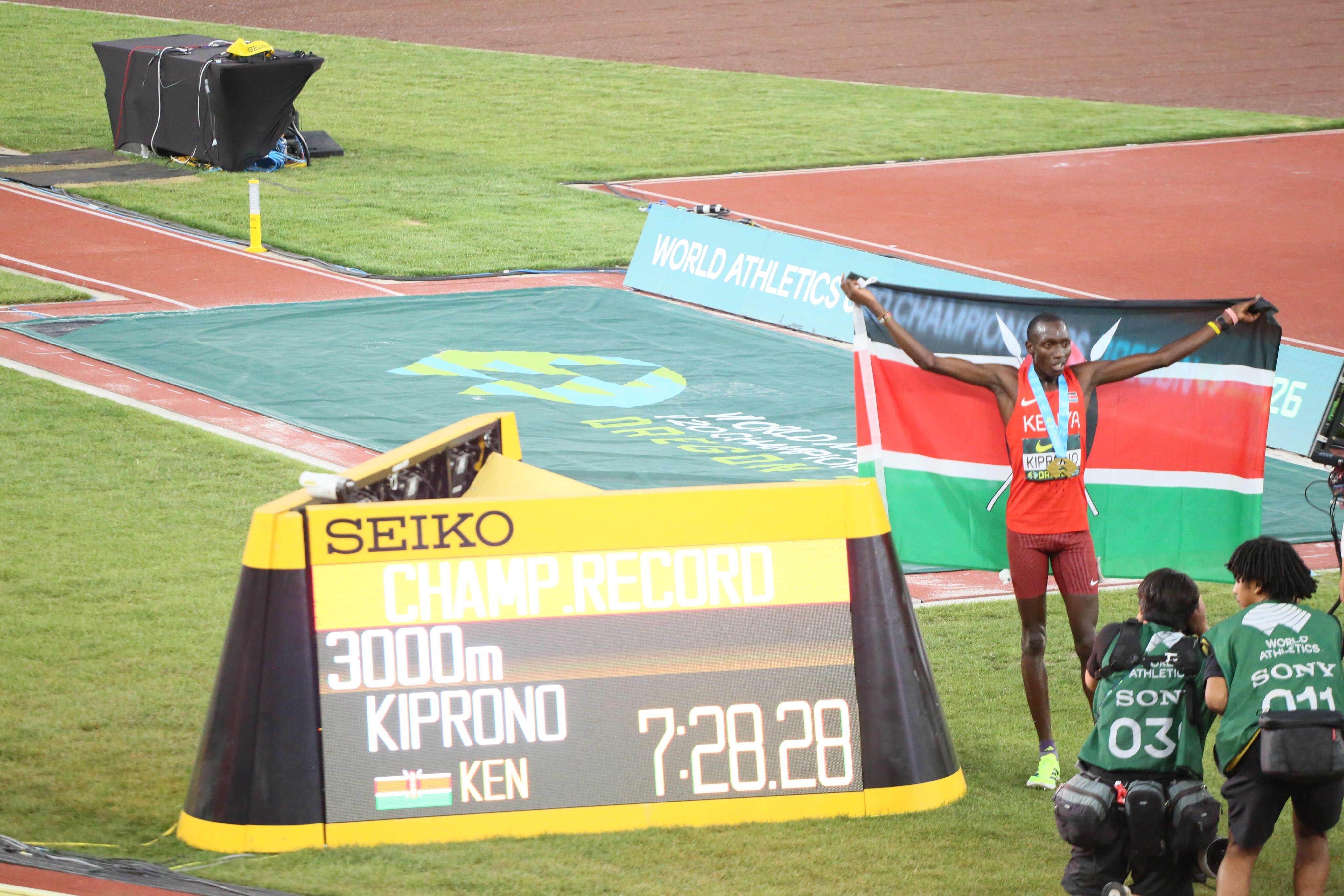
He eventually crossed the finish line in 7:28.28, smashing the championship record and coming agonisingly close to the world U20 record of 7:28.20, set by Ethiopia’s Yomif Kejelcha. Kiprono missed the global junior mark by just 0.08 seconds.
The margin of victory was equally spectacular. He finished 19 seconds ahead of France’s Alois Abraham, who took silver in 7:47.79, while Japan’s Ojiro Honda secured bronze in 7:48.49, setting a Japanese U20 record.
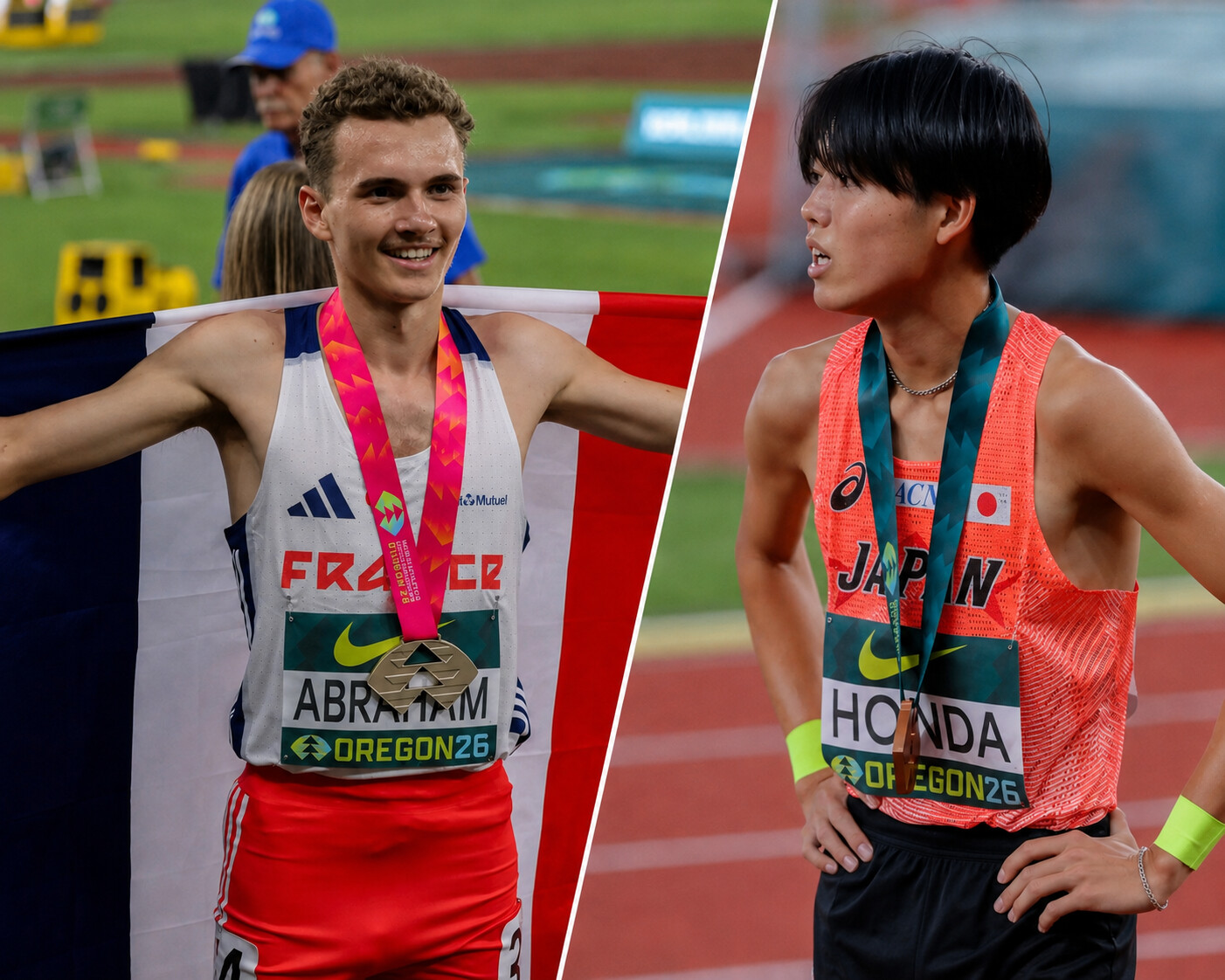
Men’s 3,000m Final
1. Emmanuel Kiprono — Kenya — 7:28.28 (Championship Record)
2. Alois Abraham — France — 7:47.79
3. Ojiro Honda — Japan — 7:48.49 (National U20 Record)
4. Liam Conway — Great Britain — 7:50.10 (Personal Best)
5. Aleksi Ahlfors — Finland — 7:50.56 (Personal Best)
6. Tzu-Chieh Chien — Chinese Taipei — 7:51.18 (National U20 Record)
7. Ilyes Druez — Belgium — 7:51.67 (Personal Best)
8. Sebastian Lörstad — Sweden — 7:51.94 (Personal Best)
9. Edwin Elkana — Kenya — 7:51.94 (Personal Best)
10. Owen Powell — United States — 7:53.35 (Personal Best)
Kiprono’s breakthrough is particularly significant given his performances earlier this year. The 17-year-old finished second in the U20 race at the World Cross Country Championships, establishing himself as one of the leading prospects in the new generation of Kenyan distance runners.
But on the track, he produced something even more extraordinary.
There was no tactical waiting game, no final-lap sprint and no group to shelter behind. Kiprono simply went to the front and challenged himself against the clock. His splits — 2:26.52 at 1,000m, 3:54.58 at 1,600m and 4:55.43 at 2,000m — demonstrate the remarkable consistency and courage behind the performance.
After the race, Kiprono celebrated with the Kenyan flag draped around him before posing beside the SEIKO championship-record display, which showed his historic 7:28.28.
His championship record also came with a tantalising glimpse of what might have been. Had he found even a fraction more in the closing metres, the world U20 record could have fallen as well. Nevertheless, coming within eight hundredths of the mark while running almost the entire race alone makes the achievement all the more remarkable.
Emmanuel Kiprono has not merely won a world junior title — he has made a statement. At only 17, his extraordinary front-running, championship record and near-world-record performance suggest that Kenyan distance running may have another major talent ready to emerge onto the global stage.
by Erick Cheruiyot for My Best Runs.
Login to leave a comment
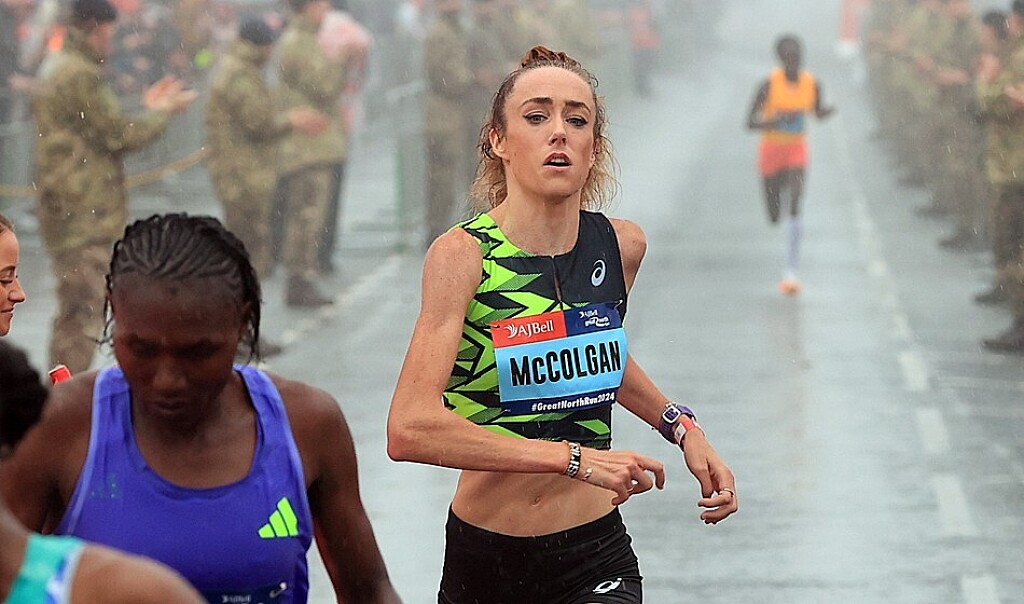
Eilish McColgan Eyes Historic Big Half Hat-Trick After Injury Setback
British distance-running star Eilish McColgan is set to make her highly anticipated return to The Big Half in London, where she will chase a record-extending third women's title after being confirmed for this year's race.
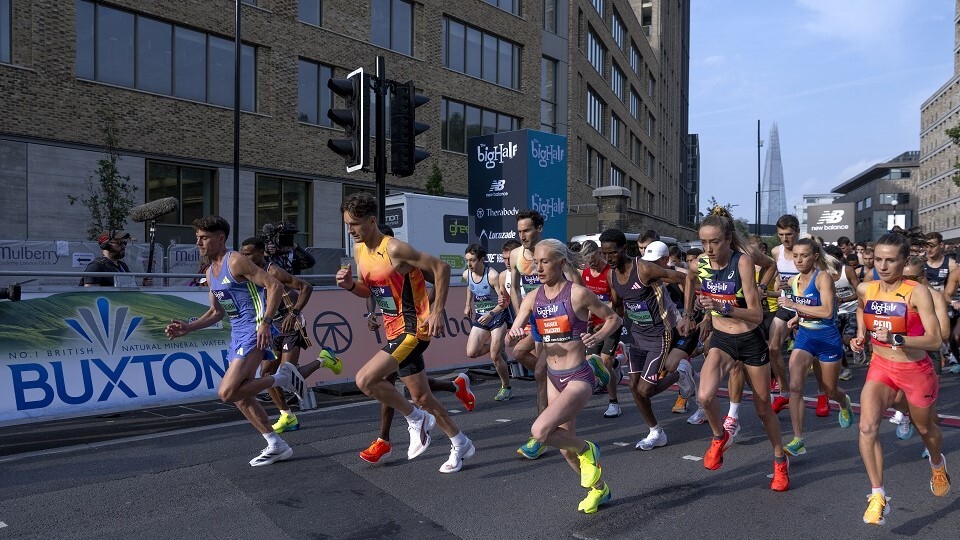
The British half marathon record holder heads back to one of her favourite events with unfinished business, determined to reignite her season following a frustrating spell on the sidelines. Having already lifted the Big Half crown in 2022 and 2024, McColgan now has the opportunity to add a third title to her impressive résumé and further cement her legacy as one of Britain's greatest road runners.
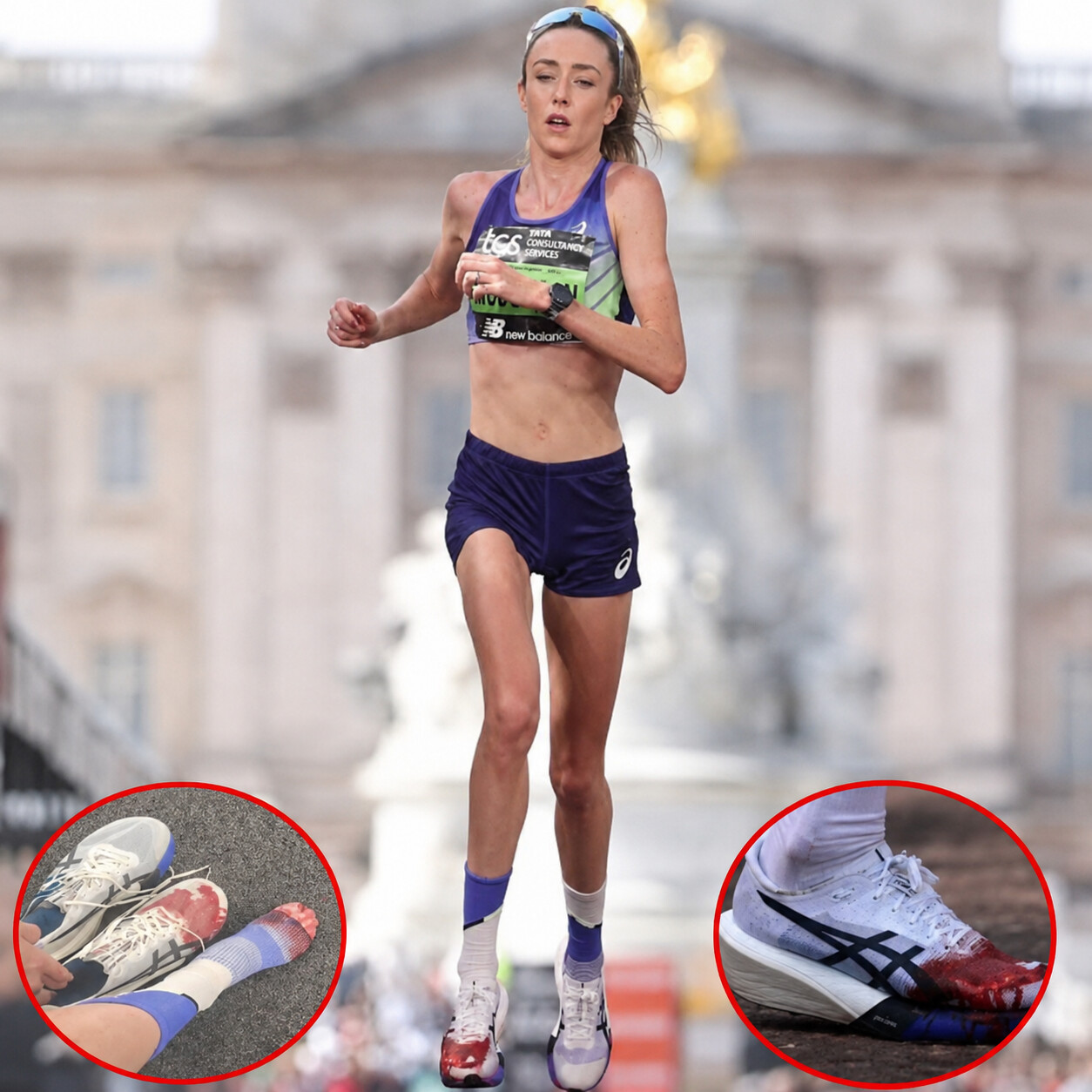
Her return comes after a difficult few months that tested both her resilience and patience. McColgan sustained a toe injury during the London Marathon in April, an issue that disrupted her training and ultimately forced her to withdraw from the Glasgow 2026 Commonwealth Games. As the defending 10,000m champion, she admitted she had not been given enough time to recover and reach the level of fitness required to defend her title.
Now fully focused on the road season, the Scottish star will be eager to put those setbacks behind her. The Big Half presents an ideal opportunity for McColgan to showcase the progress she has made since returning from injury. A strong performance would not only boost her confidence but also reaffirm her status as one of Britain's premier distance runners as she builds momentum for the races ahead.
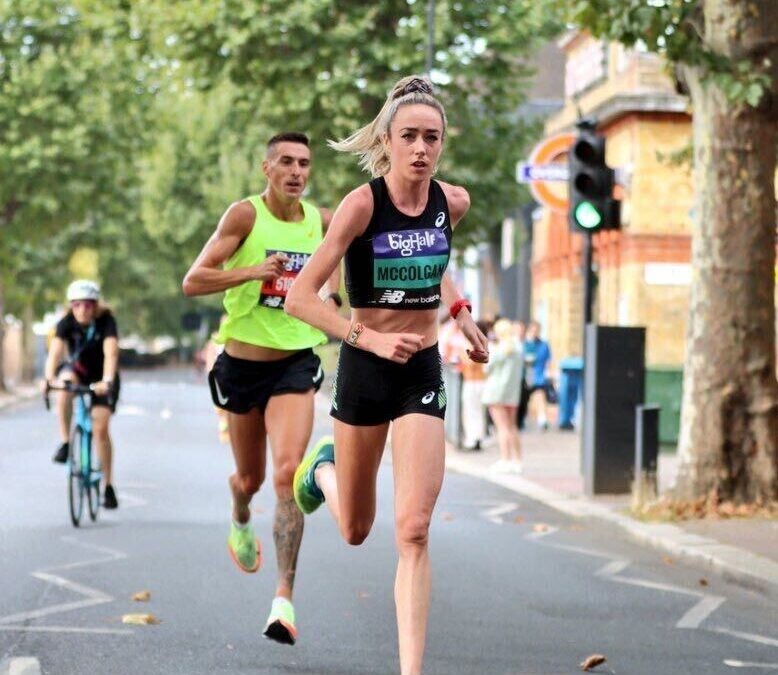
Beyond the race for another title, McColgan's appearance marks an important step in her comeback journey. After months of rehabilitation and carefully rebuilding her fitness, the event will provide a valuable measure of her progress against a world-class field. A commanding performance would reaffirm her place among Britain's and Europe's elite distance runners while strengthening her confidence for the major road races and championships still to come.
The men's elite race is also shaping up to be one of the strongest in the event's history. British marathon standout Jack Rowe has been confirmed for the race and will be chasing a remarkable fourth consecutive Big Half title. Should he triumph once again, Rowe would surpass Sir Mo Farah's record to become the most successful elite men's champion in the history of the event.
With history on the line in both elite races, this year's Big Half promises to be one of the most captivating editions yet. Thousands of runners will take to the streets of London alongside some of Britain's finest distance athletes, creating a spectacular celebration of road running. McColgan's pursuit of a historic third women's crown and Rowe's bid to establish a new men's record ensure that fans can look forward to a thrilling day of competition filled with ambition, resilience, and memorable performances.
For fans of distance running, all eyes will be on London's streets as two British stars attempt to add another memorable chapter to their careers. Whether it is McColgan completing her remarkable comeback with another victory or Rowe rewriting the history books, this year's Big Half is perfectly poised to deliver another unforgettable showcase of British distance running at its finest.
by Erick Cheruiyot for My Best Runs.
Login to leave a comment
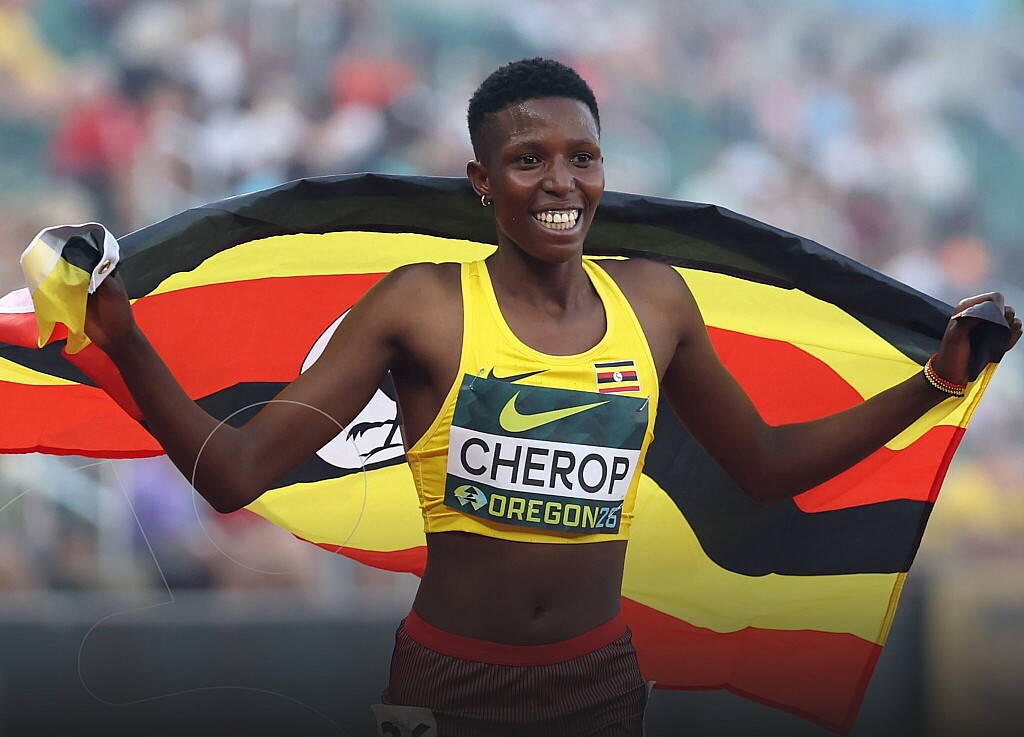
From Silver to Gold: Charity Cherop Storms to World U20 5000m Crown with Tactical Masterclass
Uganda's 19-year-old long-distance sensation Charity Cherop delivered the performance of her young career, producing a championship masterclass to capture the women's 5000m title at the 2026 World Athletics U20 Championships at Hayward Field in Eugene, Oregon.
Born on July 4, 2007, Cherop executed a tactically brilliant race, remaining patient throughout the early stages before unleashing a devastating surge over the final kilometre. Her perfectly timed move proved decisive as she crossed the finish line in 15:03.88, becoming the new World U20 champion.
The victory was more than just a world title—it completed a remarkable journey from silver to gold. After finishing runner-up at the previous World Athletics U20 Championships in Lima, Cherop returned to the global stage stronger and more determined, upgrading her silver medal to gold and confirming herself as one of the brightest young stars in international distance running.
Behind the Ugandan star, Ethiopia's Shito Gumi fought bravely to secure the silver medal in 15:07.91, while Kenya's Joyline Chepkemoi delivered an outstanding performance to claim bronze in 15:09.08, setting a new personal best in the process. The battle for the podium remained fiercely contested until the closing stages, with every medal decided through courage, tactical awareness, and a powerful finishing kick.
Kenya narrowly missed placing two athletes on the podium as Cynthia Chepkirui finished a strong fourth in 15:14.86, while Sweden's Carmen Cernjul rounded out the top five in 15:22.18.
Ethiopia's Emebet Tilahun placed sixth in 15:32.51, followed by Japan's Yui Onotora in seventh with 15:37.33. Uganda celebrated another top-10 finish through Bentalin Yeko, who finished eighth in 15:48.35, underlining the nation's impressive depth in women's distance running.
Germany's Julia Ehrle claimed ninth in 16:09.53, with France's Lamia Mourabit completing the top ten in 16:10.80.
Further down the field, Portugal's Carolina Correia impressed with an 11th-place finish in a personal best 16:11.47, while Norway's Venus Teffera also celebrated a lifetime best of 16:12.07 in 12th. Germany's Gloria Herold added another personal best, clocking 16:13.75 for 15th place.
France's Laly Porentru, Japan's Ayami Yoshida, the Netherlands' Rosalie Ten Bruggencate, Italy's Sofia Ferrari and Mimosa Miari Fulcis, Spain's Fatima Hernandez, Switzerland's Anina Hirzel, Great Britain's Eliza Nicholson, Canada's Airlie Downie-Back and Athena Andrecyk, Mexico's Kenya Cuahutle, and Australia's Libby Mantay and Imogen Baker all battled courageously to the finish, highlighting the exceptional depth and global talent assembled for the championship final.
The only athlete unable to start the race was the United States' Emily Wisniewski, who was listed as DNS.
The women's 5000m final showcased the very best of championship distance running—patience, tactical intelligence, and a thrilling finish. On the biggest stage of her junior career, Charity Cherop produced a race worthy of a world champion, transforming silver in Lima into gold in Eugene and writing another unforgettable chapter in Uganda's rich distance-running legacy.
by Erick Cheruiyot for My Best Runs.
Login to leave a comment
Composed Under Pressure: Anatasha Cheptoo Overcomes Early Drama to Secure World U20 Steeplechase Final Berth
Kenya's Anatasha Cheptoo produced one of the most memorable moments of the opening round of the women's 3,000m steeplechase at the World Athletics U20 Championships in Oregon, USA, displaying remarkable composure after an early setback to comfortably qualify for the final.
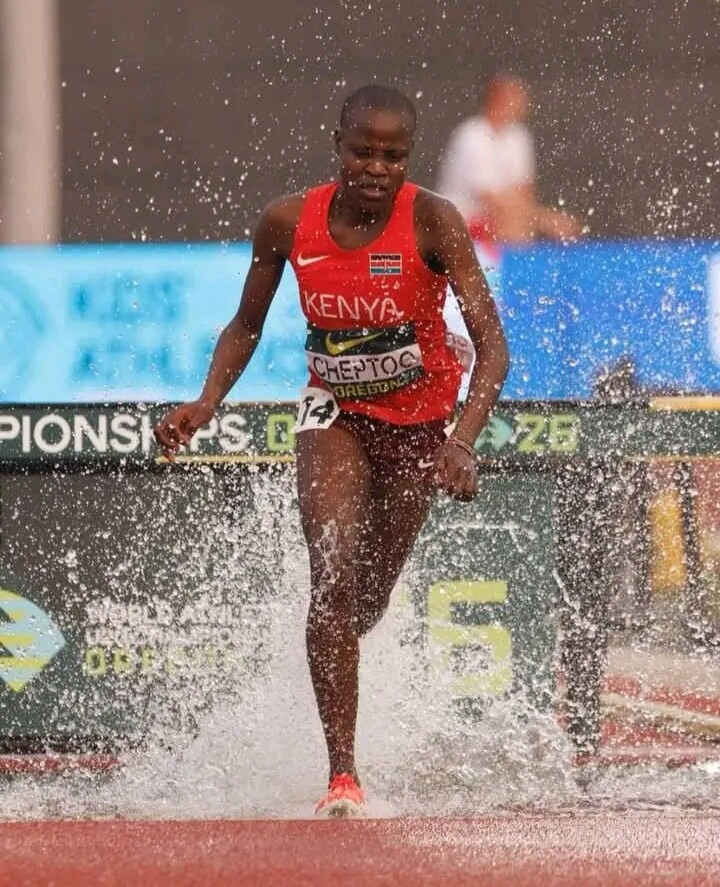
In a dramatic sequence during her heat, Cheptoo accidentally missed the water jump. Realizing the mistake almost immediately, she turned back, retraced her steps and cleared the obstacle correctly before rejoining the race. Although the incident briefly disrupted her rhythm, the young Kenyan refused to panic.
Showing maturity beyond her years, Cheptoo gradually worked her way back through the field with a determined and controlled performance. Her resilience paid off as she crossed the finish line in second place in 9:51.02, safely booking her place in the championship final.
What made the performance even more impressive was the way she transformed a potentially race-ending mistake into a qualification-worthy run. Many athletes would have struggled to recover after losing valuable seconds and momentum, but Cheptoo's calm decision-making and unwavering determination turned adversity into one of the championship's standout moments. It was a powerful reminder that championship racing is as much about mental toughness as it is about speed.
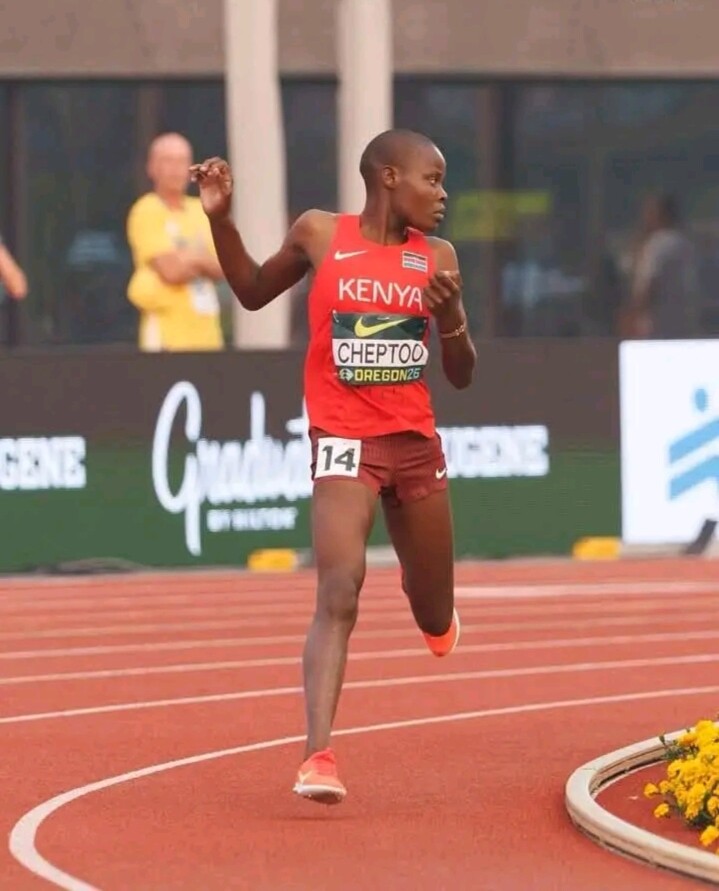
The qualification also reinforces Kenya's enduring reputation as a powerhouse in the steeplechase. For decades, Kenyan athletes have dominated the barriers and water jump on the global stage, and Cheptoo's fearless display suggests another exciting talent is emerging to carry that proud tradition into the future. Her ability to remain composed under immense pressure will make her one of the athletes to watch when the medals are decided.
Cheptoo will now shift her focus to the women's 3,000m steeplechase final, where she will be aiming to challenge for a place on the podium and add another medal to Kenya's campaign at the World Athletics U20 Championships.
The final is scheduled for Friday, 7 August 2026, and after her remarkable recovery in the heats, athletics fans will be eager to see whether the resilient Kenyan can transform an unforgettable qualification into a medal-winning performance.
by Erick Cheruiyot for My Best Runs.
Login to leave a comment
Eugene Welcomes the Future of Athletics as the 2026 World U20 Championships Get Underway
The global spotlight turns to Eugene, Oregon, today as the 2026 World Athletics U20 Championships officially get underway at the iconic Hayward Field, launching five days of elite competition that will showcase the sport's brightest young talents.
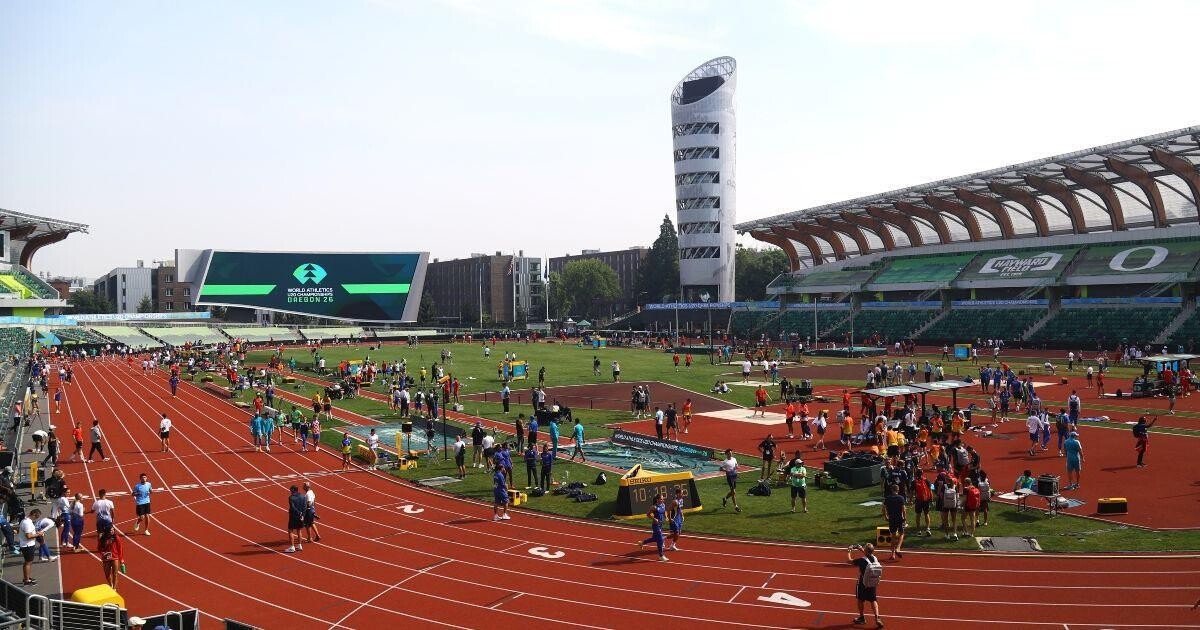
Running from August 5 to August 9, the 40th edition of the championships is the biggest in the event's history, bringing together more than 1,800 athletes representing 147 nations. For many of these rising stars, the championships mark the first major step toward future Olympic, World Championship, and Diamond League success.
The opening day immediately promises world-class action with three gold medals on the line. The women's 5,000m and men's 5,000m finals will test the endurance of the world's finest young distance runners, while the mixed 4×400m relay is expected to provide a thrilling conclusion to the day's competition as teams battle for the first relay title of the championships.
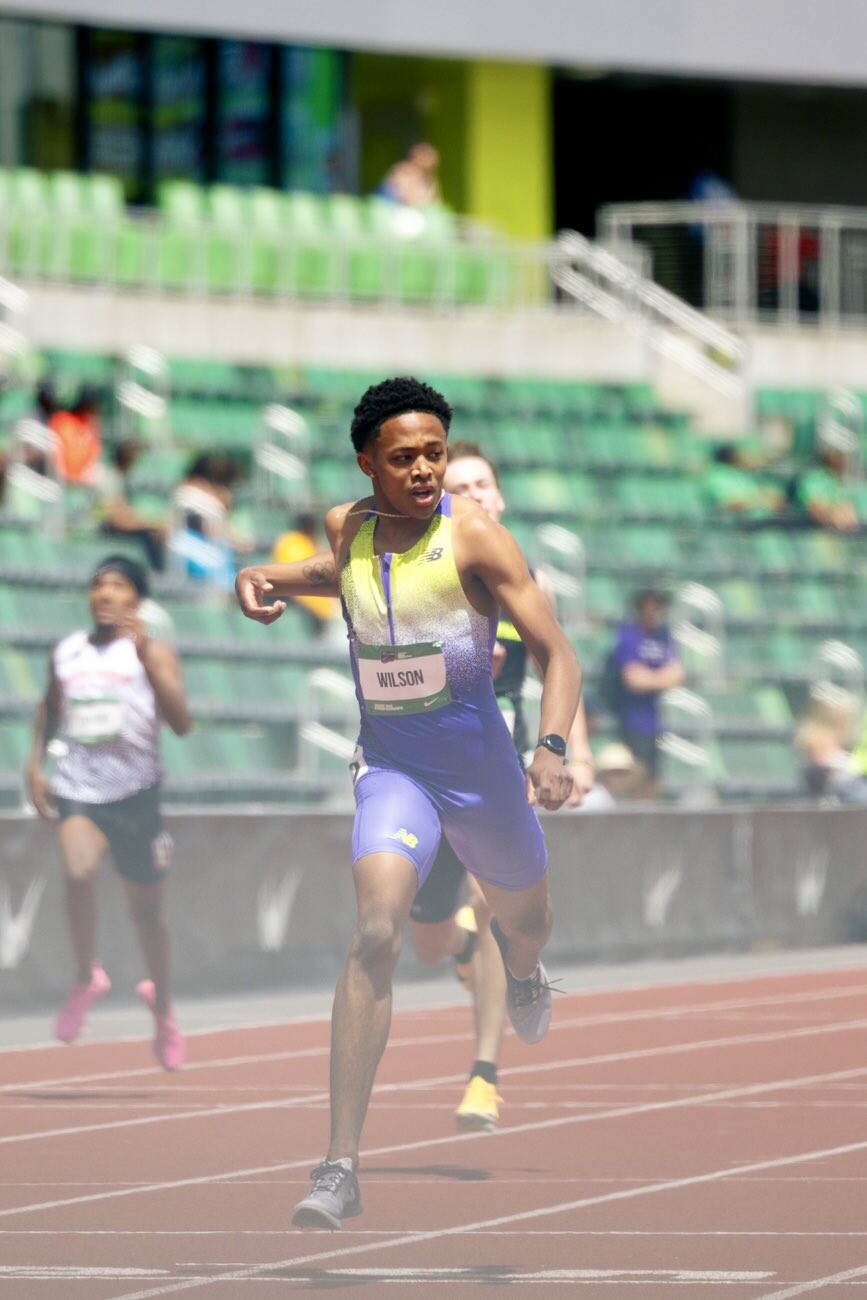
Several exciting athletes arrive in Eugene carrying high expectations. American sprint sensation Quincy Wilson will be one of the biggest attractions on home soil after establishing himself as one of the fastest young quarter-milers in the world. Fellow American Tate Taylor, the high school national record holder, will also be aiming to translate his remarkable speed into championship gold.
Jamaica's emerging sprint talent Shanoya Douglas enters the competition determined to challenge for the women's 200m title, while Kenya's Frankline Kibet will spearhead his country's pursuit of more distance-running success, continuing a tradition that has produced some of the greatest champions in athletics history.
Beyond the medals, the World U20 Championships have long served as the launching pad for future legends of the sport. Numerous Olympic and world champions first announced themselves on this very stage, making Eugene the perfect setting for another generation of athletes eager to leave their mark on the global scene.
Fans around the world will be able to follow every moment of the action through a range of broadcast partners, including Peacock in the United States, SuperSport across Sub-Saharan Africa, Eurovision Sport throughout Europe, CBC Gem in Canada, Seven Network in Australia, and World Athletics+ in eligible territories.
With national pride, championship titles, and the chance to announce themselves to the world at stake, the stage is set for five unforgettable days of athletics. As competition begins at the historic Hayward Field, the next generation of global stars is ready to write the opening chapter of what could become remarkable careers.
by Erick Cheruiyot for My Best Runs.
Login to leave a comment
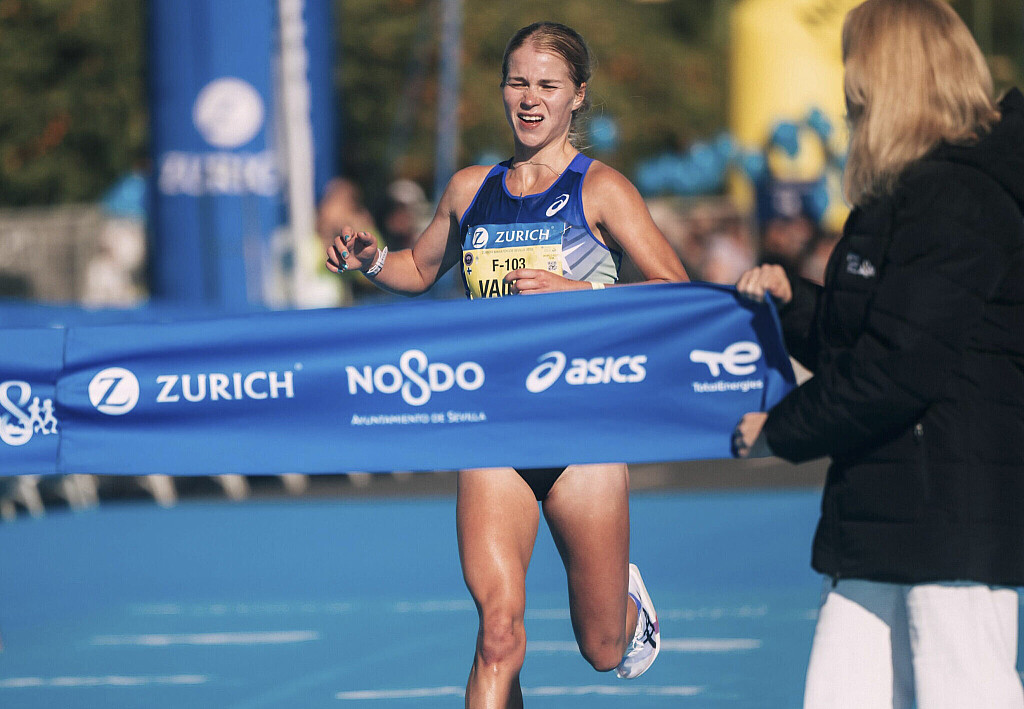
Europe's Elite Women Marathoners Ready for Thrilling Championship Battle in Birmingham
The women's marathon at the 2026 European Athletics Championships is set to be one of the most eagerly anticipated races of the championships, bringing together an exceptional field of experienced championship performers, rising stars, and defending medalists in what promises to be a fascinating battle for European glory.
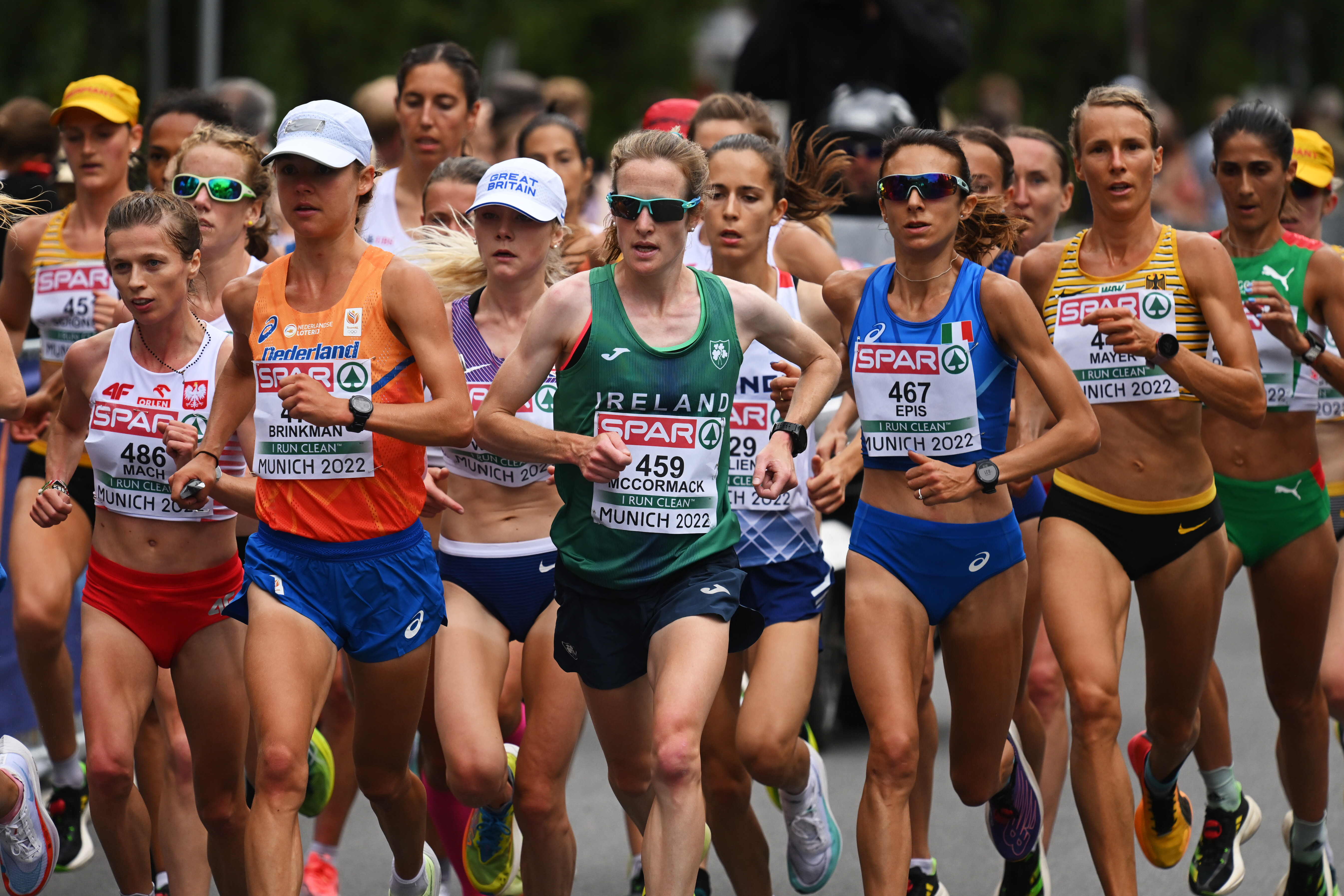
While Finland's Alisa Vainio enters Birmingham as the fastest European woman this season after clocking a brilliant 2:20:39 at the Seville Marathon, she faces stiff competition from some of the continent's strongest marathon nations, including Germany, Spain, Poland, Ireland, and host nation Great Britain.
Vainio's journey to the top has been years in the making. Widely regarded as one of Europe's brightest teenage distance-running prospects, she qualified for the marathon for the Rio 2016 Olympic Games at just 18 years old but was unable to compete because she did not meet the minimum age requirement. Instead of fading from the spotlight, she steadily rebuilt her career and has now matured into one of Europe's premier marathon runners.
Her breakthrough came at the 2025 World Athletics Championships in Tokyo, where she produced a composed and intelligent race in oppressive heat and humidity to finish fifth overall as the first European athlete across the finish line. Just three weeks later, she shattered the Finnish marathon record with a solo 2:23:06 performance at the national championships in Vantaa.
Vainio has continued her remarkable momentum ever since. She completed three additional marathons, highlighted by a commanding victory at the Seville Marathon, where she lowered the Finnish record once again while setting the European-leading mark of 2:20:39, establishing herself as the athlete to beat heading into Birmingham.
Germany arrives with one of the deepest squads in the championship and will be aiming to defend the women's team title won in Munich four years ago. Fabienne Königstein leads the German challenge after setting a personal best of 2:22:17 with a sixth-place finish at the Berlin Marathon. She is joined by the versatile Laura Hottenrott, who added another major achievement to her career earlier this year by winning silver in the uphill race at the European Athletics Off-Road Running Championships.
Spain also boasts an exceptionally strong lineup and is expected to challenge for both the individual and team honors. Fatima Azzahraa Ouhaddou Nafie demonstrated her championship resilience by recovering from a mid-race fall to win the marathon at the 2025 European Running Championships. Laura Luengo brings a personal best of 2:22:31, while Meritxell Soler, Ester Navarrete, and Carolina Robles complete a formidable squad. Impressively, every Spanish athlete in the team owns a lifetime best under 2:25, highlighting the country's remarkable marathon depth.
Defending champion Aleksandra Lisowska of Poland cannot be overlooked despite not being among the pre-race favorites. Her surprise victory in Munich four years ago proved that championship marathons often reward tactical brilliance, patience, and resilience rather than raw speed alone. Having already demonstrated her ability to thrive under championship pressure, the Polish star remains a genuine threat in Birmingham.
Ireland's Fionnuala McCormack will also be one of the most compelling athletes to watch. Just weeks before her 42nd birthday, the experienced marathoner continues her pursuit of a first European Championships medal after several near misses during her distinguished career. She finished fourth twice in the 10,000m at previous championships and was seventh in the marathon in Munich before producing another impressive performance with ninth place at the 2025 World Athletics Championships, finishing second among the European athletes behind Vainio.
Host nation Great Britain will be eager to make history on home roads. British women have never won an individual medal in the European Athletics Championships marathon since the event was introduced in 1982. Their hopes rest with Paris Olympians Rose Harvey and Clara Evans, alongside 2023 European cross-country bronze medallist Abbie Donnelly, who made an impressive marathon debut with a time of 2:24:11 in Frankfurt last year.
With proven champions, emerging contenders, experienced veterans, and deep national teams all chasing medals, the women's marathon is expected to deliver one of the most competitive races of the championships. Whether the title is decided by relentless pace, tactical patience, or a decisive late surge, Birmingham is set to provide a memorable contest worthy of the European crown.
by Erick Cheruiyot for My Best Runs.
Login to leave a comment
European Athletics Champioships
The27thEuropean Athletics Championshipswill be held from 10 to 16 August 2026 at theAlexander StadiuminBirmingham, United Kingdom.[1] This is the first time that a British city will have staged the European Athletics Championships although Birmingham has hosted many high-profile events, including the2007 European Athletics Indoor Championships, the2003and2018 IAAF World Indoor Championshipsand the2022 Commonwealth Games. Alexander Stadium was renovated between 2019 and...
more...
Anisleidis Ochoa Produces Stunning Late Surge to Capture CAC Games 5,000m Gold in Santo Domingo
Cuba's Anisleidis Ochoa Suárez delivered a remarkable finishing kick to storm to victory in the women's 5,000m final at the 2026 Central American and Caribbean Games in Santo Domingo, Dominican Republic, earning the gold medal in a dramatic battle that went down to the final lap.
Nicknamed "La Polaca," Ochoa showcased exceptional composure throughout the race before unleashing a devastating final-lap sprint that left her rivals unable to respond. Her perfectly timed acceleration carried her across the finish line in 16:57.67, securing Cuba's first-place finish in one of the closest distance races of the championships.
Venezuela's Edymar Brea pushed Ochoa all the way to the line, claiming the silver medal in 16:59.67, just two seconds behind the Cuban champion. Mexico's Dafne Juárez completed the podium with a strong run of 17:00.45, finishing less than three seconds off the winning time after an intensely competitive contest.
Women's 5,000m – Medalists
1. Anisleidis Ochoa Suárez (Cuba) – 16:57.67
2. Edymar Brea (Venezuela) – 16:59.67
3. Dafne Juárez (Mexico) – 17:00.45
The race highlighted the growing depth of women's distance running across the Central American and Caribbean region, with the medalists separated by fewer than three seconds in a thrilling finish.
Ochoa's latest triumph further strengthens her reputation as one of Cuba's premier distance runners. The victory adds another major international title to her résumé and follows her memorable success at the Clásica Candelaria Internacional 10K in Costa Rica, where she also claimed victory with an impressive performance.
With another championship gold around her neck, Anisleidis Ochoa Suárez continues to establish herself as one of the region's most formidable long-distance athletes, once again proving that her trademark finishing speed can make the difference when the biggest titles are on the line.
by Erick Cheruiyot for My Best Runs.
Login to leave a comment
Two Canadians, One Big Statement: Fetherstonhaugh and Stewart-Barnett Shine in Commonwealth Steeplechase Final
Canada's Grace Fetherstonhaugh delivered the finest championship performance of her career on Wednesday night, producing a superb personal best of 9:27.49 to finish among the top six in the women's 3000m steeplechase final at the 2026 Commonwealth Games.
Competing against one of the strongest steeplechase fields assembled at the Games, Fetherstonhaugh showed remarkable composure from the opening laps. She stayed in contention throughout the demanding race, clearing each barrier with confidence before finishing strongly to slice valuable seconds off her previous lifetime best.
Her time of 9:27.49 not only marked a new personal record but also underlined her continued rise as one of Canada's most promising distance runners. Producing a career-best performance on one of the sport's biggest stages demonstrated both her physical preparation and her ability to thrive under championship pressure.
Canada's success in the final extended beyond Fetherstonhaugh's impressive run. Making her debut at a major international multi-sport Games, Katelyn Stewart-Barnett delivered an encouraging performance of her own, finishing ninth in 9:46.98. Competing on one of the biggest stages of her career, she raced with determination and poise, gaining invaluable championship experience while announcing herself as another emerging talent in Canadian distance running.
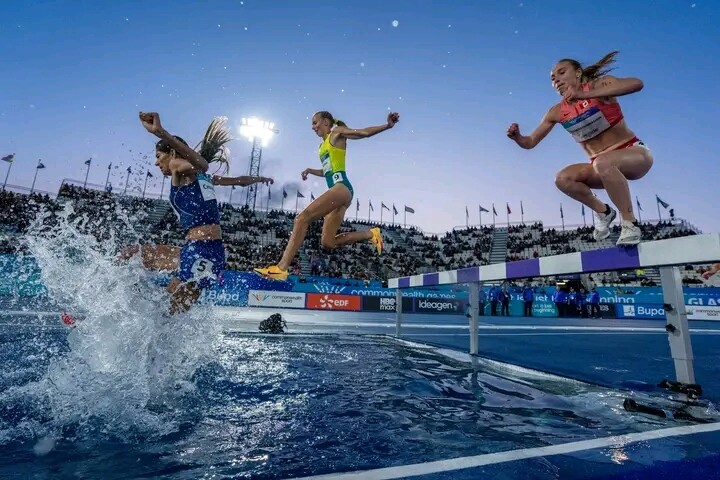
Although the medals were fiercely contested, Fetherstonhaugh's top-six finish and Stewart-Barnett's confident debut highlighted the depth of Canada's women's steeplechase program. Both athletes demonstrated resilience and composure against a world-class field, providing further evidence that Canada's future in the event is exceptionally bright.
The race also provided valuable championship experience that could prove instrumental in the years ahead. Performing at such a high level against elite opposition will give both athletes added confidence as they continue their development and prepare for future global championships.
For Canada, the performances were another encouraging sign of the nation's growing strength in women's distance running. By combining tactical discipline, technical efficiency over the barriers, and determined finishing efforts, Fetherstonhaugh and Stewart-Barnett left Glasgow with performances that will serve as important milestones in their careers.
Beyond the impressive times on the clock, both athletes showcased resilience and consistency throughout the demanding race. Their performances reflected not only months of preparation but also the determination required to succeed in one of athletics' most technically challenging events.
With a new personal best and a top-six Commonwealth Games finish now on her résumé, Fetherstonhaugh has taken another significant step forward in her career. Stewart-Barnett, meanwhile, can leave her first major international Games with confidence after a composed top-10 finish that signals an exciting future. Together, their performances marked a memorable night for Canadian athletics and offered plenty of optimism for the seasons ahead.
by Erick Cheruiyot for My Best Runs.
Login to leave a comment

Forty Years Apart: The McColgan Legacy That Was Meant to Come Full Circle
Forty years after her mother etched her name into Commonwealth Games history, Eilish McColgan was poised to write the next chapter of one of Scottish athletics' most cherished family legacies. Instead, Glasgow 2026 was remembered for the race she never got to run.
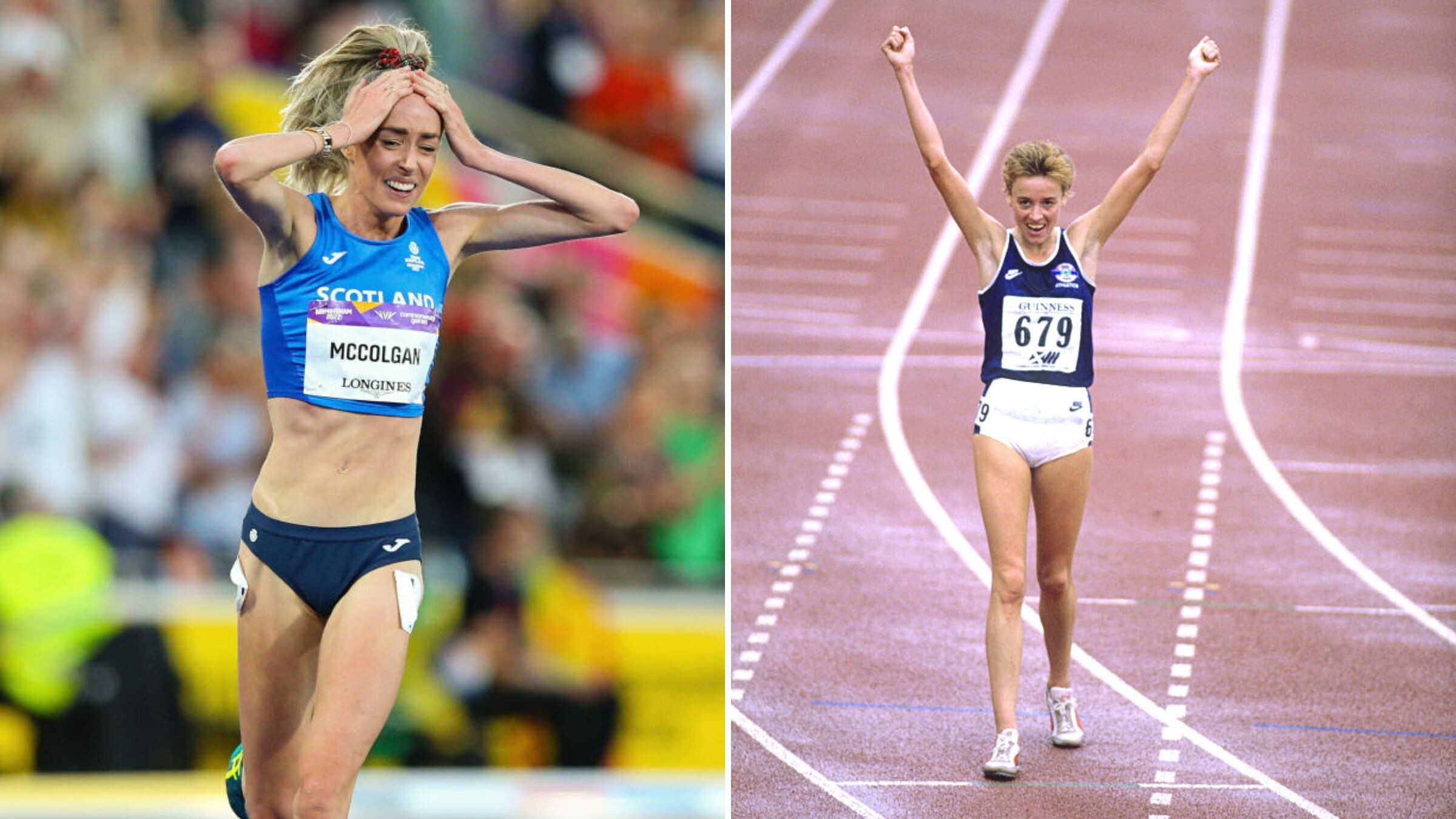
The defending Commonwealth 10,000m champion had been forced to withdraw from the Games after suffering a fractured foot, bringing months of anticipation to a heartbreaking end. What had been expected to become one of the defining moments of the athletics programme instead became one of its greatest disappointments.
For Scotland, it was a heartbreaking blow. For McColgan, it was the cruel interruption of a dream that carried far greater meaning than simply defending a title.
Back in 1986, at the Commonwealth Games in Edinburgh, Liz McColgan won the women's 10,000m gold on home soil, producing one of the most memorable victories in Scottish athletics history. She successfully defended her title four years later at the 1990 Commonwealth Games in Auckland, New Zealand, becoming a two-time Commonwealth 10,000m champion and cementing her place among the greatest distance runners in the history of the Games. Forty years after that first triumph in Edinburgh, Eilish had been presented with the rare opportunity to defend the same title on home soil, wearing the same Scottish colours and hoping to continue one of Scottish athletics' most remarkable family legacies.
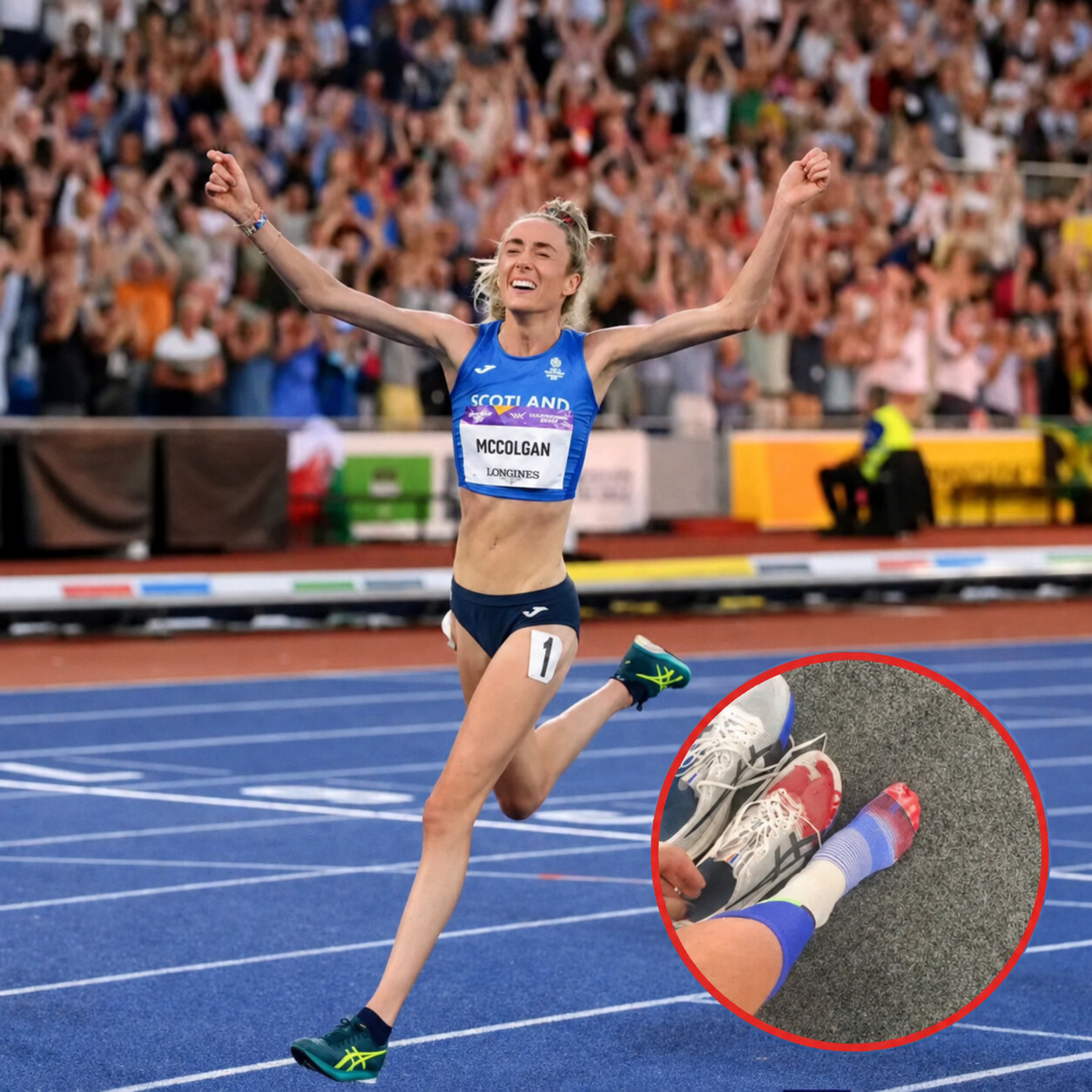
It was a remarkable sporting symmetry: mother and daughter, the same event, the same nation, separated by four decades.
But elite sport rarely followed the script.
McColgan had spoken throughout the season about how much those Games had meant to her. Returning to Glasgow, where Scottish athletics had enjoyed some of its greatest modern moments, and defending a title that connected directly to her family's legacy had become one of the defining ambitions of her season.
Instead, injury had the final word.
A fractured foot ruled her out of the competition, leaving the women's 10,000m final at Scotstoun Stadium without its defending champion and without the athlete many believed would provide the emotional centrepiece of the championships.
There was still a Commonwealth champion crowned, and medals were awarded in one of nine athletics finals at Scotstoun. Yet McColgan's absence inevitably changed the atmosphere, removing the storyline that had captured the imagination of Scottish fans long before the opening gun.
For the home crowd, the disappointment extended far beyond the loss of a medal contender. They did not witness the continuation of a family story that had spanned generations, linking Edinburgh 1986 with Glasgow 2026 through one remarkable surname.
For McColgan, the season became one of rebuilding rather than defending her Commonwealth crown. Her immediate focus shifted from chasing another gold medal to recovering fully and ensuring the injury did not define the next chapter of her career.
Athletics has always celebrated stories of resilience as much as victory. Although Glasgow moved forward without its hometown favourite on the start line, few doubted that Eilish McColgan would return stronger.
Sometimes the race everyone remembered was not the one that was won, but the one that never had the chance to begin.
by Erick Cheruiyot for My Best Runs.
Login to leave a comment
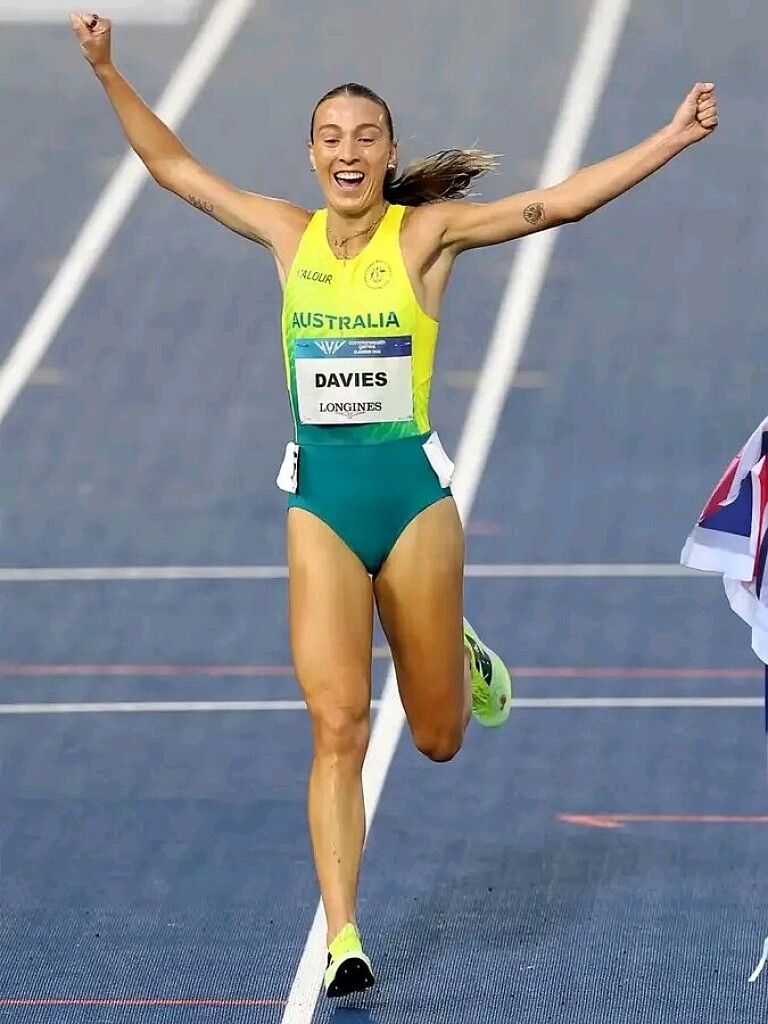
Rose Davies Completes Golden Double as Australia Delivers Historic One-Two in Thrilling Commonwealth Games 5,000m Final
Australia produced one of the most memorable distance-running performances of the Glasgow 2026 Commonwealth Games on Thursday night, claiming a remarkable one-two finish in the women's 5,000 metres as Rose Davies sprinted to her second gold medal of the championships.
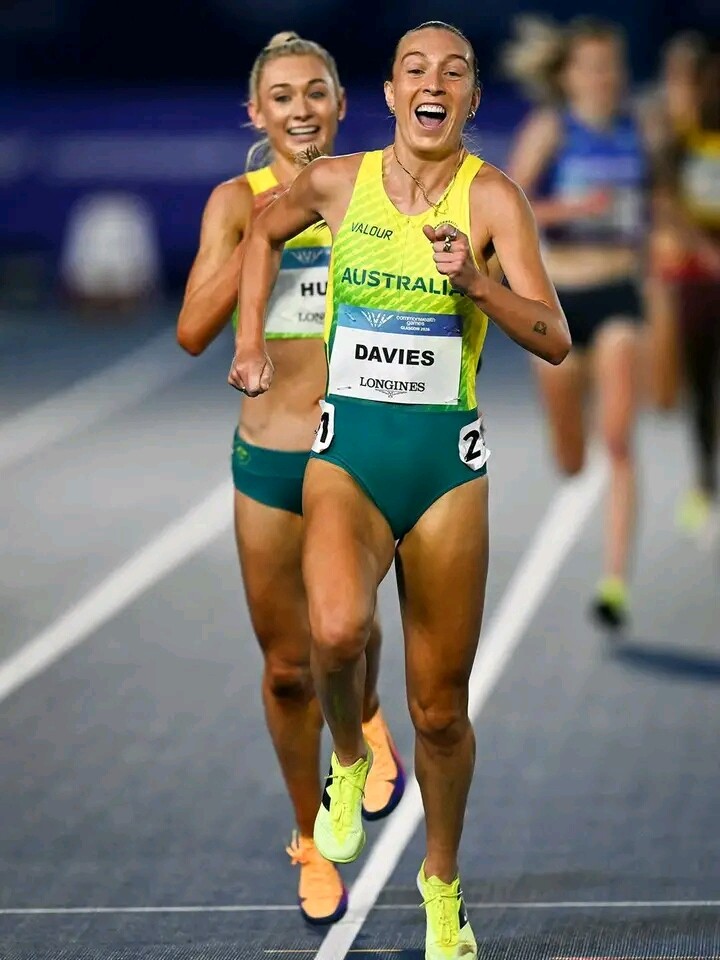
Just days after conquering the 10,000m, Davies completed a sensational distance double by clocking a season's best 14:44.53 to edge fellow Australian Jessica Hull, who crossed the line just 0.48 seconds later in 14:45.01. The historic finish marked a dominant night for Australian athletics, with the nation's two leading distance stars proving untouchable when the race reached its decisive stages.
The women's 5,000m unfolded as a tactical contest for much of the race before exploding into life with 1,200 metres remaining. Davies, Hull and Scotland's Megan Keith launched a sustained surge that immediately stretched the field and shattered the hopes of the chasing pack. Their relentless acceleration proved too much for the African contenders, who were unable to respond as the medals slipped away.
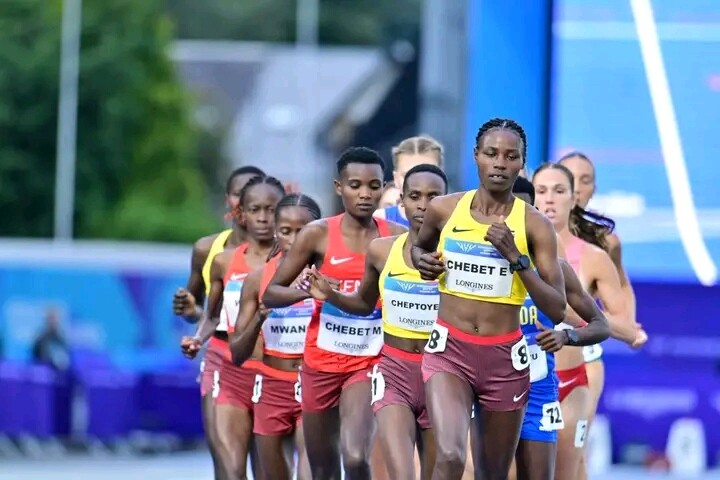
Davies remained composed over the closing lap despite fierce pressure from Hull, holding her form all the way to the finish to secure another Commonwealth crown and cement her place among the standout performers of the Games. Her victory completed a rare golden double in the 5,000m and 10,000m, underlining her exceptional endurance and championship racing instincts.
Hull's silver medal completed Australia's historic one-two finish, rewarding another world-class performance from one of the sport's premier middle- and long-distance runners. Meanwhile, the home crowd erupted as Scotland's Megan Keith produced a season's best 14:49.10 to claim bronze, giving the hosts a memorable podium finish in front of a packed Glasgow stadium.
Uganda's Esther Chebet battled bravely to finish fourth in a personal best 14:50.70 after leading the pursuit of the front trio, while England's Hannah Nuttall placed fifth in a season's best 14:51.34. Kenya's Caroline Nyaga crossed the line sixth in 14:54.00, with Australia's Linden Hall adding further depth to her country's outstanding evening by finishing seventh.
The race also featured several outstanding individual performances further down the field. South Africa's Tayla Kavanagh recorded a personal best, Rwanda's Emeline Imanizabayo celebrated a new national record with ninth place, while Uganda's Joy Cheptoyek, England's Innes Fitzgerald, Canada's Gabriela Debues-Stafford and several others produced season or lifetime bests in one of the deepest women's 5,000m finals of the Games.
Women's 5,000m Top 10 Final Results
1. Rose Davies (Australia) – 14:44.53 (Season Best)
2. Jessica Hull (Australia) – 14:45.01 (Season Best)
3. Megan Keith (Scotland) – 14:49.10 (Season Best)
4. Esther Chebet (Uganda) – 14:50.70 (Personal Best)
5. Hannah Nuttall (England) – 14:51.34 (Season Best)
6. Caroline Nyaga (Kenya) – 14:54.00
7. Linden Hall (Australia) – 14:55.28
8. Tayla Kavanagh (South Africa) – 14:58.49 (Personal Best)
9. Emeline Imanizabayo (Rwanda) – 14:59.92 (National Record)
10. Joy Cheptoyek (Uganda) – 15:00.97 (Season Best)
With two gold medals around her neck and Australia's first-ever Commonwealth Games one-two finish in the women's 5,000m, Rose Davies leaves Glasgow having delivered one of the defining performances of the championships. Her unforgettable triumph, backed by Jessica Hull's silver medal, showcased Australia's growing strength in global distance running and ensured the event will be remembered as one of the highlights of the 2026 Commonwealth Games.
by Erick Cheruiyot for My Best Runs.
Login to leave a comment

The Commonwealth Games
The Commonwealth Games are coming to Victoria - bringing an action packed sports program to our regional cities and delivering a long-term legacy for our future. From 17 to 29 March 2026, Geelong, Bendigo, Ballarat, Gippsland and Shepparton will be on the world stage, attracting millions of viewers and creating thousands of jobs. The multi-city model will...
more...
Elise Thorner Delivers the Race of Her Life to Capture Historic Commonwealth Silver
Elise Thorner produced the performance of her career with a breathtaking display of determination and courage, storming to a sensational silver medal in the women's 3000m steeplechase at the Glasgow 2026 Commonwealth Games.
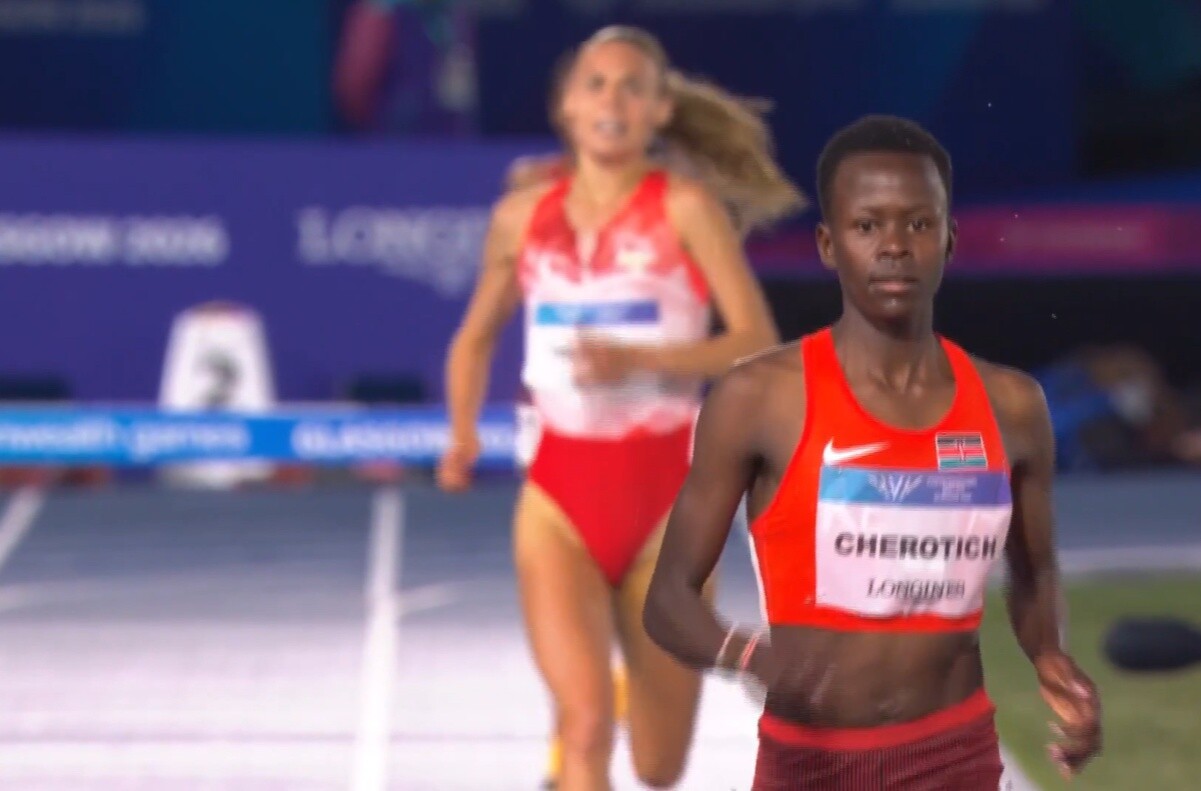
The England star delivered a remarkable final-lap charge in one of the most dramatic races of the championships, overturning what had looked like a secure position for Uganda's Olympic champion Peruth Chemutai. With every stride, Thorner closed the gap before surging past her rival in the closing stages to seal an unforgettable second-place finish.
She crossed the finish line in a lifetime best of 9:05.45, smashing her previous personal best and earning the first senior international medal of her career. It was a breakthrough performance on one of the biggest stages in athletics, confirming her arrival among the world's elite steeplechasers.
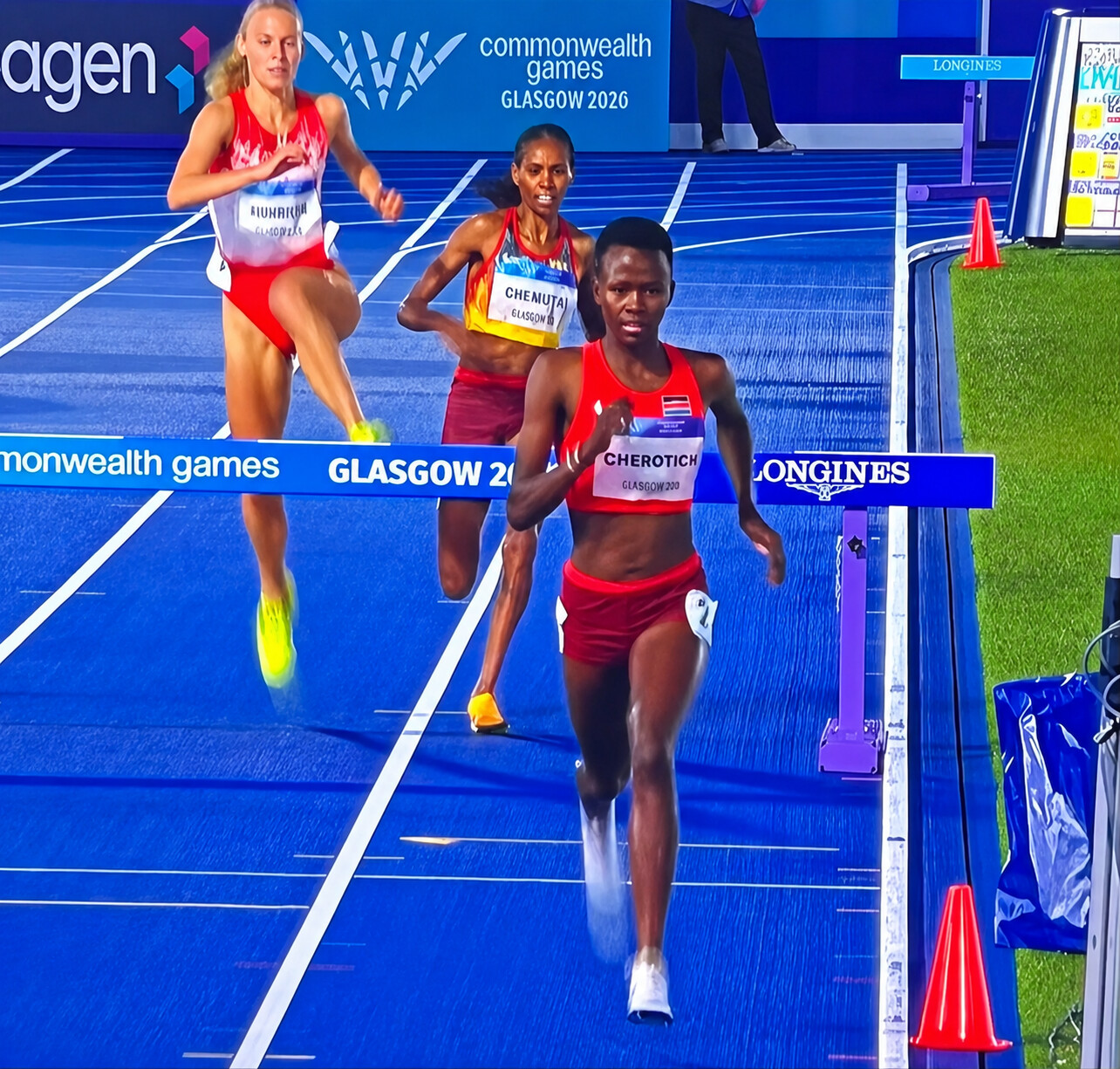
Thorner's outstanding run came agonizingly close to rewriting British history. Her time finished just 1.10 seconds outside Lizzie Bird's British record of 9:04.35, underlining the exceptional quality of her performance and suggesting that a national record could soon be within reach.
The race itself was an electrifying contest from start to finish, but it was Thorner's fearless closing lap that stole the spotlight. Refusing to surrender despite trailing late in the race, she unleashed a devastating kick that transformed an already impressive run into a career-defining moment.
The magnitude of her achievement only truly became clear after she crossed the finish line. Still trying to process what she had accomplished, an emotional Thorner admitted she was overwhelmed by the outcome. “When I crossed the line I was honestly in shock. I didn’t really know what happened!” she said after claiming the Commonwealth silver medal. Her heartfelt reaction perfectly reflected the disbelief and joy of an athlete who had just delivered the race of her life, producing a stunning personal best of 9:05.45 while finishing just over a second shy of Lizzie Bird's British record.
For England, the silver medal represents far more than a place on the podium. It marks the emergence of a new championship contender capable of challenging the very best, while for Elise Thorner, Glasgow 2026 will forever be remembered as the night she announced herself on the international stage with a performance of extraordinary class.
by Erick Cheruiyot for My Best Runs.
Login to leave a comment
Faith Cherotich Rewrites Commonwealth Games History with Record-Breaking Steeplechase Triumph
Faith Cherotich delivered one of the greatest performances of the Glasgow 2026 Commonwealth Games, producing a breathtaking run to capture the women's 3,000m steeplechase gold medal while rewriting the championship record books.
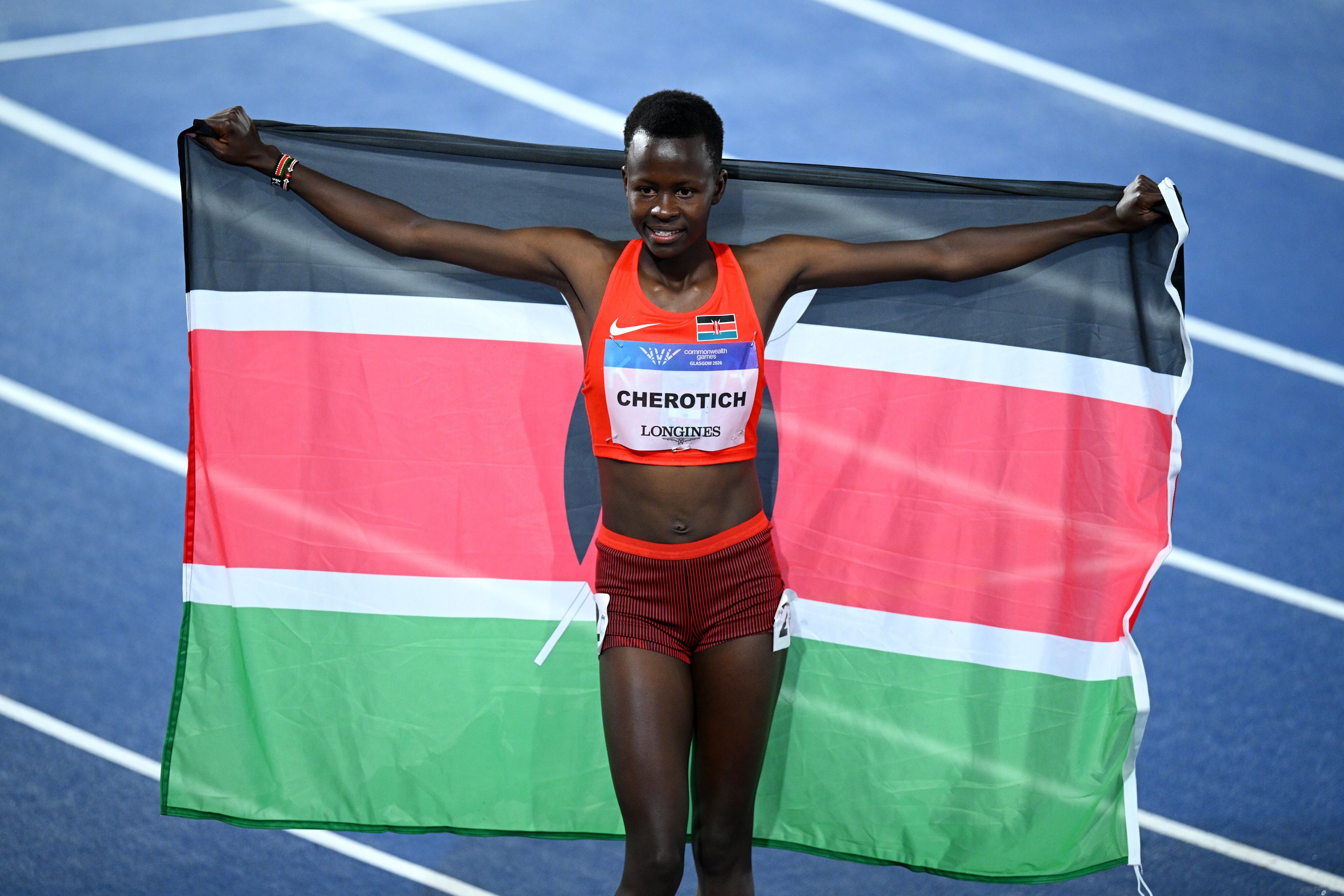
The Kenyan sensation powered away from the field with authority, crossing the finish line in a remarkable 9:01.76 to claim the Commonwealth title in unforgettable fashion. Her stunning performance erased the previous Commonwealth Games record of 9:15.68, set by fellow Kenyan Jackline Chepkoech at the Birmingham 2022 Games, underlining Kenya's continued dominance in one of its signature events.
From the opening laps, Cherotich looked composed and determined, confidently controlling the race before unleashing a devastating surge that none of her rivals could answer. Clearing every barrier with precision and maintaining a relentless rhythm, she transformed the closing stages into a celebration of world-class steeplechasing.
The battle for the medals was every bit as captivating. England's Elise Thorner produced a lifetime best of 9:05.45 to secure the silver medal, while Olympic champion Peruth Chemutai of Uganda claimed bronze in 9:09.96 after another courageous performance. Australia's Cara Feain-Ryan finished fourth in 9:22.07, with India's Parul Chaudhary taking fifth in 9:26.75. Canada's Grace Fetherstonhaugh crossed the line sixth in a personal best 9:27.49, while Kenya's Celestine Jepkosgei Biwot added a strong seventh-place finish in 9:33.61.
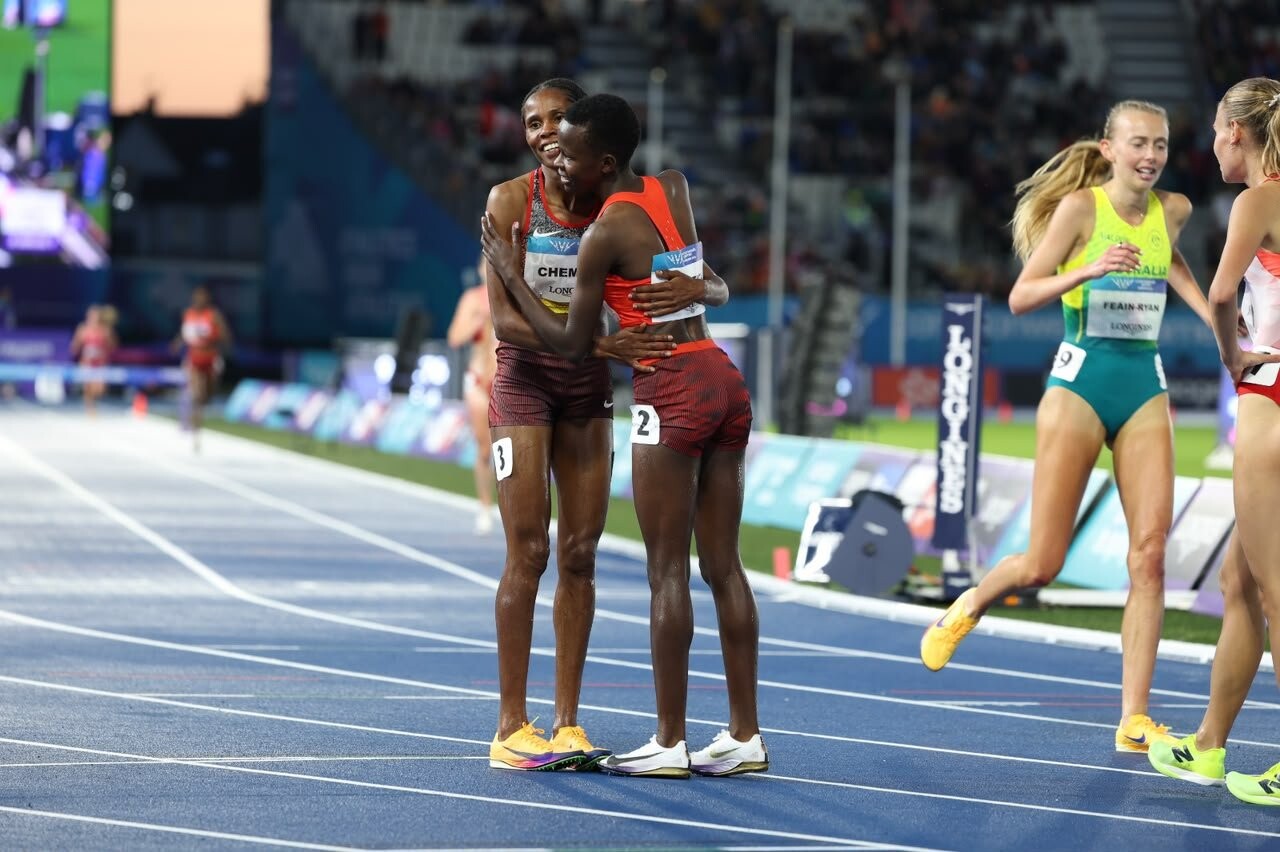
Women's 3000m Steeplechase Final – Glasgow 2026 Commonwealth Games
1. Faith Cherotich (Kenya) – 9:01.76 (Gold, Commonwealth Games Record)
2. Elise Thorner (England) – 9:05.45 (Silver, Personal Best)
3. Peruth Chemutai (Uganda) – 9:09.96 (Bronze)
4. Cara Feain-Ryan (Australia) – 9:22.07
5. Parul Chaudhary (India) – 9:26.75
6. Grace Fetherstonhaugh (Canada) – 9:27.49 (Personal Best)
7. Celestine Jepkosgei Biwot (Kenya) – 9:33.61
8. Cari Hughes (Wales) – 9:40.71 (National Record)
9. Katelyn Stewart-Barnett (Canada) – 9:46.98
10. Sarah Tait (Scotland) – 9:47.41
Cherotich's victory not only earned Kenya another gold medal but also reinforced the nation's remarkable legacy in the women's steeplechase. Breaking the Commonwealth Games record by nearly 14 seconds is a statement that echoes far beyond Glasgow, confirming the young Kenyan as one of the world's finest athletes in the event.
On a night filled with memorable performances, Faith Cherotich stood above them all. Draped in the Kenyan flag after her historic triumph, she celebrated a victory that will be remembered for years to come—a performance defined by courage, speed, and history-making brilliance.
by Erick Cheruiyot for My Best Runs.
Login to leave a comment
The Commonwealth Games
The Commonwealth Games are coming to Victoria - bringing an action packed sports program to our regional cities and delivering a long-term legacy for our future. From 17 to 29 March 2026, Geelong, Bendigo, Ballarat, Gippsland and Shepparton will be on the world stage, attracting millions of viewers and creating thousands of jobs. The multi-city model will...
more...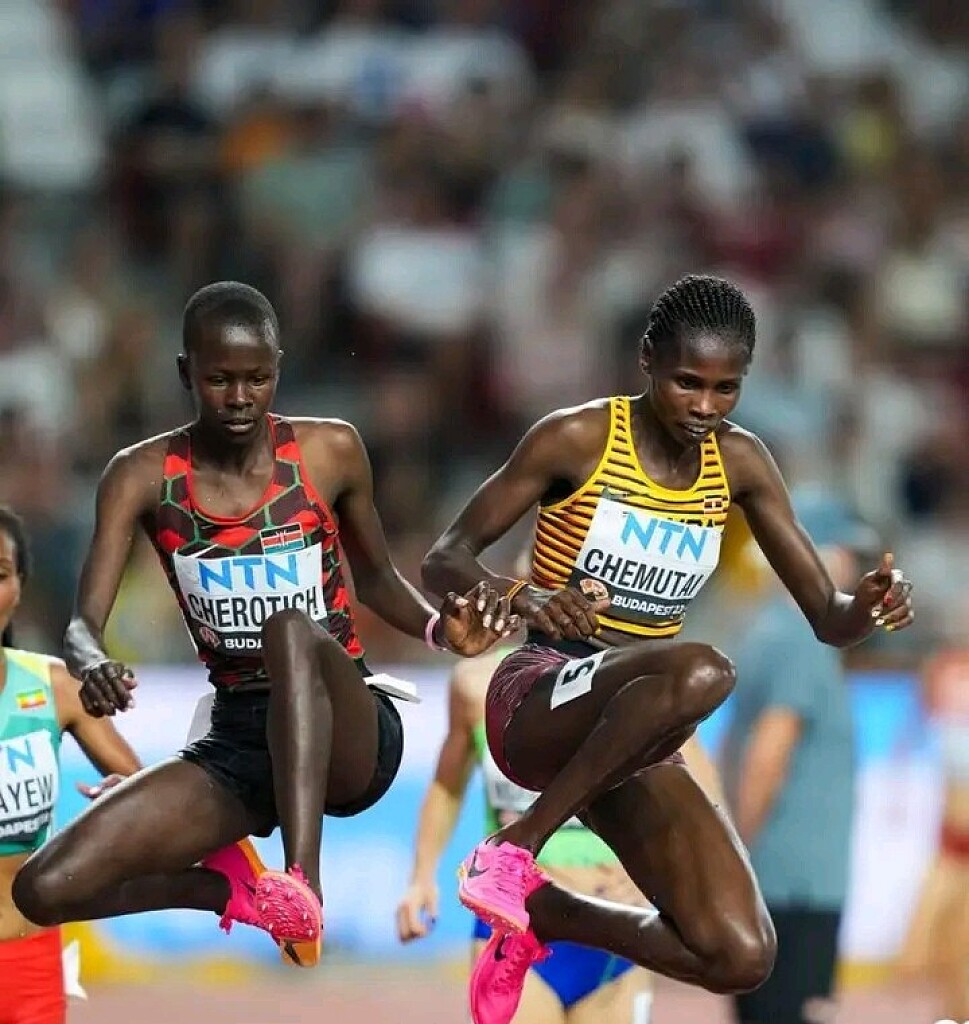
Faith Cherotich and Peruth Chemutai Set for Blockbuster Commonwealth Games Steeplechase Final in Glasgow
One of the most eagerly anticipated distance races of the 2026 Commonwealth Games will take center stage tonight in Glasgow as the women's 3,000m steeplechase final brings together two of the world's finest barrier specialists in a captivating battle for Commonwealth gold.
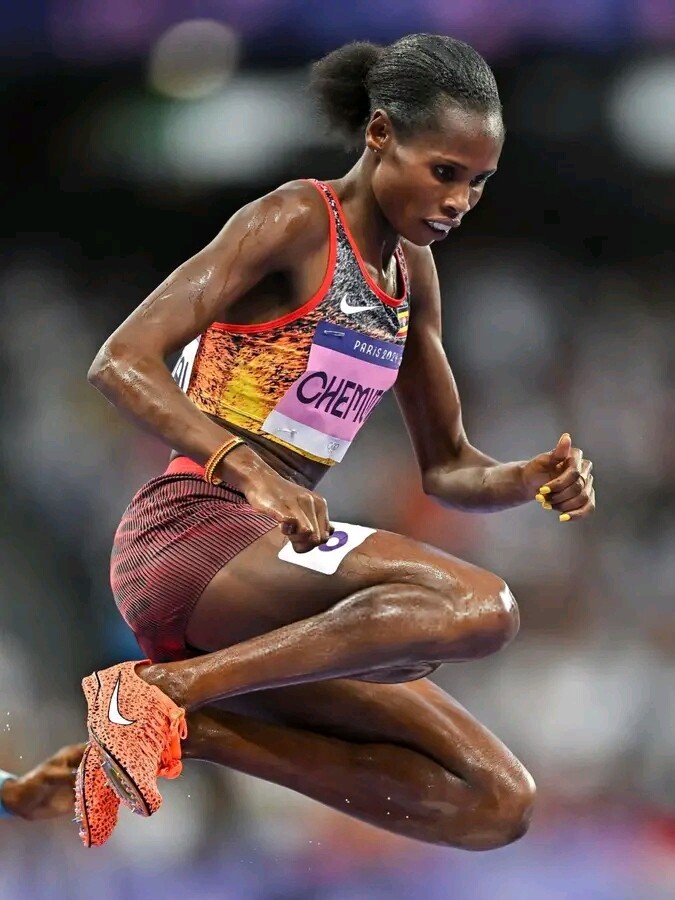
All eyes will be on Kenya's Faith Cherotich and Uganda's Peruth Chemutai, whose remarkable form this season has set the stage for what promises to be an unforgettable showdown. With both athletes arriving in Glasgow separated by less than half a second on the season's rankings, the margin for error could hardly be smaller.
Chemutai, the Olympic champion from Uganda, enters the final with the fastest season's best in the field at 8:51.06, while Kenya's rising star Cherotich has clocked an equally impressive 8:51.48. Even more remarkably, both women own personal bests under 8:49, highlighting the exceptional quality expected in the final.
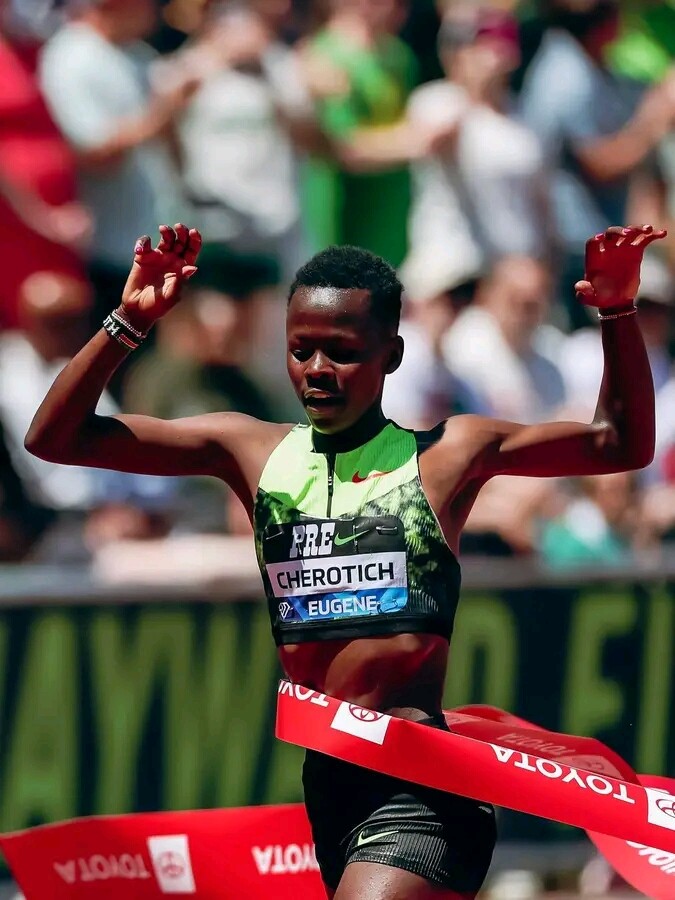
The race is expected to be a fascinating clash of styles. Chemutai's experience and relentless rhythm over the barriers will be tested by Cherotich's fearless racing instincts and devastating finishing speed. If the pace remains honest throughout, the outcome may not be decided until the final water jump or the last sprint down the home straight.
Although the spotlight naturally falls on the East African rivals, the battle for the medals extends well beyond them. England's Elise Thorner, boasting a personal best of 9:07.39, arrives as a genuine podium contender, while India's Parul Chaudhary has consistently demonstrated her ability to compete at the highest international level. Scotland's Sarah Tait will also enjoy passionate home support as she attempts to challenge the established favorites.
Kenya's Celestine Jepkosgei Biwot adds further depth to a competitive field that also includes Canada's Grace Fetherstonhaugh and Katelyn Stewart-Barnett, Australia's Cara Feain-Ryan, and Wales' Cari Hughes, ensuring the race will feature talent from across the Commonwealth.
Women's 3,000m Steeplechase Final – Start List
1. Grace Fetherstonhaugh (Canada) – PB: 9:28.42 | SB: 9:31.98
2. Faith Cherotich (Kenya) – PB: 8:48.71 | SB: 8:51.48
3. Peruth Chemutai (Uganda) – PB: 8:48.03 | SB: 8:51.06
4. Sarah Tait (Scotland) – PB: 9:18.66 | SB: 9:40.92
5. Parul Chaudhary (India) – PB: 9:12.46 | SB: 9:12.84
6. Katelyn Stewart-Barnett (Canada) – PB: 9:33.21 | SB: 9:36.69
7. Elise Thorner (England) – PB: 9:07.39 | SB: 9:07.39
8. Celestine Jepkosgei Biwot (Kenya) – PB: 9:17.06 | SB: 9:26.12
9. Cara Feain-Ryan (Australia) – PB: 9:21.35 | SB: 9:21.35
10. Cari Hughes (Wales) – PB: 9:41.66 | SB: 9:59.89
With two world-class athletes at the peak of their powers, national pride on the line, and a Commonwealth title at stake, Glasgow is set for a spectacular night of steeplechasing. Whether it is Chemutai's championship experience or Cherotich's youthful brilliance that prevails, fans can expect an electrifying contest that could become one of the defining races of the 2026 Commonwealth Games. The stage is set, the athletes are ready, and tonight promises to deliver a thrilling battle all the way to the finish line.
by Erick Cheruiyot for My Best Runs.
Login to leave a comment
The Commonwealth Games
The Commonwealth Games are coming to Victoria - bringing an action packed sports program to our regional cities and delivering a long-term legacy for our future. From 17 to 29 March 2026, Geelong, Bendigo, Ballarat, Gippsland and Shepparton will be on the world stage, attracting millions of viewers and creating thousands of jobs. The multi-city model will...
more...
Australia Ends Long Wait as Ky Robinson Claims Historic Commonwealth 10,000m Gold in Glasgow
Australia's Ky Robinson produced the race of his career to capture the men's 10,000m gold medal at the 2026 Commonwealth Games in Glasgow, Scotland, becoming the first Australian ever to win the Commonwealth title in the event.
On a cold and rain-soaked night at Scotstoun Stadium, Robinson timed his finish to perfection, crossing the line in 27:48.93 to secure a landmark victory and complete an Australian sweep of the Commonwealth Games 10,000m titles after the nation's success in the women's race.
The race unfolded into one of the most dramatic distance finals of the championships. With the rain making conditions treacherous, a tightly packed lead group remained together well into the closing stages as the pace intensified lap after lap. Robinson found another gear in the final stretch to hold off a determined challenge from India's Gulveer Singh, while David Mullarkey unleashed a late surge to secure bronze. Just behind them, Edwin Kurgat fought bravely for Kenya but missed the podium by only 0.70 seconds, highlighting just how fiercely contested the battle for medals was. The top four athletes were separated by barely two seconds, making it one of the closest and most thrilling men's 10,000m finals in recent Commonwealth Games history.
India also celebrated a historic breakthrough as Gulveer Singh delivered the performance of his life to take silver in 27:49.78, earning India's first-ever Commonwealth Games medal in the men's 10,000m. David Mullarkey of the Isle of Man completed the podium in 27:50.28, capping a memorable evening for both nations.
For Kenya, hopes of extending its proud tradition in the event fell agonizingly short. Edwin Kurgat led the Kenyan challenge with a courageous fourth-place finish in 27:50.98, narrowly missing out on a medal. Former Commonwealth Games Birmingham 2022 silver medalist Daniel Ebenyo finished sixth in 27:56.35, while Ishmael Kipkurui placed 10th in 28:04.60 as the Kenyan team was left without a podium finish.
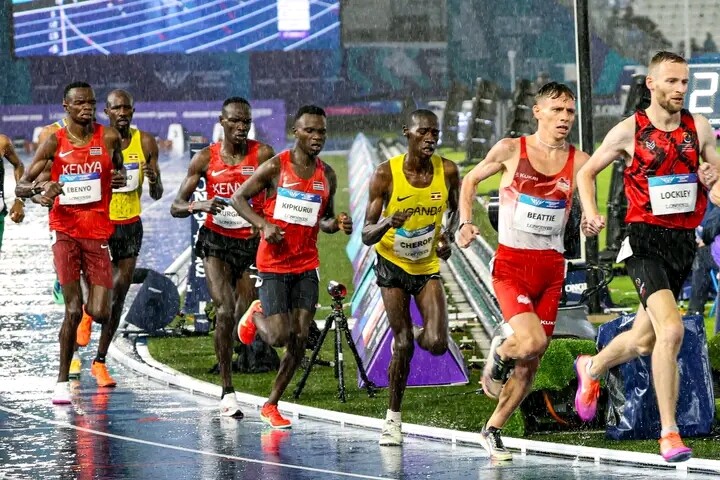
Uganda also came up short despite another determined performance from Samuel Simba Cherop, who clocked a personal best of 27:56.68 to finish seventh. The result ended an extraordinary era of Ugandan dominance in the men's 10,000m at the Commonwealth Games. Since Boniface Kiprop's victory at the 2006 Commonwealth Games in Melbourne, Australia, Uganda had ruled the event for two decades through a succession of outstanding distance runners, making Ky Robinson's triumph the first by another nation since Kiprop's breakthrough gold in Melbourne.
The final also showcased the growing depth of Commonwealth distance running, with athletes from Australia, India, the Isle of Man, Kenya, England, Uganda, Lesotho, Scotland and Tanzania all featuring prominently in a race that demonstrated the event's increasing global competitiveness.
Men's 10,000m Final Results – Glasgow 2026 Commonwealth Games
1. Ky Robinson (Australia) – 27:48.93
2. Gulveer Singh (India) – 27:49.78
3. David Mullarkey (Isle of Man) – 27:50.28
4. Edwin Kurgat (Kenya) – 27:50.98 (SB)
5. Scott Beattie (England) – 27:54.50
6. Daniel Ebenyo (Kenya) – 27:56.35 (SB)
7. Samuel Simba Cherop (Uganda) – 27:56.68 (PB)
8. Benjamin Ratsim (Tanzania) – 27:59.70 (PB)
9. Kamohelo Mofolo (Lesotho) – 28:01.00 (NR)
10. Ishmael Rokitto Kipkurui (Kenya) – 28:04.66 (SB)
11. Dan Kibet (Uganda) – 28:05.84 (SB)
12. Oscar Chelimo (Uganda) – 28:10.60
13. Andrew Butchart (Scotland) – 28:16.70
Robinson's historic triumph not only delivered Australia's first-ever Commonwealth men's 10,000m gold medal but also signaled a changing landscape in Commonwealth distance running, ending Uganda's remarkable 20-year reign and proving that the battle for long-distance supremacy is becoming more competitive than ever.
by Erick Cheruiyot for My Best Runs.
Login to leave a comment
The Commonwealth Games
The Commonwealth Games are coming to Victoria - bringing an action packed sports program to our regional cities and delivering a long-term legacy for our future. From 17 to 29 March 2026, Geelong, Bendigo, Ballarat, Gippsland and Shepparton will be on the world stage, attracting millions of viewers and creating thousands of jobs. The multi-city model will...
more...
Nadia Battocletti Completes Another Italian Championship Double to Extend Her Domestic Reign
Italy's distance-running queen, Nadia Battocletti, once again proved why she remains the country's dominant force after producing another remarkable championship double at the Italian National Championships.
The Olympic silver medalist successfully defended both her 1,500m and 5,000m national titles, showcasing her impressive range from the middle distances to the longer events. Battocletti first secured victory in the 1,500m, crossing the finish line in 4:17.29, before returning to the track to claim the 5,000m crown in 15:12.65.
Her latest triumph carries even greater significance in the longer race. By winning the 5,000m title once again, Battocletti completed a hat-trick of consecutive Italian championships over the distance, further cementing her place among the country's finest distance runners. The achievement highlights not only her consistency but also her ability to remain at the top despite the increasing level of competition.
The double victory is another statement of intent as Battocletti continues to build momentum during a crucial stage of the season. Her ability to excel in both events demonstrates the endurance, speed, and tactical awareness that have made her one of Europe's most respected distance athletes.
With another pair of national titles added to her growing collection, Battocletti leaves the championships with renewed confidence and reinforces her status as Italy's leading distance star. Her commanding performances serve as another reminder that she will be one of the athletes to watch on the international stage as the season continues.
by Erick Cheruiyot for My Best Runs.
Login to leave a comment
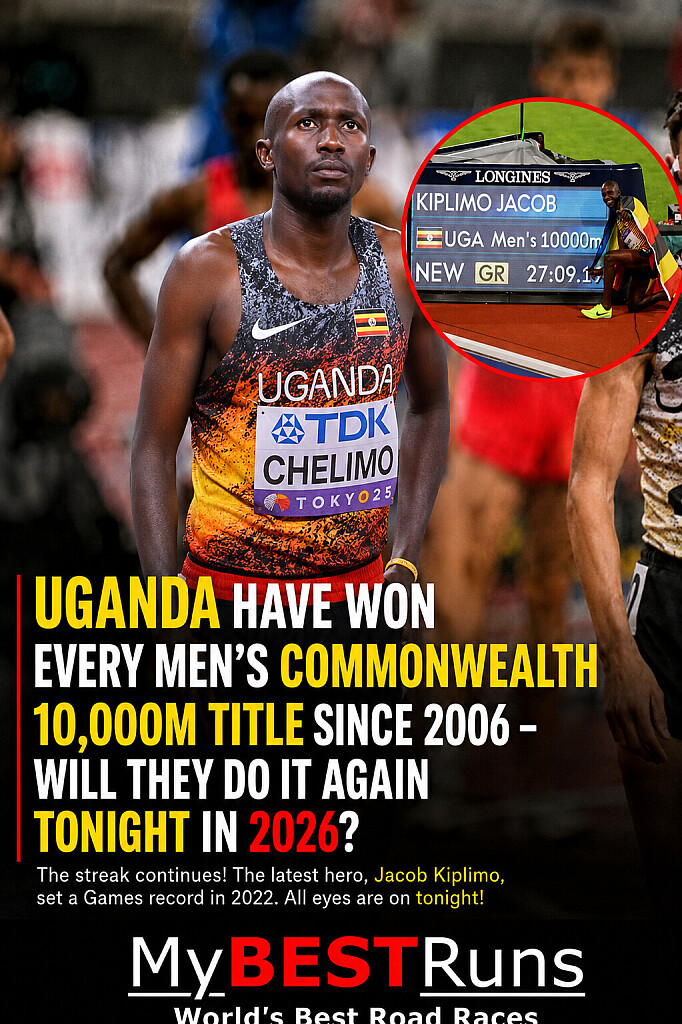
Can Uganda Keep Its Commonwealth 10,000m Crown Alive Tonight? A Historic Streak Faces Its Biggest Test
Tonight, one of the most remarkable legacies in Commonwealth Games history will once again be put on the line as Uganda bids to extend its extraordinary dominance in the men's 10,000m.
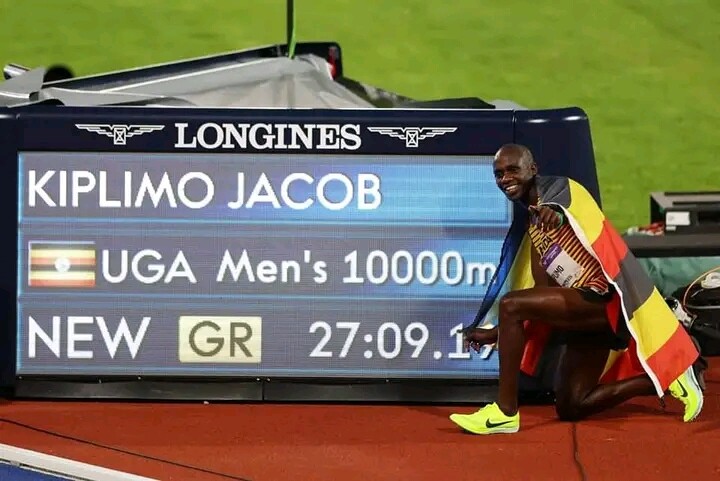
Since 2006, every Commonwealth Games men's 10,000m title has been won by a Ugandan athlete, establishing a remarkable streak that has become a symbol of the nation's excellence in long-distance running. The latest chapter was written by Jacob Kiplimo, who stormed to victory at the 2022 Commonwealth Games in Birmingham, setting a new Games record of 27:09.19 in a commanding performance.
Now, all eyes turn to tonight's final, where Uganda will attempt to continue a reign that has spanned nearly two decades.
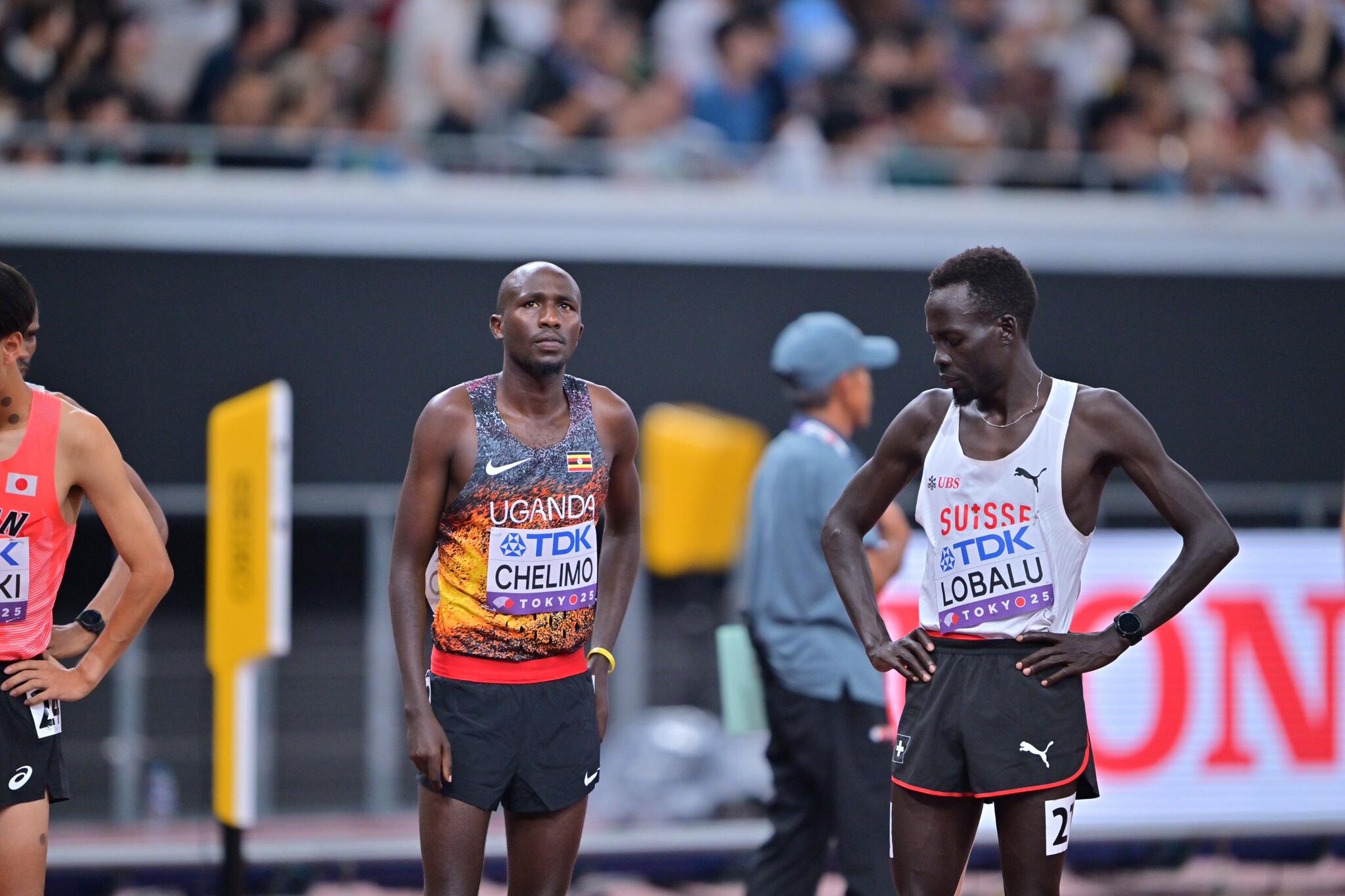
Uganda's hopes of preserving that incredible record will rest on a formidable trio of Dan Kibet, Oscar Chelimo, and Cherop Samuel Simba. Together, they carry the weight of a proud tradition and will be determined to ensure the men's 10,000m title remains in Ugandan hands for another Commonwealth Games.
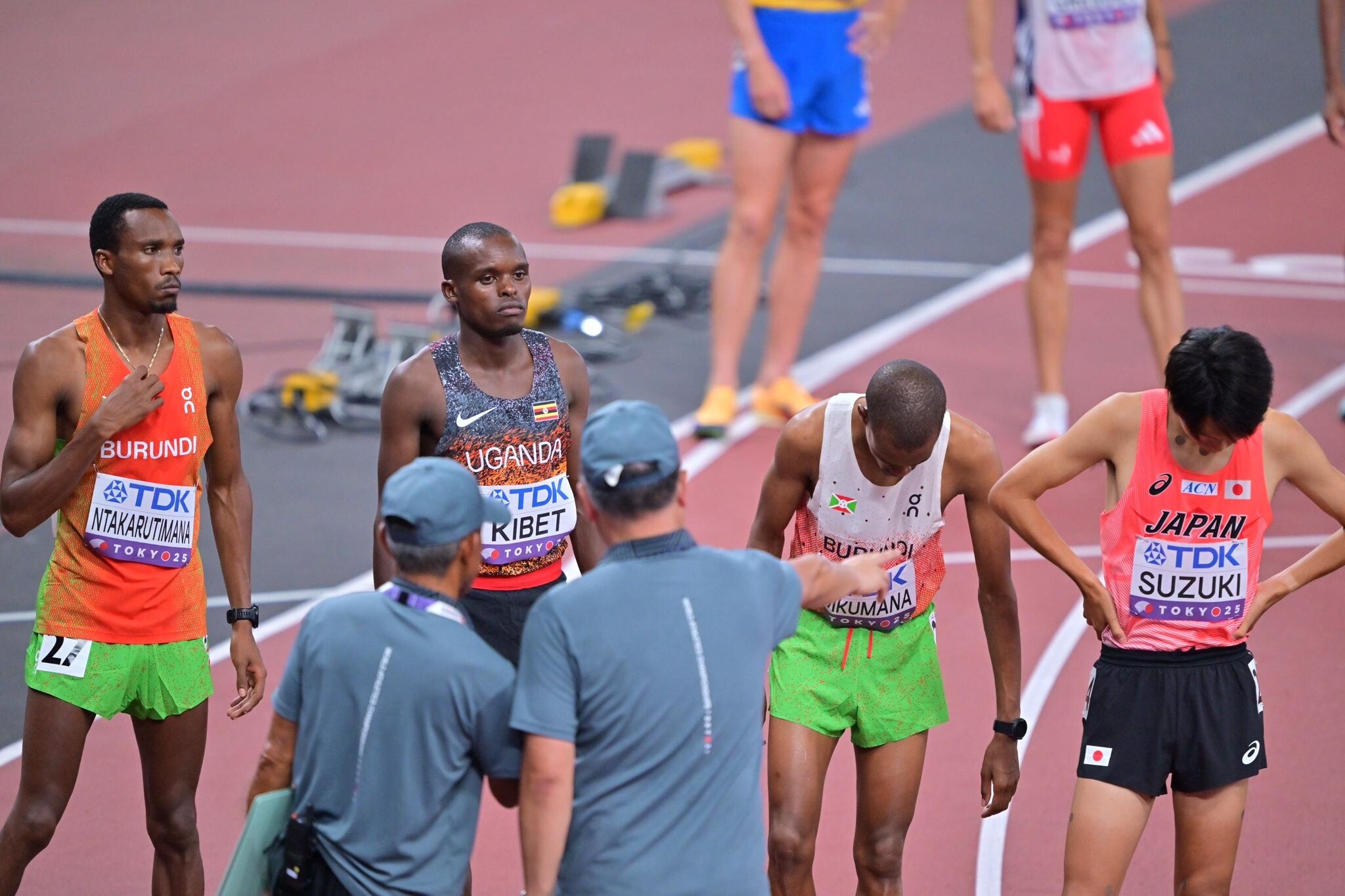
The challenge, however, promises to be fiercer than ever. Some of the Commonwealth's finest distance runners will line up with one goal—to end Uganda's remarkable run and claim one of the most prestigious titles in championship athletics. Every lap will carry the weight of history, with both seasoned stars and emerging talents eager to seize the moment.
For Uganda, this race is about far more than another gold medal. It is an opportunity to protect a legacy built through years of discipline, resilience, and world-class performances on the championship stage. Extending the streak would further strengthen the nation's reputation as one of the greatest forces in distance running.
Yet championship races are rarely decided by reputation alone. Tactical awareness, patience, and the ability to respond when the decisive move is made often separate the champion from the rest of the field. With several accomplished rivals eager to rewrite history, tonight's contest promises to deliver drama from the opening lap to the finish.
Will Uganda celebrate another unforgettable triumph tonight, or will a new champion finally bring an end to one of the longest winning streaks in Commonwealth Games history? By the end of the race, the answer will be written on the track, adding another unforgettable chapter to one of athletics' most enduring traditions.
by Erick Cheruiyot for My Best Runs.
Login to leave a comment
The Commonwealth Games
The Commonwealth Games are coming to Victoria - bringing an action packed sports program to our regional cities and delivering a long-term legacy for our future. From 17 to 29 March 2026, Geelong, Bendigo, Ballarat, Gippsland and Shepparton will be on the world stage, attracting millions of viewers and creating thousands of jobs. The multi-city model will...
more...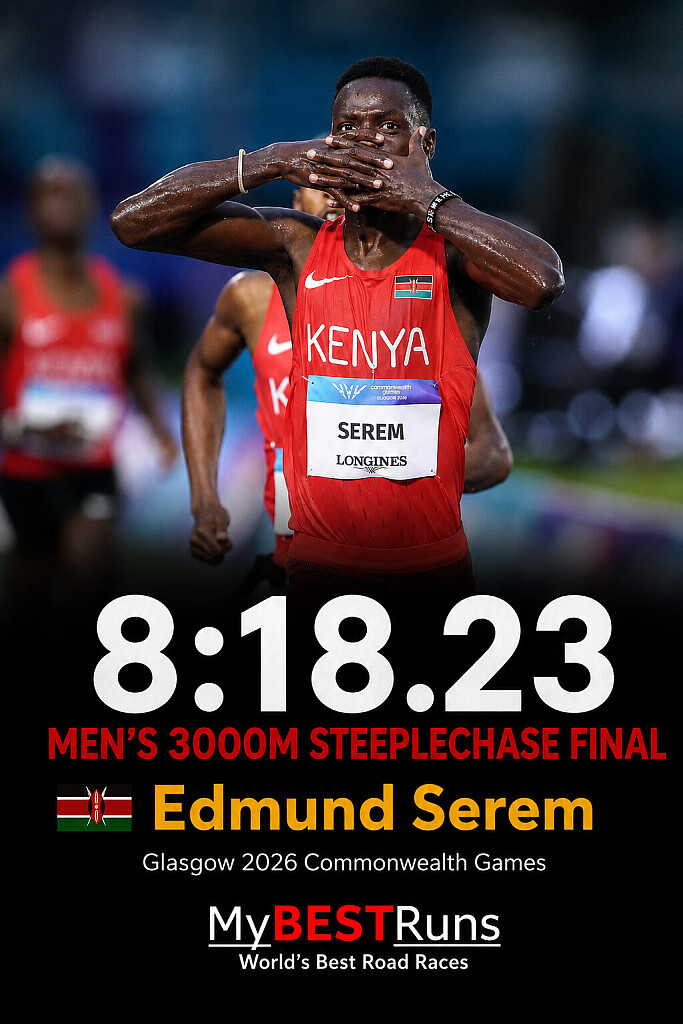
Kenya Reclaims Steeplechase Supremacy with Historic 1-2-3 Sweep at Glasgow 2026 Commonwealth Games
Kenya emphatically reaffirmed its status as the undisputed powerhouse of the men's 3000m steeplechase by producing a sensational podium clean sweep at the 2026 Commonwealth Games in Glasgow. In a commanding display of tactical brilliance, endurance, and finishing speed, Edmund Serem, Simon Kiprop Koech, and Leonard Kipkemoi Bett shut out the rest of the field to secure all three medals in one of Kenya's most treasured athletics events.
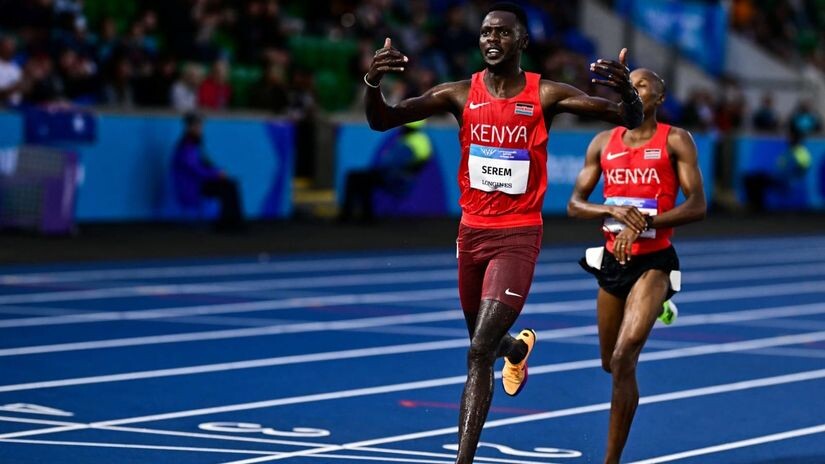
The Kenyan trio remained patient through the early stages before steadily increasing the pace over the closing laps. As the race reached its decisive moments, they broke clear of the chasing pack, leaving reigning world champion Geordie Beamish of New Zealand and the rest of the field unable to match their relentless surge.
Edmund Serem produced the winning move over the final barriers, powering away in the closing metres to capture the Commonwealth title in 8:18.23. Simon Kiprop Koech, who had led the race at the bell, battled all the way to the finish and claimed the silver medal in 8:18.59, while Leonard Kipkemoi Bett completed the historic sweep with bronze in 8:21.63, ensuring an unforgettable day for Team Kenya.
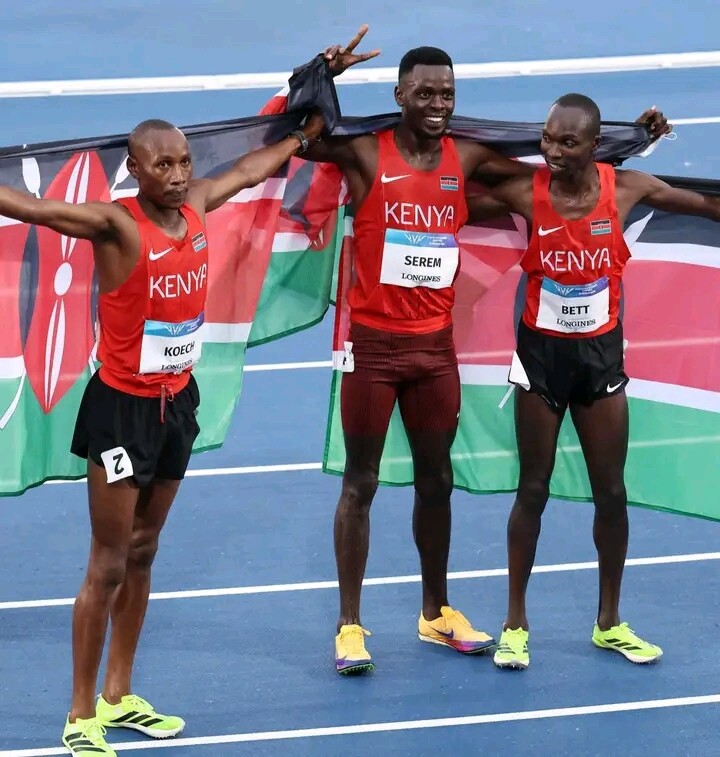
The achievement marks one of Kenya's defining moments of the Glasgow Games and restores the nation's complete dominance in an event that has long been synonymous with Kenyan distance running excellence. It also serves as a powerful response to the 2022 Commonwealth Games in Birmingham, where India's Avinash Sable ended Kenya's remarkable run of podium sweeps by winning the silver medal. Four years later, Serem, Koech, and Bett emphatically returned the men's steeplechase podium entirely to Kenyan hands, reaffirming the country's unrivalled legacy in the discipline.
Behind the Kenyan trio, reigning world champion Geordie Beamish finished fourth in 8:24.09, while Canada's Jean-Simon Desgagnes and Aaron Ahl placed fifth and sixth respectively. England's Kristian Imroth and Mark Pearce completed the top eight.
Men's 3000m Steeplechase Final – Glasgow 2026 Commonwealth Games
1. Edmund Serem (Kenya) — 8:18.23
2. Simon Kiprop Koech (Kenya) — 8:18.59
3. Leonard Kipkemoi Bett (Kenya) — 8:21.63
4. Geordie Beamish (New Zealand) — 8:24.09
5. Jean-Simon Desgagnes (Canada) — 8:25.43
6. Aaron Ahl (Canada) — 8:31.71
7. Kristian Imroth (England) — 8:38.12
8. Mark Pearce (England) — 8:42.39
The performance once again highlighted the extraordinary depth of Kenya's steeplechase talent, proving that a new generation is ready to carry forward one of the nation's greatest traditions in global athletics. Their flawless execution, unwavering composure, and dominant finish left no doubt that Kenya remains the standard bearer in the men's 3000m steeplechase.
by Erick Cheruiyot for My Best Runs.
Login to leave a comment
The Commonwealth Games
The Commonwealth Games are coming to Victoria - bringing an action packed sports program to our regional cities and delivering a long-term legacy for our future. From 17 to 29 March 2026, Geelong, Bendigo, Ballarat, Gippsland and Shepparton will be on the world stage, attracting millions of viewers and creating thousands of jobs. The multi-city model will...
more...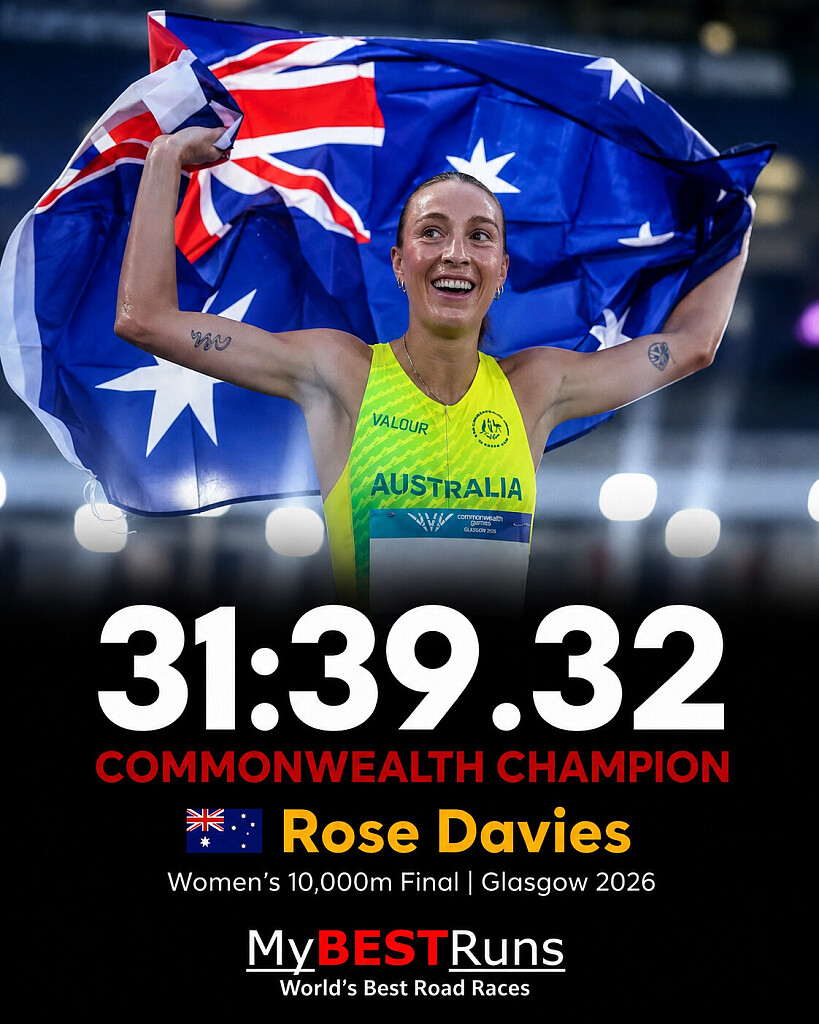
Rose Davies Makes History, Diana Wanza Claims Silver, and Florence Niyonkuru Shines with Bronze in Memorable Commonwealth Games 10,000m Final
Australia celebrated a landmark moment in distance running as Rose Davies produced a brilliant performance to win the women's 10,000m title at the 2026 Commonwealth Games in Glasgow, becoming the first Australian athlete ever to capture Commonwealth gold in the event. Clocking 31:39.32, Davies also recorded a season's best (SB) to crown a remarkable evening and write her name into Australian athletics history.
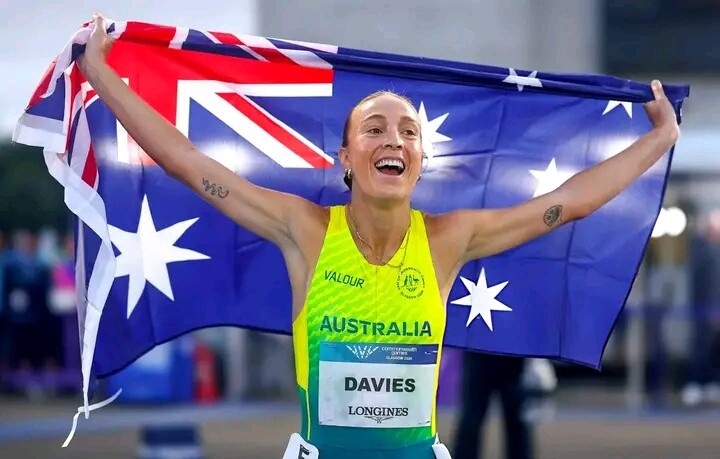
Davies delivered a composed and confident race from start to finish, demonstrating exceptional patience before unleashing a decisive surge in the closing stages to secure a historic victory. Her remarkable triumph not only earned Australia a long-awaited gold medal but also etched her name into the Commonwealth Games record books, adding one of the finest achievements in Australian distance-running history.
Kenya's Diana Wanza produced a courageous and determined performance to secure the silver medal in 31:50.13, further strengthening the nation's proud legacy in long-distance running. Remaining among the front-runners throughout the race, Wanza matched every challenge with grit and composure before crossing the finish line with a well-deserved runner-up finish against an outstanding field.
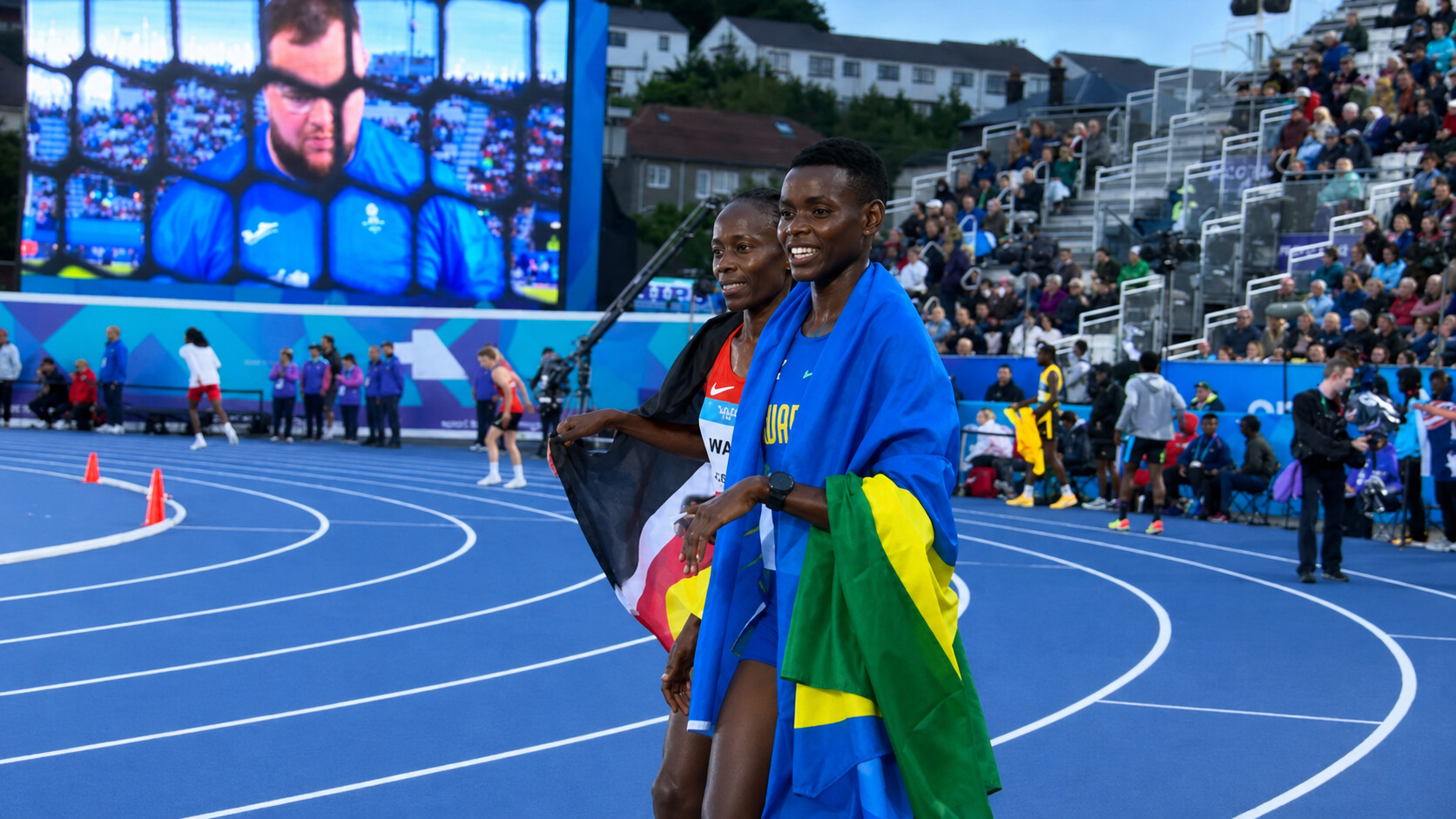
Rwanda's Florence Niyonkuru completed the podium with a superb run to capture the bronze medal in 31:55.47. Her impressive display underlined Rwanda's continued rise in international distance running and rewarded months of hard work with one of the biggest achievements of her career.
The race was fiercely contested from the opening laps, with the leading pack refusing to give an inch as the pace intensified. As the tension built inside the stadium, every lap brought fresh excitement and anticipation from the Glasgow crowd. Davies found another gear when it mattered most, Wanza responded with tremendous determination in pursuit of gold, while Niyonkuru held her composure to secure bronze in a thrilling finish. Behind the medalists, Uganda's Esther Chebet narrowly missed the podium by just 0.23 seconds, finishing fourth in a personal best of 31:55.70, highlighting just how competitive the championship final proved to be.
The depth of the field was reflected throughout the results, with several athletes producing season's bests and personal bests in one of the highest-quality women's 10,000m finals of the Games. Australia's Lauren Ryan finished fifth with a season's best, Uganda's Joy Cheptoyek placed sixth with another season's best, while Scotland's Megan Keith delighted the home crowd with a season's best ninth-place finish. The race showcased the exceptional standard of women's distance running across the Commonwealth.
Women's 10,000m Final – Commonwealth Games Glasgow 2026
1. Rose Davies (Australia) – 31:39.32 (SB)
2. Diana Wanza (Kenya) – 31:50.13
3. Florence Niyonkuru (Rwanda) – 31:55.47
4. Esther Chebet (Uganda) – 31:55.70 (PB)
5. Lauren Ryan (Australia) – 31:59.41 (SB)
6. Joy Cheptoyek (Uganda) – 32:01.92 (SB)
7. Miriam Chebet (Kenya) – 32:12.97
8. Rebecca Chelangat (Uganda) – 32:16.28 (SB)
9. Megan Keith (Scotland) – 32:22.11 (SB)
10. Rebecca Mwangi (Kenya) – 32:36.12
11. Izzy Fry (England) – 32:50.81
12. Poppy Tank (England) – 32:50.83
13. Florence Caron (Canada) – 32:59.51
14. Nthabiseng Letokoto (Lesotho) — 34:52.00 (SB)
The women's 10,000m final perfectly illustrated the depth of talent across the Commonwealth, with three exceptional athletes delivering performances worthy of the podium. While Rose Davies celebrated a groundbreaking victory for Australia, Diana Wanza once again demonstrated Kenya's enduring excellence in distance running, and Florence Niyonkuru's bronze medal highlighted Rwanda's growing presence among the world's elite. Together, they produced a championship race that will be remembered for its quality, intensity, and historic significance.
by Erick Cheruiyot for My Best Runs.
Login to leave a comment
The Commonwealth Games
The Commonwealth Games are coming to Victoria - bringing an action packed sports program to our regional cities and delivering a long-term legacy for our future. From 17 to 29 March 2026, Geelong, Bendigo, Ballarat, Gippsland and Shepparton will be on the world stage, attracting millions of viewers and creating thousands of jobs. The multi-city model will...
more...
The Road Back Begins: Beatrice Chebet Shares First Training Run Since Motherhood
The first signs of Beatrice Chebet's return are here.

The Kenyan distance running superstar has delighted fans by sharing a photo from her early morning run, signaling the beginning of what promises to be an inspiring comeback. Captioning the image, the Olympic and world champion wrote: "Early mornings, beautiful skies and a little movement. Happy New Week," while tagging Nike and Nike Women.
The update may have seemed simple, but for athletics fans it carried a powerful message. After stepping away from competition to embrace motherhood and welcome her baby boy, Chebet is back on the roads, taking the first strides toward returning to elite racing.
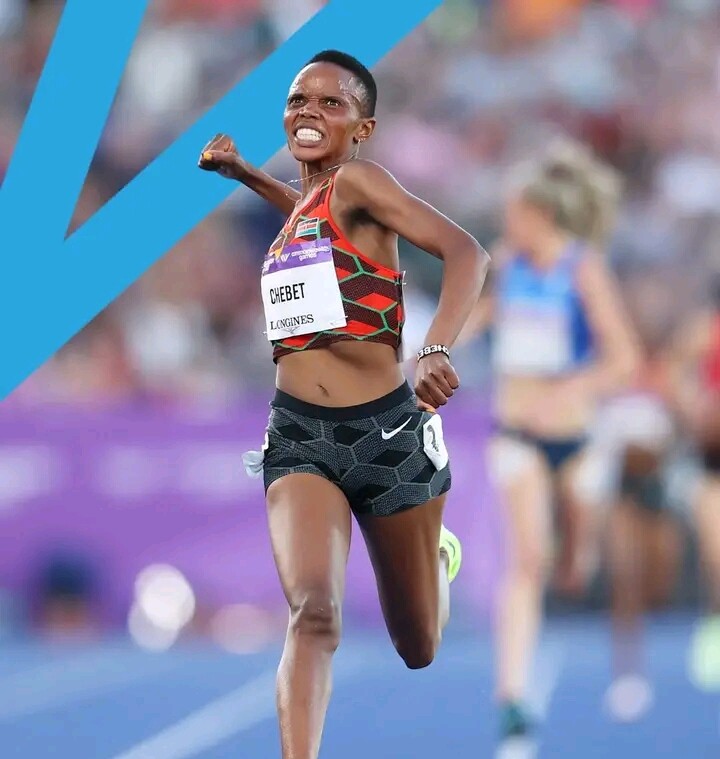
Few athletes have built a résumé as remarkable as Chebet's. She is the world record holder in the 5,000m, 10,000m, and road 5km, and her career includes Olympic gold medals in both the 5,000m and 10,000m, world titles, and multiple global championships that have established her as one of the greatest distance runners of her generation.
Now, her journey enters a different but equally inspiring phase. As she balances motherhood with the demands of elite training, every run represents another step toward regaining race fitness and returning to the sport she has dominated for years.
While there is no official timeline for her return to competition, Chebet's latest post has already sparked excitement across the athletics community. Fans will be hoping that these early morning runs are the foundation of another extraordinary chapter—one that could see the Kenyan superstar back on the starting line, chasing records and titles once again.
For one of the sport's brightest stars, the comeback has begun—not with medals or finish-line celebrations, but with quiet early morning miles, beautiful skies, and the determination that has always defined a champion.
by Erick Cheruiyot for My Best Runs.
Login to leave a comment
